
Kenya Safari Astrophotography: Which Dark-Sky Conservancies Give You the Milky Way? 📸
Kenya sits almost exactly on the equator, and that single geographic fact changes everything for night-sky photographers. From the Laikipia Plateau at 1,800m above sea level, you can photograph the Southern Cross, the Milky Way galactic center, and the Pleiades all in a single night. The Bortle scale measures light pollution from 1 (pure black sky) to 9 (city orange glow). Borana Conservancy and Lewa Wildlife Conservancy in Laikipia both measure at Bortle 2. That quality of darkness is genuinely rare anywhere on earth that is also accessible, comfortable, and populated with lions.
Safari astrophotography in Kenya is not a niche add-on. At Trunktrails Safaris, we treat night-sky tours and safaris as their own itinerary category because the logistics are specific and the timing is everything. This guide covers which conservancies to choose, when to go, what gear to pack, and how to build a game-drive schedule that also delivers the Milky Way.
What Makes Kenya One of the World’s Best Safari Astrophotography Destinations?
Most dark-sky locations are remote and offer nothing to do during daylight hours. Kenya is the opposite. You photograph a cheetah at golden hour, eat dinner under a billion stars, and then spend two hours shooting star trails before midnight. The wildlife does not shut down at sunset either: nighttime game drives on private conservancies reveal leopards, civets, porcupines, and aardvarks that are invisible during day drives.
Kenya’s equatorial position is a technical advantage every serious photographer appreciates. The Milky Way galactic center passes nearly overhead between June and August, producing a near-vertical arch rather than the low, horizon-hugging band that European or North American photographers must work around. You can also reach celestial objects from both hemispheres in a single session, including the Magellanic Clouds, which are only visible south of the equator.
Altitude amplifies the effect. The Laikipia Plateau sits between 1,700m and 2,100m. Higher elevation means less atmospheric scatter, a lower dew point on your front element, and cooler nights that reduce digital sensor noise significantly.
Which Dark-Sky Conservancies in Kenya Have the Darkest Skies?
Not all conservancies are equal for light pollution. The southern Mara region sits roughly 260 km from Nairobi, and on clear nights a faint horizon glow is visible above the northeast treeline. Northern and central Kenya are substantially darker. Here is a practical comparison of the best safari astrophotography Kenya sites:
| Conservancy or Reserve | Region | Distance from Nairobi | Drive Time | Bortle Class (approx.) | Park or Conservancy Fee (indicative) | Camp Rate (indicative, pp sharing) |
|---|---|---|---|---|---|---|
| Borana Conservancy | Laikipia | ~240 km | ~3.5 hrs | Bortle 2 | Included in conservancy rate | $800-$1,600/night |
| Lewa Wildlife Conservancy | Laikipia | ~240 km | ~3.5 hrs or 45 min fly | Bortle 2 | Included in conservancy rate | $700-$1,400/night |
| Ol Pejeta Conservancy | Laikipia | ~200 km | ~3 hrs | Bortle 2-3 | $120/day non-resident adult (indicative) | $300-$900/night |
| Chyulu Hills (Ol Donyo area) | SE Kenya | ~220 km | ~3 hrs | Bortle 1-2 | $100/day KWS fee (indicative) | $1,000-$2,000/night |
| Samburu National Reserve | Northern Kenya | ~350 km | ~5.5 hrs | Bortle 1-2 | $80/day non-resident adult (indicative) | $350-$700/night |
| Mara North Conservancy | Mara Region | ~260 km | ~5-6 hrs | Bortle 2-3 | Included in conservancy rate | $500-$1,200/night |
All rates are indicative USD per person per night on full-board basis. Verify current fees and availability with Trunktrails Safaris before booking. Conservancy fees may be bundled or billed separately depending on the camp.
Borana and Lewa in Laikipia are the top picks for most photographers. Both conservancies sit on a high volcanic plateau, share a single electrified fence perimeter with zero external light sources visible from inside, and run private vehicle-only game drives so you stop exactly where you want for as long as you need.
Chyulu Hills (northeast of Tsavo West, around 220 km from Nairobi) is an extinct volcanic field at roughly 2,100m. The volcanic terrain creates naturally flat, wide horizons. Only a handful of ultra-luxury camps operate here, including Ol Donyo Lodge, which has a dedicated rooftop star bed where guests sleep under the open sky.
When Is the Best Time for Astrophotography on a Kenya Safari?
The Milky Way galactic center is visible from Kenya between March and October, with the peak window running from June through August. During these months, the galactic center rises steeply after sunset and stays high enough for four to five hours of shooting after full dark.
Moon phase matters more than season for night photography. Plan your trip around the new moon window: the three to four nights on either side of a new moon. A full moon washes out Milky Way visibility entirely. At Trunktrails Safaris, we build astrophotography itineraries backward from the lunar calendar so that your best dark nights align exactly with your stay on the conservancy.
June to August advantages:
- Peak Milky Way visibility: galactic center sits nearly overhead
- Dry season on the Laikipia Plateau: minimal cloud cover
- Cold nights (8-15 degrees Celsius in Laikipia): reduced atmospheric shimmer and sensor noise
- Great Migration underway in the Mara region for daytime drama on the same trip
March to May: The Milky Way is excellent, but the long rains affect Laikipia and parts of northern Kenya. Chyulu Hills and Tsavo East tend to stay drier. Most tours and safaris to those areas stay fully accessible throughout the long rain season.
What Camera Gear Do You Need for Kenya Milky Way Photography?
You need the right kit, not necessarily the most expensive kit. It also needs to survive fine Laikipia dust, 30-degree temperature swings, and a Land Cruiser bouncing down a lava-rock track at midnight.
Essential gear list:
- Camera body: Full-frame mirrorless or DSLR for the largest pixel well and best high-ISO performance. Sony A7 IV, Nikon Z6 III, and Canon R6 II all perform well in this environment.
- Wide-angle lens: 14-24mm prime at f/1.4 to f/2.8. Wider aperture means shorter exposures, which means less star trailing per frame.
- Sturdy carbon-fibre tripod: Carbon keeps weight down on game drives. Use a ball head with an Arca-Swiss plate for fast setup in the dark.
- Intervalometer or in-body time-lapse function for star trail stacking.
- Three or more batteries: Cold Laikipia nights drain batteries faster than the manufacturer will admit. Always bring spares.
- Red-light headlamp: Preserves your night vision and does not ruin your guide’s dark adaptation.
- Lens wipes and a dust blower: Laikipia volcanic dust is ultrafine and gets into everything.
For star trails, set the intervalometer to 30-second exposures at ISO 1600 before dinner. Return 90 to 120 minutes later and stack the 180 or so frames in Sequator (free desktop software) using trail mode. You leave the camera unattended and come back to a finished image.
How Do Nighttime Safari Game Drives Pair with Astrophotography?
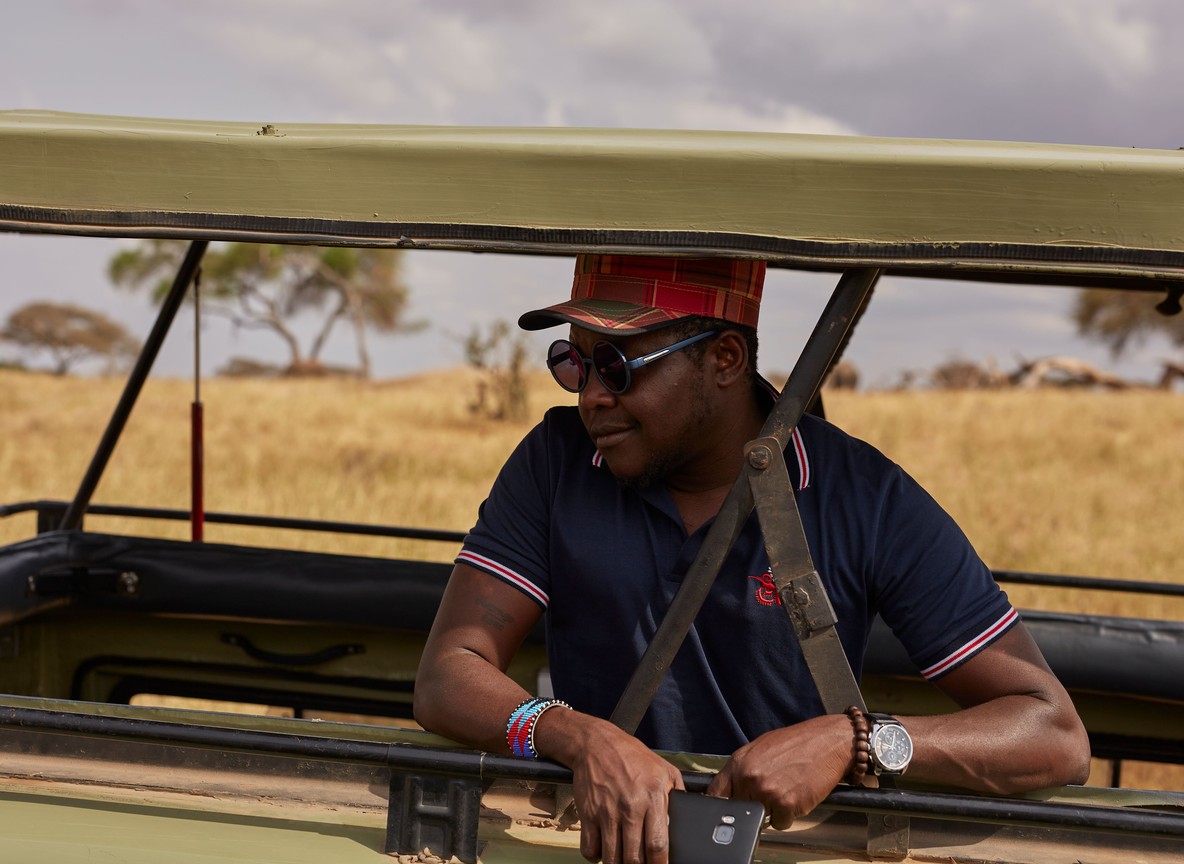
This combination is only possible on private conservancies. Inside Kenya’s national parks, night drives are not permitted. On a private conservancy, your driver-guide can go out after dark with a spotlight, stop the vehicle wherever you want, cut the engine, and wait while you set up a tripod on the roof hatch or on the ground beside the vehicle.
The schedule that works best for safari astrophotography tours and safaris in Kenya:
- 5:30 AM: Pre-dawn drive, lions and cheetahs are most active
- 7:30 AM: Return to camp, breakfast, process morning images, rest
- 4:00 PM: Afternoon drive for golden-hour photography
- 7:30 PM: Sundowners in the bush, then return for dinner
- 9:00 PM to midnight: Dedicated dark-sky session, Milky Way and star trails
- Midnight onwards: Sleep
Your guide positions the vehicle so a specific acacia tree, a granite kopje, or a dry riverbed edge sits in front of the galactic center rise point. That kind of positioning takes genuine local knowledge. An experienced Laikipia guide knows which direction gives you a low, clear western horizon, which waterholes stay active past 10 PM, and exactly how much time you have before atmospheric turbulence builds above the Aberdare Range to the south.
For a full breakdown of light positions and field shooting workflow across Kenya’s northern conservancies, see our northern Kenya photography safari guide, which covers both Samburu and Laikipia in detail.
What Are the Best Lodges and Camps for Dark-Sky Photography in Kenya?
The best camps for safari astrophotography in Kenya share three qualities: they sit at least 80 km from any major town, they have a fire or lantern policy that dims significantly after 10 PM, and they operate their own private vehicle fleet so you are not competing with 20 other vehicles at a sighting.
Laikipia recommendations:
- Borana Lodge: The main camp at Borana Conservancy in Laikipia has open-sided cottages facing northwest, directly toward the darkest horizon arc. The camp runs on solar with a generator curfew by 9:30 PM.
- Sirikoi Lodge (Lewa Conservancy): Maximum 20 guests, roof terraces on each cottage, and a camp manager who actively manages light output during new-moon windows.
- Ol Malo Lodge: A four-cottage camp at the top of a volcanic ridge with a 360-degree unobstructed horizon. One of the few camps in Kenya where you can genuinely see the sky from horizon to horizon.
Chyulu Hills:
- Ol Donyo Lodge: The only camp in Kenya with a purpose-built rooftop star bed. Guests sleep on a raised platform with mattress, bedding, and a mosquito net but no roof. The Chyulu Hills block all Nairobi light dome on the northern horizon. For route planning from Nairobi to the Laikipia camps, see our Laikipia Plateau safari guide.
Northern Kenya (Samburu):
- Elephant Bedroom Camp: Set directly on the Ewaso Nyiro River with river-facing tents that have zero ambient light behind them. Samburu’s remoteness keeps its Bortle class in the 1-2 range.
For a multi-destination itinerary that combines Samburu, Laikipia, and the Masai Mara in one logically sequenced trip, our 12-day Kenya photographic safari itinerary shows exactly how the routing and scheduling works.
How Do Star Trail Shoots Work on a Kenya Safari?
Star trails capture the apparent rotation of the sky as the earth turns. From Kenya at approximately 1 degree south of the equator, stars near the celestial equator (Orion’s belt, Scorpius, the Southern Cross) move nearly horizontally across your frame. Stars near the south celestial pole rotate in tight concentric circles around Sigma Octantis. This strong east-to-west trail direction is distinct from what Northern Hemisphere photographers produce and gives Kenya star trail images a visual signature you cannot replicate anywhere above the Tropic of Cancer.
Field setup workflow:
- Arrive at your shooting location 30 minutes early and let your eyes dark-adapt fully
- Shoot a 10-second test frame at ISO 12800 and f/2.8 to check composition and confirm focus
- Focus on the brightest star in the frame (Canopus is the second-brightest star in the night sky and visible year-round from Kenya)
- Drop to ISO 1600, set 30-second exposures with a 1-second gap, and start the intervalometer
- Walk away and have dinner or rest
- Return in 90 minutes. Stack 180 frames in Sequator using star trail mode, not the “astronomical stacking” single-exposure mode.
Weather forecasting apps like Clear Outside and Astrospheric both work via mobile data at most Laikipia camps and at the Samburu lodges near Archer’s Post. Your guide will also know from experience which evenings are likely to cloud over after midnight.
For a comprehensive look at what the full scope of Kenya’s wildlife photography conditions offers, from Big Five dawn shoots to star field nights, see our guide to Kenya safari photography. ✨
What Is the Trunktrails Advantage for Astrophotography Safari Kenya Guests? 🌍
Tours and safaris designed for photographers move differently from standard itineraries. We know what it costs a photographer to cut short a star trail session because the vehicle needs to be back at camp for the next group’s early departure.
At Trunktrails Safaris, our astrophotography packages are built on three principles:
Private vehicle guarantee. Every astrophotography guest travels on a dedicated vehicle with their own driver-guide. You stop when you want, stay as long as conditions hold, and the full schedule revolves around moon phase and galactic center position, not a shared camp timetable.
Moon-phase itinerary design. When you contact us, we build your travel dates around the lunar calendar. We identify the best new-moon window between June and August, confirm lodge availability around those exact dates, and hand you an itinerary built for photography first. Most operators sell you the lodge dates and let you sort out the moon yourself. We do it the other way around.
Experienced local guide network. Our guides on the Laikipia Plateau have supported wildlife researchers and documentary film crews on night sessions for years. They know which dry riverbeds give a low, clear western horizon for the galactic center rise, which camp generators are switched off earliest, and which conservancy rangers will escort your vehicle on an extended midnight session.
Tours and safaris at Trunktrails Safaris accommodate all budget levels. A six-night Laikipia astrophotography safari starts from approximately $2,400 per person sharing on a full-board private-vehicle basis (indicative, subject to season and availability). We are a Kenyan-owned and operated company with no overseas agency layer. Every booking connects you directly to our Nairobi operations team, and 5% of every booking goes to wildlife conservation programs on the conservancies where we operate.
Further reading
- Maasai Mara Wildlife Conservancies Association
- African Wildlife Foundation
- Magical Kenya (Kenya Tourism Board)
More safari planning resources
- Ol Pejeta and Sweetwaters safari package from Valley Safaris
- Samburu National Reserve guide on Touring Insights
- Samburu destination guide on FindMySafari
- Map of Samburu from Valley Safaris
Ready to Plan Your Safari Astrophotography Kenya Trip with Trunktrails Safaris?
The next ideal new-moon window over the Laikipia Plateau is closer than you think. Dark skies open by 8:30 PM in June, the Milky Way arch stays sharp until well past midnight, and there is no light dome on any horizon. Send us your target dates and we will return a custom itinerary within 24 hours, aligned to the lunar calendar and the conservancy that fits your photography goals.
WhatsApp: +254 113 208888 Email: info@trunktrailssafaris.com Website: https://trunktrailssafaris.com