Meru National Park Safari Kenya: The Complete Insider’s Guide 🌍
Most travelers fly into Nairobi and head straight for the Masai Mara. That is a great choice. But Kenya has another park, one that most visitors never reach, and that park rewards the curious in ways that few destinations in East Africa can match. A Meru National Park safari Kenya trip offers untouched savannah, a Big Five that includes recently reintroduced rhinos, and a wildlife story rooted in one of the most famous conservation narratives ever told. This guide covers everything you need to know to plan your visit with Trunktrails Safaris, from the best time to go to where to stay and what to look for when you get there. For more detail, read our Rhino Tourist Camp Near Oloolaimutia Gate Maasai Mara. For more detail, read our Ngare Serian Camp Mara North Conservancy Accessible Only Via Rope Bridge Maasai Mara.
Why Meru National Park Deserves a Spot on Your Kenya Safari
Meru National Park sits in the heart of Kenya, roughly 350 kilometres north-east of Nairobi. It covers 870 square kilometres of diverse habitat: open grassland, dense riverine forest, swampland, and semi-arid bush. Thirteen rivers flow through the park, and the landscape shifts dramatically as you move through it.
The park has a complicated history. It was the home of Joy and George Adamson, the conservationists who raised Elsa the lioness and released her back into the wild, a story told in the book and film “Born Free.” After the Adamsons were murdered by poachers in the late 1980s, the park fell into neglect. Poaching devastated the wildlife population. The black rhinos were wiped out entirely.
Then Kenya Wildlife Service (KWS) stepped in. Over the past two decades, working with private conservancies and organisations including the Borana Conservancy and Lewa Wildlife Conservancy, the park has been systematically restocked. Black rhinos are back. Elephants, lions, leopards, buffalo, and reticulated giraffe have returned in healthy numbers. Meru today is a functioning Big Five park, and it receives a fraction of the visitors that crowd the Masai Mara in peak season.
For travelers booking tours and safaris who want an authentic Kenya wildlife experience without the convoy of vehicles, Meru is the answer.
Wildlife in Meru National Park: What You Will See 🐘
The big draw at Meru is the diversity of its wildlife and the low density of vehicles. You will rarely share a sighting with more than one or two other safari vehicles, even in peak season.
The Big Five at Meru:
- Elephants are abundant throughout the park, particularly near the river systems. Meru elephants are notably large-tusked due to the park’s relative isolation.
- Lions are well established, especially in the open grassland areas in the northern sections. Pride dynamics here are less studied than in the Mara, which makes sightings feel more raw and unscripted.
- Leopards favour the dense riverine bush along the Tana and Rojewero rivers. Early morning drives along these corridors offer the best chance of a sighting.
- Buffalo move in large herds through the park’s wetter zones, particularly after the short rains.
- Black Rhinos live inside a fenced sanctuary within the park, managed by KWS. This protected enclosure allows for guided rhino tracking on foot with a KWS ranger. It is one of the few places in Kenya where you can approach black rhino on foot legally and safely.
Beyond the Big Five, Meru supports reticulated giraffe, Grevy’s zebra, gerenuk, cheetah, wild dog, hippo, and an extraordinary bird list of over 427 species. The park sits on the edge of the Somali-Masai biome, meaning several dry-country species found in Samburu also appear here. For birders, this is a genuinely exciting combination.
The Tana River and Rojewero: Life Force of Meru
Water defines Meru. The Tana River, Kenya’s longest river, forms the park’s southern and eastern boundary. The Rojewero River cuts through the interior. These waterways are not incidental geography. They are the reason the wildlife density is what it is.
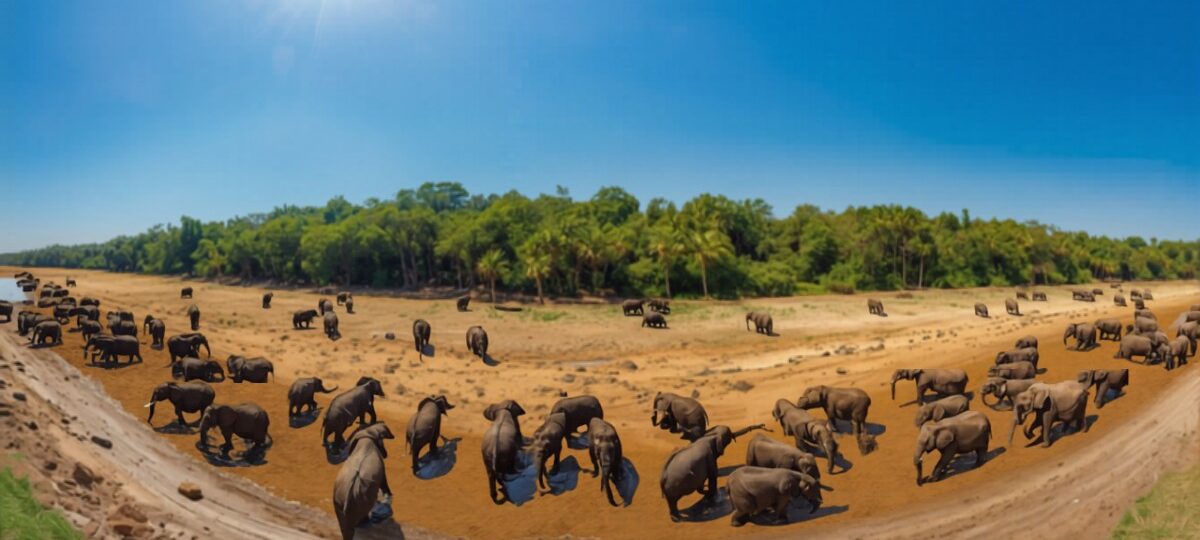
During the dry season, when the surrounding landscape turns brown and animals concentrate around permanent water, the river banks become extraordinary wildlife corridors. Elephants drink at dusk in family groups. Hippos bask on sandbanks. Crocodiles hold their positions in the shallows with the patience of stone. Kingfishers, herons, and fish eagles work the surface.
Tours and safaris that include evening game drives along the Tana are among the most productive wildlife experiences in the park. The combination of predator activity and elephant movement along the river in the golden hour is, in the words of Trunktrails guides, “worth the drive from Nairobi on its own.”
The rivers also mark the park’s wild edge. Cross the Tana at the right point and you are in the vast Kora National Park, part of an enormous protected landscape that stretches north into untracked wilderness. This connectivity is what allows species like wild dog to use Meru as part of a larger range.
Adamson’s Falls and the Spirit of the Wild
At the southern tip of Meru, where the Tana River carves through a granite gorge, you find Adamson’s Falls: a series of cascades named after George Adamson. The falls are not signposted on most tourist maps. Many visitors to Meru never make it there.
They should.
The falls mark the place where George Adamson released his last lions before his death in 1989. Standing at the edge of the gorge, watching the Tana push through the rocks below, you feel the weight of the conservation story that this park carries. The Adamson legacy is not nostalgia. It is the reason the wildlife is back.
For Trunktrails Safaris, the Adamson’s Falls stop is a standard part of any multi-day Meru itinerary. It is the kind of destination that turns a game drive into a conversation, and a good conversation into a booking for a return trip.
Best Time to Visit Meru National Park
Meru is a year-round destination, but the seasons affect the experience significantly.
Dry season (June to October and January to February): This is peak wildlife viewing. Vegetation thins, animals concentrate around water, and road conditions are at their best. June to October is the optimal window, coinciding with the Great Migration in the Mara. Traveling to Meru in this period means world-class wildlife viewing without the crowds.
Short rains (November to December): Brief afternoon showers refresh the landscape. Wildlife disperses slightly but the park turns dramatically green. Birdlife peaks. Resident species have calves and cubs.
Long rains (March to May): Meru receives more rainfall than the southern parks, and the long rains can make some tracks muddy. However, this is also the quietest period, with the lowest rates and essentially no other vehicles in the park. Trunktrails Safaris offers green season tours and safaris at Meru for travelers who prioritise solitude and value.
The Kenya Wildlife Service (KWS) maintains excellent park infrastructure, and road conditions improve each year as KWS continues to invest in Meru’s rehabilitation. For up-to-date road conditions and entry fees, check the Kenya Wildlife Service (KWS) website before your trip.
Getting to Meru National Park
Meru is accessible by road and by air.
By road: Nairobi to Meru is approximately 350 kilometres via the A2 highway through Thika, Embu, and Meru town. The drive takes around 5 to 6 hours depending on traffic through Nairobi. Trunktrails Safaris provides private 4×4 transfers in pop-top Land Cruisers, which double as game drive vehicles throughout the trip.
By air: Meru is served by a grass airstrip at Kinna and a second strip at Murera Gate. Charter flights from Wilson Airport in Nairobi take approximately 45 minutes. Fly-in packages are available through Trunktrails Safaris and are the preferred option for travelers combining Meru with Samburu or Laikipia.
Where to Stay in Meru National Park
Accommodation at Meru ranges from KWS-managed bandas and campsites to tented camps operated by private concessions.
Elsa’s Kopje is the landmark property in Meru, built on the rocky kopje where George Adamson camped with Elsa. Rooms are built into the boulders and overlook a wide sweep of open bush. It is a mid-to-upper range property with a strong conservation ethos.
Rhino River Camp sits on the Rojewero River and offers tented accommodation with direct river frontage. Game drives, rhino tracking, and guided walks are all available from this property.
Meru Mulika Lodge is the KWS-affiliated lodge inside the park, offering mid-range accommodation for budget and group travelers. It has a strong local character and excellent position near the Murera Gate.
Trunktrails Safaris can arrange accommodation at any tier based on your budget and group profile. All tours and safaris through Meru include private vehicles, guide-led game drives, and where available, guided walking opportunities including rhino tracking with a KWS ranger. ✨
The Trunktrails Advantage: Why Book With Us
Trunktrails Safaris is a native Kenyan-owned operator based in Nairobi, certified by. We do not operate as a middleman. Every itinerary is built directly by our team, and your guide is a Trunktrails guide, not a subcontracted driver.
For Meru specifically, this matters more than at most parks. Meru rewards patience and local knowledge. Knowing which river crossing the elephants use at dawn, which thicket the leopard favours, where the cheetah coalition hunts in the dry season – this is the difference between a good game drive and an extraordinary one.
What Trunktrails Safaris brings to your Meru visit:
- Ecosystem-specialist guides with specific Meru field experience
- Private 4×4 vehicles with a pop-top roof for 360-degree game viewing
- Tailor-made itineraries – 2-day, 3-day, 4-day and longer combinations with Samburu, Laikipia, or Mount Kenya
- Rhino tracking access coordinated with KWS rangers inside the sanctuary
- 5% conservation contribution from every booking goes directly to wildlife conservation programmes in Kenya
- 24/7 direct WhatsApp support from our Nairobi operations team throughout your trip
Tours and safaris with Trunktrails are built around what you want to see, not around what is cheapest to operate. 🐆
Frequently Asked Questions About Meru National Park
Is Meru National Park safe to visit? Yes. Meru is a well-managed KWS-gazetted national park with ranger patrols throughout the reserve. The rhino sanctuary has additional security. Trunktrails Safaris guides carry KWS-required safety equipment and communicate with the park’s ranger network throughout every game drive. Contact us to discuss specific safety questions before your trip.
Can I see rhinos in Meru National Park? Yes. Meru has a dedicated black rhino sanctuary within the park. Visitors can book guided rhino tracking on foot with a KWS ranger. This is one of a small number of parks in Kenya where foot-based rhino tracking is available. Trunktrails Safaris coordinates the KWS permits for rhino tracking as part of your tour package.
How many days should I spend at Meru National Park? A minimum of two nights (three days) gives you enough time to cover the key circuits: the northern grasslands, the river systems, the rhino sanctuary, and Adamson’s Falls. Three nights is recommended for a fuller experience. Meru combines well with Samburu National Reserve (4 to 5 hours north) for a northern Kenya circuit. Contact Trunktrails Safaris at the link below to design your itinerary.
What is the best time of year to visit Meru National Park? June to October is the optimal dry season for wildlife viewing. January and February are also excellent. Green season (November to May) offers lower rates, dramatically lush scenery, and exceptional birdlife. Meru is genuinely worth visiting year-round.
Does Trunktrails Safaris run tours to Meru National Park? Yes. Trunktrails Safaris operates Meru safaris as standalone 2- to 4-day programmes and as part of northern Kenya circuits combining Meru with Samburu, Laikipia, and Ol Pejeta. All safaris use private 4×4 Land Cruisers with specialist guides. Reach out via the contact link below for pricing and availability.
Is Meru National Park good for birding? Excellent. Over 427 bird species have been recorded in Meru, including Pel’s fishing owl, martial eagle, Somali ostrich, and a range of dry-country and riverine species not found in the southern parks. For birders, Meru is one of Kenya’s top destinations. Trunktrails Safaris offers birding-focused game drives with guides trained in avian identification.
Ready to Visit Meru National Park? 🌅
Meru National Park is one of Kenya’s great undiscovered safari destinations. The wildlife is back. The rhinos are tracked on foot. The rivers run wild. And the vehicles are few.
Trunktrails Safaris builds bespoke Meru itineraries for all budgets, from 2-day overland breaks to 10-day northern Kenya circuits. Every safari includes a private vehicle, an ecosystem-specialist guide, and our full 24/7 support.
Plan your Meru National Park safari Kenya trip today.
Contact Trunktrails Safaris to get a personalised itinerary and availability for your dates.
Further reading
More safari planning resources
- Kenya national parks map from Valley Safaris
- Best time to visit Kenya on Touring Insights
- Big Five safari collection on FindMySafari
- Best time to visit Kenya month-by-month map from Valley Safaris
Trunktrails Safaris | Native Kenyan-Owned Website: https://trunktrailssafaris.com WhatsApp: +254 113 208888 Email: info@trunktrailssafaris.com
About the Author This guide was produced by the Trunktrails Safaris content team, led by guides and operators with firsthand field experience in Meru National Park. Trunktrails Safaris is a -certified, native Kenyan-owned operator based in Nairobi, committed to conservation-led tours and safaris across Kenya.