
Kenya Birding Safari: Best Parks and Bucket-List Species 🌍
Kenya holds more than 1,100 recorded bird species, more than any other East African country and enough to rank it among the global top tier for avian diversity. For a wildlife enthusiast, a Kenya birding safari is not a side trip. It is the main event. Flamingo clouds at Lake Nakuru. The liquid call of an African fish eagle at first light across Lake Baringo. The high-canopy chaos of Kakamega Forest where 380 species occupy a single square kilometre of ancient rainforest. Kenya delivers birding experiences that are hard to find anywhere else on the continent.
This guide covers the best parks for a Kenya birding safari, the bucket-list species at each one, peak season timing, gear, and how Trunktrails Safaris structures dedicated birding tours and safaris.
Why Kenya Ranks Among the World’s Top Birding Destinations
Kenya’s 1,100-plus species represent roughly 11% of all known bird species. That density comes from four major ecological zones: the Great Rift Valley lakes, coastal Swahili forest, montane forest on the Aberdares and Mount Kenya, and the vast savannah of the Mara and Tsavo. On a seven-day itinerary you can tick water birds at a soda lake, forest endemics in Kakamega, savannah raptors in the Mara, and arid-zone specials in Samburu.
Add the November-to-April window when Palearctic migrants arrive from Europe and Asia, and species counts on a single morning drive can exceed 80. Birding safaris in Kenya are built around this seasonal rhythm.
Lake Nakuru: The Flamingo Coast and Beyond
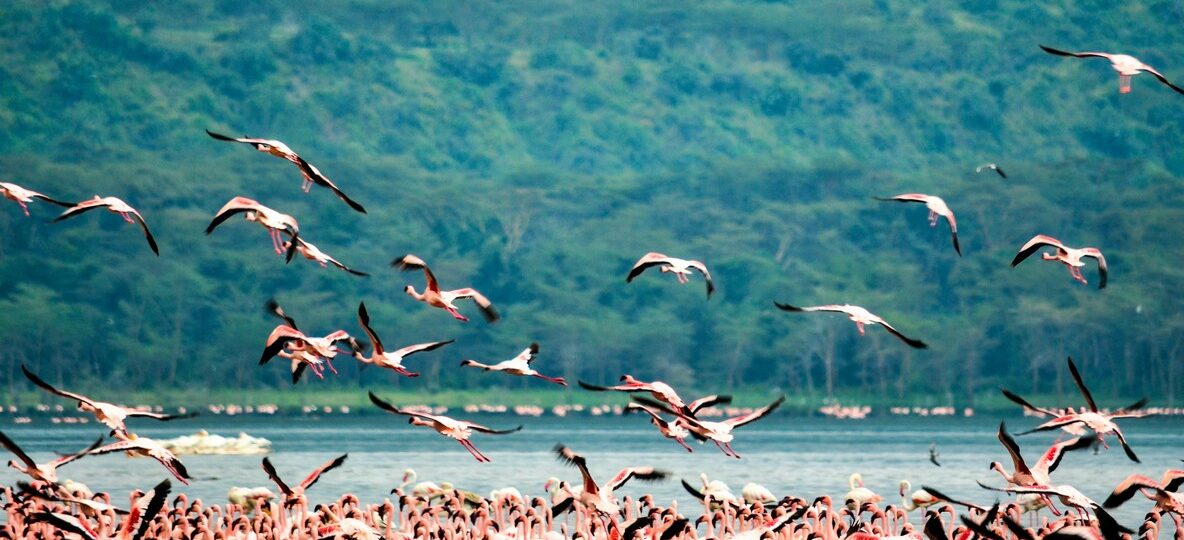
Lake Nakuru National Park is the image most people carry when they think about Kenya safari birds: a horizon of pink, the surface of the alkaline lake turned rose by hundreds of thousands of lesser flamingos feeding on cyanobacteria. At peak concentration, the spectacle is extraordinary. Numbers fluctuate with water levels, but even in lean years, Lake Nakuru reliably holds tens of thousands of birds. 📸
The flamingos dominate the first look, but birders should work the shoreline and the acacia woodland above the lake too. The yellowbill stork colony near the southern cliffs is one of Kenya’s most accessible breeding sites. African spoonbills and pied kingfishers line the shallows. In the woodland, look for Ross’s turaco, a bird almost comically vivid in violet and crimson.
Key species at Lake Nakuru:
- Lesser flamingo and greater flamingo
- Yellowbill stork (nesting colony)
- African spoonbill
- Ross’s turaco
- African fish eagle
- Malachite kingfisher
- African finfoot
Best months: November through March when water levels are stable and migrant waders are present.
Kakamega Forest: Kenya’s Endemic Heartland
Kakamega Forest, in the western highlands near the Ugandan border, is the easternmost fragment of the Guineo-Congolian rainforest belt, a habitat type that does not recur anywhere else in Kenya. For a birder, that isolation has produced a remarkable list of species found nowhere else in the country. Bird watching safaris in western Kenya almost always route through Kakamega for precisely this reason. 🦁
More than 380 species have been recorded in the forest. Kakamega specials include Turner’s eremomela, Chapin’s flycatcher, and the African grey parrot (a forest bird here, not a cage bird). The great blue turaco, 75 centimetres of iridescent blue-green plumage, moves through the canopy in long gliding arcs and is one of the most reliable sightings in the forest. Blue-headed bee-eater and the rare Nahan’s francolin complete the must-see list.
Key species at Kakamega Forest:
- Turner’s eremomela (near-endemic)
- Chapin’s flycatcher
- Great blue turaco
- African grey parrot
- Blue-headed bee-eater
- Nahan’s francolin
Dawn chorus at Kakamega is one of the defining experiences of any Kenya birding safari. Arrive at the forest edge before first light. The layers of sound building from 05:30 onwards are extraordinary.
Lake Baringo: Rift Valley Raptors and Water Birds
Lake Baringo sits in the northern Rift Valley, a freshwater lake ringed by acacia scrub and rocky escarpments. The bird list here is radically different from Nakuru and Kakamega. Baringo is Kenya’s premier site for Verreaux’s eagle, Hemprich’s hornbill, African skimmer, and Goliath heron. The Ruko Community Conservancy on the northern shore offers boat birding where African skimmer and Pel’s fishing owl at dusk are the headline sightings.
Birding tours and safaris pairing Baringo with Nakuru in a two-day circuit typically add 80 to 120 species across two contrasting ecosystems.
Key species at Lake Baringo:
- Verreaux’s eagle
- African skimmer
- Goliath heron
- Hemprich’s hornbill
- Pink-backed pelican
- Pel’s fishing owl (dusk/nocturnal)
- African darter
Masai Mara: Raptors, Migrants, and Open-Country Specials
The Masai Mara is not marketed as a birding destination, but serious birders return surprised. The open grasslands hold one of East Africa’s densest raptor communities: martial eagle, bateleur, tawny eagle, and long-crested eagle are regular sightings. Secretary bird pairs stride through the short grass each morning. ✨
During the November-to-April migration window, barn swallows arrive in large flocks and Montagu’s harriers hunt the grasslands from December through March. The riparian forest along the Mara River holds malachite kingfisher, long-tailed paradise whydah, and African reed warbler. Trunktrails Safaris birding guides structure morning drives around specific microhabitats rather than the standard Big Five circuit.
Key species at the Masai Mara:
- Secretary bird
- Kori bustard
- Bateleur
- Grey-crowned crane
- Long-crested eagle
- Ground hornbill
- Montagu’s harrier (migrant, Nov-Mar)
Amboseli: Wetlands Under Kilimanjaro
Amboseli National Park is best known for its elephants, but the wetlands fed by Kilimanjaro’s glacial melt attract yellow-billed stork, African jacana, saddle-billed stork, and large wader concentrations during migration. The Kenya rufous sparrow, a country endemic, is reliable here. Amboseli works best as a combination stop on a multi-park Kenya birding safari rather than a standalone birding destination.
Kenya Birding by Park: Quick Reference
| Park | Key Species | Best Months | Ecosystem |
|---|---|---|---|
| Lake Nakuru | Lesser flamingo, Ross’s turaco, African fish eagle | Nov-Mar | Alkaline lake + acacia |
| Kakamega Forest | Great blue turaco, Turner’s eremomela, African grey parrot | Nov-Apr | Guineo-Congolian forest |
| Lake Baringo | Verreaux’s eagle, African skimmer, Pel’s fishing owl | Year-round | Freshwater lake + escarpment |
| Masai Mara | Secretary bird, bateleur, Kori bustard, Montagu’s harrier | Jul-Mar | Open savannah + riparian forest |
| Amboseli | Saddle-billed stork, African jacana, Kenya rufous sparrow | Oct-Apr | Wetland + open lakebed |
| Samburu | Golden-breasted starling, vulturine guineafowl, Somali ostrich | Year-round | Arid savannah |
Best Season for a Kenya Birding Safari
November to April is the peak window. Palearctic migrants from Europe and Central Asia arrive in late October and stay through March, lifting species counts sharply across every ecosystem. Many residents are in breeding plumage from November onward, making identification easier.
January and February are particularly productive when vegetation thins and birds are visible. March and April are exceptional in forest habitats as canopy-feeders respond to the first rains. Kakamega Forest in May, just after the long rains begin, delivers some of the most intense birding activity of the year.
Year-round parks including Lake Baringo and Samburu are productive in any month and work well when the highland sites are too wet to access comfortably.
The Trunktrails Advantage
Trunktrails Safaris structures Kenya birding safaris around species targets, not standard game-drive circuits. Most Kenya tours and safaris follow fixed routes optimised for the Big Five. A birder needs flexible timing (dawn departures, forest walks, dusk boat sessions at Baringo), specialist guides with genuine field skills, and itineraries that put you at productive habitat at the right time.
As a native Kenyan-owned operator, we build tailor-made tours and safaris for solo birders, couples, and small groups. We commit 5% of every booking to wildlife conservation. There are no middlemen and no fixed group departures.
Frequently Asked Questions
Further reading
More safari planning resources
- Rift Valley lakes map from Valley Safaris
- Best time to visit Kenya on Touring Insights
- Masai Mara destination guide on FindMySafari
- Best time to visit Kenya month-by-month map from Valley Safaris
How many bird species can I see on a Kenya birding safari? A well-structured 7 to 10-day itinerary covering Lake Nakuru, Kakamega Forest, Lake Baringo, and the Masai Mara can yield 350 to 500 species. Single-day birding at Kakamega alone commonly produces 80 to 120 species in a morning walk. Contact Trunktrails Safaris at info@trunktrailssafaris.com or WhatsApp +254 113 208888 to discuss a target list and realistic species count for your dates.
What is the most common bird sound on a Kenya safari? The African fish eagle. Its two-note descending yodel carries for several kilometres across open water. It is the sound most returning visitors associate immediately with Kenya, heard throughout the day at any Rift Valley lake.
Are dedicated birding tours and safaris more expensive than standard game drives? Not significantly. The main difference is that birding tours and safaris use smaller vehicles, allow longer stops, and typically build in early morning and late afternoon sessions that standard packages skip. Pricing is comparable to a mid-range wildlife safari. Trunktrails Safaris can quote a birding itinerary at any budget level.
Is Kakamega Forest worth adding if I only have one day? Yes, without qualification. A full day at Kakamega regularly produces 80 to 100 species including endemics and near-endemics you cannot find anywhere else in Kenya. For a serious birder, it is arguably the highest-return single day in the entire country.
Do I need specialist birding guides, or can general safari guides run a birding safari? Specialist guides make a measurable difference. Trunktrails Safaris pairs dedicated birding guides with every Kenya birding safari. These are guides who know call recognition, microhabitat use by season, and specific access points at Baringo, Kakamega, and the Mara that are not on the standard tourist circuit.
What is the best time of year for a Kenya birding safari? November through April covers the Palearctic migration peak and the resident breeding season. November and March are particularly productive. July to September offers the Great Migration spectacle alongside strong raptor sightings in the Mara, though species counts are lower than the wet-season peak.
Plan Your Kenya Birding Safari with Trunktrails Safaris
Kenya’s birding is exceptional, but itinerary design determines what you actually see. Getting the timing right at Kakamega, being at Baringo for the dusk Pel’s fishing owl, positioning yourself at Nakuru during stable water levels: these details separate a good trip from an outstanding one.
Trunktrails Safaris builds Kenya birding safari itineraries around your species targets. Our guides are Kenyan specialists with field-level knowledge of call recognition and microhabitat use by season. Get in touch and we will match an itinerary to your dates, budget, and list.
Contact Trunktrails Safaris:
- WhatsApp: +254 113 208888
- Email: info@trunktrailssafaris.com
- Website: https://trunktrailssafaris.com
The birds are there. The only question is when you are coming. 🌅