Samburu Special Five: How to See Gerenuk, Reticulated Giraffe and Grevy’s Zebra
Kenya has two distinct safari worlds. South of the equator, the Masai Mara and Amboseli deliver the classic safari picture: open savannah, lion prides, elephant herds, wildebeest by the million. North of the equator, a drier, more remote landscape holds wildlife that simply does not exist anywhere else in Kenya. Samburu National Reserve is where the northern corridor begins, and the animals it holds, the Samburu Special Five, are the reason wildlife specialists put this park at the top of their Kenya list.
At Trunktrails Safaris, we consider a Kenya circuit incomplete without Samburu. This samburu special five guide covers each species in detail, when and where to find them, and how to plan a visit that maximises your time in one of East Africa’s most underrated parks. 📸
The Samburu Special Five at a glance
| The five | Grevy’s zebra, reticulated giraffe, Somali ostrich, beisa oryx and gerenuk |
| Rarest of them | Grevy’s zebra: only about 3,000 remain worldwide, the vast majority in northern Kenya |
| The reserve | 165 sq km along the Ewaso Nyiro River; fee about USD 85 per non-resident adult |
| Where to look | Riverine woodland for giraffe and gerenuk; open acacia plains for oryx, ostrich and Grevy’s |
| Best season | Rewarding year-round; June to October is driest and concentrates game on the river |
The Special Five are not marketing invention; they are genuine dryland specialists whose ranges barely dip south of the equator, which is why the Mara cannot show you a gerenuk standing on its hind legs to browse. Samburu compresses all five into a reserve small enough to find them in two or three drives, with the Ewaso Nyiro pulling everything to water in the dry months. Trunktrails Safaris treats a Grevy’s sighting with the reverence it deserves, since fewer of them survive than black rhinos, and northern Kenya is their last real stronghold.
What Are the Samburu Special Five?
The “Samburu Special Five” refers to five species uniquely adapted to the hot, semi-arid northern Kenya ecosystem and not reliably found in southern Kenya’s savannah parks.
The five species:
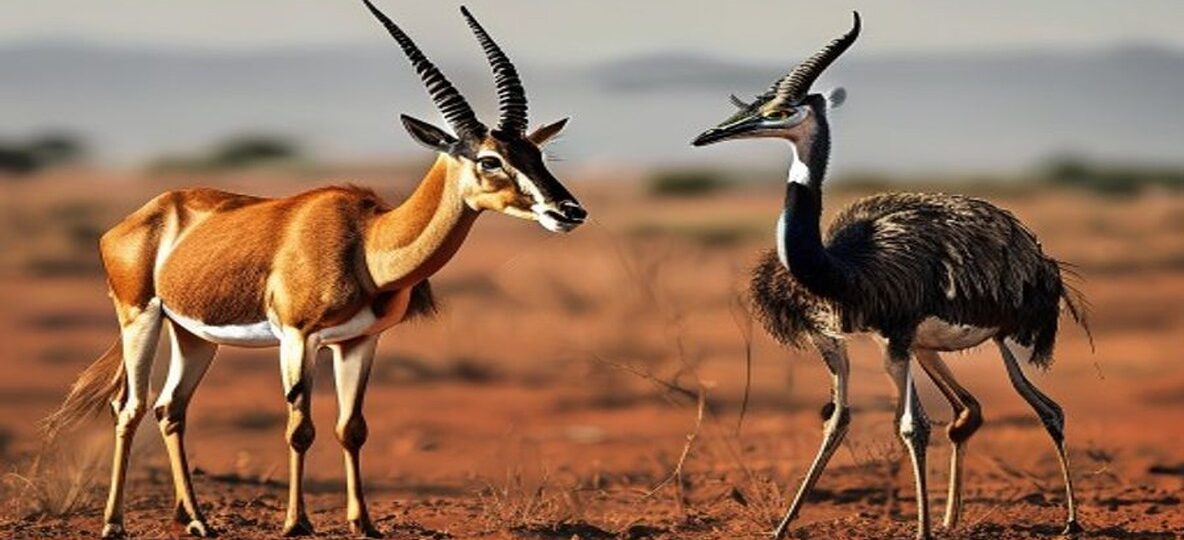
- Gerenuk (Litocranius walleri) — The giraffe gazelle. Stands on hind legs to browse from acacia branches no other antelope can reach. Identified by its extraordinarily long neck and legs relative to its body.
- Reticulated Giraffe (Giraffa reticulata) — A distinct giraffe subspecies with sharply defined polygonal patches separated by white lines (unlike the irregular patches of Maasai giraffe). Northern Kenya and Somalia only.
- Grevy’s Zebra (Equus grevyi) — The largest wild equid species. Distinguished from plains zebra by its very narrow stripe pattern, large rounded ears, and white belly. Critically endangered globally, with Kenya holding over 80% of the world population.
- Beisa Oryx (Oryx beisa) — A large antelope with long straight horns and a striking black-and-white face mask. Adapted to extreme heat and water scarcity.
- Somali Ostrich (Struthio molybdophanes) — A recently recognised separate ostrich species, distinguishable from common ostrich by the blue-grey skin on the neck and thighs in breeding males (rather than pink-red).
These five species share a common characteristic: they are adapted to survive in conditions that most Kenya safari animals cannot tolerate. Samburu’s semi-arid acacia thornbush is their primary habitat.
Gerenuk: The Animal That Changes How You See Browsing
The gerenuk is the Samburu animal most visitors talk about most. The combination of its improbable proportions, its habit of standing upright, and its complete indifference to the heat sets it apart from every antelope you will see in southern Kenya.
Gerenuk key facts:
- Weight: 28-52 kg (among Kenya’s medium-sized antelopes)
- Height at shoulder: 90-105 cm; neck adds another 30-40 cm of reach
- Diet: exclusively browse (leaves, shoots, flowers) — never grazes grass
- Water: obtains all moisture from food, rarely drinks free water
- Social groups: small, typically 2-5 individuals
Watching a gerenuk feed is an event rather than a sighting. The animal selects a branch, positions itself on its hind legs with front legs resting on higher branches for stability, then feeds with careful deliberation. It will stand upright for 30-60 seconds at a time before dropping back to four legs and repositioning.
Where to find them in Samburu:
Gerenuk are dispersed throughout the reserve but concentrate along the Ewaso Nyiro River’s acacia woodland edge and in the eastern sections of the reserve near Archer’s Post. Dawn and late afternoon are optimal for activity. Midday heat sends them into shade.
Trunktrails Safaris guides know the specific acacia thickets where gerenuk feed most reliably at different times of day. This is the difference between a vehicle passing through and a guide who has watched these animals in the same locations for years.
Reticulated Giraffe: The World’s Most Endangered Giraffe Subspecies
The reticulated giraffe is the giraffe most people picture when they think of the animal — the sharply geometric coat pattern is the one that appears in most natural history imagery. In reality, the Masai giraffe (which most Kenya visitors see in the south) has a messier, more irregular pattern. The reticulated giraffe’s precision is striking.
Population status: Approximately 15,900 animals globally, classified as Vulnerable on the IUCN Red List. Kenya holds the majority of the world population, with Samburu and Laikipia being the two main strongholds.
Where to see them at Samburu:
Reticulated giraffe are reliably seen throughout the reserve. The Ewaso Nyiro River area and the open acacia plains north of the main circuit are strong locations. Groups of 5-15 are common; larger aggregations of 20-30 occur during dry season when water sources concentrate animals.
A comparison worth noting for wildlife specialists:
| Feature | Reticulated Giraffe | Maasai Giraffe |
|---|---|---|
| Coat pattern | Geometric polygons, clean white lines | Irregular jagged patches, cream lines |
| Geographic range | Northern Kenya, Somalia, Ethiopia | East Africa south of equator |
| IUCN status | Vulnerable | Vulnerable |
| Typical group size | 5-20 | 5-15 |
| Habitat | Semi-arid acacia savannah | Open savannah |
The Samburu Special Five, Species by Species
Samburu’s calling card is a set of five arid-adapted species found together almost nowhere else in Kenya. Spotting all five is the northern safari’s version of the Big Five challenge.
| Species | Why it is special |
|---|---|
| Grevy’s zebra | Narrow stripes, endangered, northern Kenya |
| Reticulated giraffe | Sharp, map-like coat pattern |
| Gerenuk | Long-necked antelope that browses on its hind legs |
| Beisa oryx | Striking grey desert antelope |
| Somali ostrich | Blue-grey legged northern race |
These five thrive in dry country, which is why Samburu and its neighbouring conservancies are the place to tick them off.
Grevy’s Zebra: The World’s Largest Wild Horse
The Grevy’s zebra is the most visually distinct of the three zebra species in Kenya, and Samburu is one of the best places in the world to see them. At the current global population of approximately 2,800, seeing a Grevy’s is a genuine privilege.
How to distinguish Grevy’s from plains zebra:
- Stripes are narrow and numerous (almost like fingerprints compared to plains zebra’s bold bands)
- The belly is completely white with no stripes
- The ears are large and rounded, like a donkey’s
- The body is larger and more barrel-shaped than plains zebra
- Males weigh up to 450 kg
Grevy’s are often seen mixed with plains zebra herds in Samburu, which creates excellent comparison opportunities. Look for the size difference and the belly stripe gap: Grevy’s bellies are consistently white, plains zebra stripes continue to the belly.
Conservation note: Grevy’s zebra declined from approximately 15,000 animals in the 1970s to the current 2,800, primarily due to habitat loss and competition with domestic livestock. Kenya’s conservation community, supported by organisations like the Grevy’s Zebra Trust (headquartered near Samburu), is working to stabilise the population. Trunktrails Safaris contributes 5% of every booking to wildlife conservation, including northern Kenya species recovery programmes.
Beisa Oryx and Somali Ostrich: Completing the Five
Beisa Oryx:
The oryx is a large, striking antelope built for desert conditions. Both sexes carry long, straight horns (unlike most antelope where only males are horned). A standing oryx with its black-and-white face and perfectly parallel horns is an extraordinary animal to photograph.
Beisa oryx tolerate midday heat by allowing their body temperature to rise several degrees without sweating excessively — a physiological adaptation that allows them to conserve water in the same way camel physiology does. You will often see oryx standing in full sun when other animals have retreated to shade.
Somali Ostrich:
The Somali ostrich was only recognised as a separate species from common ostrich in 2014 through genetic analysis. In the field, the easiest identification is the breeding male’s colouration: neck skin is blue-grey, not the pink-red of common ostrich males. The bare skin on the thighs is also blue-grey.
Samburu is one of the most reliable locations in Kenya to confirm the Somali ostrich identification rather than assuming common ostrich. Trunktrails Safaris guides are familiar with the field identification characters.
When to Visit Samburu for the Special Five
| Season | Conditions | Special Five Sightings |
|---|---|---|
| Jan-Mar | Dry, very hot (up to 40C at midday) | Excellent (animals concentrate at river) |
| Apr-May | Long rains; some flooding possible | Good; lush vegetation means more dispersal |
| Jun-Aug | Dry, cooler | Excellent; peak visibility |
| Sep-Oct | Short dry season | Very good |
| Nov-Dec | Short rains | Variable but often productive |
The dry season concentrates wildlife at the Ewaso Nyiro River. During rains, animals disperse across the reserve as temporary water sources become available, making sightings less predictable but scenery more dramatic.
June to October is the overall best period for Samburu visits. 🦁
The Trunktrails Advantage for Samburu Safaris
Trunktrails Safaris is a native Kenyan operator. Our guides have deep familiarity with Samburu’s wildlife patterns and know where each of the Special Five concentrate across different seasons and times of day.
What sets our Samburu trips apart:
- We do not run group departures to Samburu. Every itinerary is private.
- Our guides can name individual gerenuk feeding zones, oryx watering patterns, and the specific acacia thickets where gerenuk are most reliably upright-feeding at dawn.
- We combine Samburu with Laikipia, Ol Pejeta, or the northern Lake Turkana circuit for travellers who want the full northern Kenya experience.
- Our tours and safaris to northern Kenya include a full pre-trip briefing on the Special Five, so you arrive knowing what to look for and how to identify each species.
5% of every booking with Trunktrails Safaris funds wildlife conservation. In Samburu, this contribution goes toward species recovery programmes supporting Grevy’s zebra and reticulated giraffe.
How to Get to Samburu National Reserve
By road from Nairobi: 5-6 hours via Nanyuki and Isiolo. The route is scenic through the Mount Kenya foothills and the Laikipia plateau.
By air: 45-minute charter flight from Wilson Airport (Nairobi) to Samburu or Archers Post airstrip. We arrange charters for all our Samburu itineraries.
Entry fees (2026): $52 per adult non-resident per day. KWS Fimbo digital payment system. Children under 3 free; ages 3-18 at $26. Trunktrails Safaris handles all logistics.
Recommended stay: Minimum 2 nights (3 nights optimal for relaxed Special Five viewing). The reserve rewards time — many of the best sightings come from spending three days in the same area rather than covering ground.
Further reading
More safari planning resources
- Map of Samburu from Valley Safaris
- Samburu National Reserve guide on Touring Insights
- Samburu destination guide on FindMySafari
- Best time to visit Kenya month-by-month map from Valley Safaris
Ready to Plan Your Samburu Special Five Safari?
The Samburu Special Five are not a bonus on a wider Kenya itinerary. For wildlife-specialist travellers, they are the reason to come to Kenya. The gerenuk, the reticulated giraffe, the Grevy’s zebra, the oryx, the Somali ostrich — these animals are not available anywhere in southern Kenya, and seeing them requires coming north.
Trunktrails Safaris designs every samburu safari around the specific wildlife priorities of each client. If your goal is a complete Samburu Special Five checklist, we build the itinerary and timing around that goal specifically.
WhatsApp Micah to build your northern Kenya itinerary:
📞 WhatsApp: +254 113 208888 📧 Email: info@trunktrailssafaris.com 🌐 Website: https://trunktrailssafaris.com