Samburu in July: Dry Season Wildlife and the Special Five at Maximum Visibility
Every Kenya safari calendar has a defining month for each region. The Masai Mara belongs to the wildebeest. Amboseli belongs to elephants under Kilimanjaro. For Samburu National Reserve, that month is July.
Visiting Samburu in July puts you inside the peak of the dry season in northern Kenya. The Ewaso Ng’iro River, the artery that runs through the heart of the reserve, is at its lowest and clearest level of the year. The surrounding acacia thornbush has been stripped of its cover. And the Samburu Special Five, five species found nowhere else on a Kenya safari circuit, are concentrated along the river corridor in numbers and visibility that no other month can match.
At Trunktrails Safaris, we run tours and safaris into Samburu every month of the year. July is consistently the month our guides describe as the single best wildlife month in the northern circuit. This guide explains exactly what makes it so, and how to plan a trip that makes the most of peak dry season. 🦒
Why July Is the Peak Month for Samburu
Samburu National Reserve sits at roughly 850 metres above sea level, approximately 340 kilometres north of Nairobi. The reserve covers 165 square kilometres of semi-arid acacia thornbush, cut through from west to east by the Ewaso Ng’iro River.
Kenya’s northern circuit has two rain seasons: the long rains from March to May and the short rains in October and November. By June, both are over. By July, the landscape has dried out completely. Grass is cropped short. The luggas, the seasonal dry riverbeds that cross the reserve, are bare sand. The only reliable surface water in the entire reserve is the Ewaso Ng’iro itself.
That concentration of water is the wildlife engine. When water exists in only one place, every animal in the reserve needs to pass through the river corridor at least once a day. For a safari vehicle, this is decisive. You do not need to search the reserve. You position yourself along the river, and the wildlife comes to you.
The Ewaso Ng’iro in July: The River That Runs the Reserve
The Ewaso Ng’iro originates in the Aberdare highlands and flows northeast through the Laikipia plateau before entering Samburu. In July the river is at its lowest annual level, reduced to a sequence of clear pools connected by narrow channels in the drier stretches.
That low level concentrates everything. Elephants wade across in the morning and again in the early evening. Reticulated giraffe spread their front legs awkwardly at the bank to reach the water. Grevy’s zebra herds move down the sandy approaches in single-file columns. Crocodiles bask on every exposed sandbank. The predator activity in July is exceptional. Leopards use the riverine fig and acacia trees as both hunting platforms and resting spots through the heat of the day. Lion prides patrol the open ground on either side of the river.
Bird diversity along the Ewaso Ng’iro peaks in July. Carmine bee-eaters nest in the sandy cut banks in breeding colonies that can number several hundred pairs. Goliath herons stand motionless in the shallows. The Samburu-Buffalo Springs corridor is regarded by Kenya birders as one of the top sites in East Africa for watching northward-bound raptors during the boreal summer. 📸
The Samburu Special Five in July: What to Expect
The Samburu Special Five are five species uniquely adapted to the semi-arid northern Kenya ecosystem. They are not reliably found in southern Kenya’s parks. July is the optimal month to see all five, because dry conditions eliminate the vegetation cover that can make them hard to spot in wetter months.
| Species | July Sighting Likelihood | Best Location | Key July Behaviour |
|---|---|---|---|
| Gerenuk | Very High | Acacia scrub east of Samburu Lodge | Solitary browsing; stands on hind legs to reach foliage above cover |
| Reticulated Giraffe | Very High | Riverine woodland, Ewaso Ng’iro corridor | Visits river at dawn and mid-afternoon; visible from 800 m in open bush |
| Grevy’s Zebra | High | Open flats and sandy luggas, Buffalo Springs NR | Territorial bulls call at dawn; large mixed herds form near permanent water |
| Beisa Oryx | High | Open luggas and sandy bushland between Samburu and Shaba | Active through midday heat when other grazers rest; long horns visible at 500 m |
| Somali Ostrich | Moderate-High | Sandy flats, Shaba National Reserve | Males in full blue-grey breeding plumage in July; courtship displays on open ground |
Gerenuk are almost guaranteed in July. Without leaf cover, the gerenuk’s signature posture, standing on its hind legs to browse, is visible from 200 metres across bare ground. The eastern section of Samburu National Reserve, between the main lodge cluster and Archers Post Gate, is their core range.
Reticulated giraffe are always present along the Ewaso, but July makes watching them drink one of the most reliable and photogenic scenes in any Kenya safari. They drink in the morning and again in the late afternoon. Any vehicle parked at a good river access point will wait no more than 15 to 20 minutes for a giraffe to approach. Their sharply defined polygonal patches and white-line markings are a distinct subspecies trait, unlike the irregular patches of the Maasai giraffe in the south.
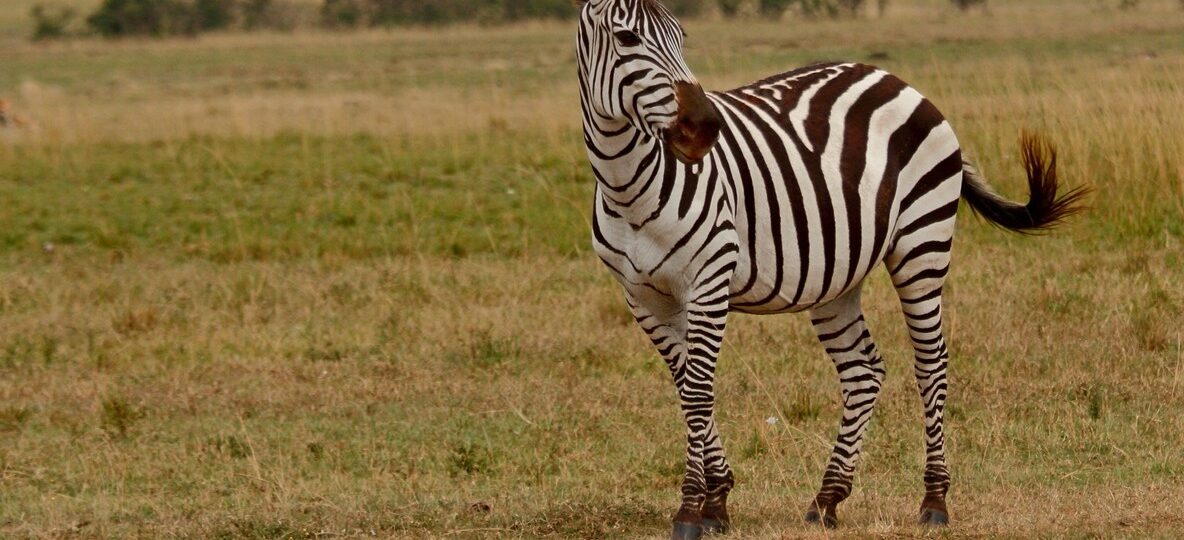
Grevy’s zebra are most concentrated in Buffalo Springs National Reserve (131 km², adjacent to Samburu to the south of the Ewaso Ng’iro). Kenya holds over 80 percent of the global Grevy’s zebra population, estimated at under 3,000 individuals. Samburu and Buffalo Springs together host one of the largest concentrations on earth. In July, the plains around the Buffalo Springs themselves, natural springs inside the reserve, reliably hold herds of 20 to 60 animals. 🌍
Beisa oryx are heat-adapted and do not need to drink daily. They range more widely across the reserve than other grazers in July. The open lugga systems between Samburu and Shaba National Reserve (239 km², connected to the east) are the most reliable habitat.
Somali ostrich are at their most recognisable in July. Breeding males carry their distinctive blue-grey neck and thigh skin, which contrasts immediately with the pink-red of the common ostrich. The flat sandy sections of Shaba hold the highest concentrations in the wider Samburu ecosystem.
Samburu in July: Weather and Conditions on the Ground
July is one of the cooler months in Samburu, which is relative. Daytime temperatures reach 25 to 31 degrees Celsius. Morning game drives begin around 6 AM when temperatures sit at 18 to 20 degrees. Bring a light fleece for the first hour. By 9 AM the temperature climbs quickly and the light becomes harsher.
Rainfall in July averages near zero. Dust is the main environmental variable. On open flats with multiple vehicles, dust can reduce visibility during the mid-morning period. Experienced drivers plan routes to stay upwind of other vehicles during busy sighting periods.
Humidity is very low in July, making the heat feel drier and more manageable than coastal or equatorial safari destinations. Sunscreen, good sunglasses, and a hat are essential for open-vehicle game drives. All Trunktrails Safaris vehicles carry a shade-rated roof and drinking water on every drive.
Where to Stay: Camps and Lodges for July
July is peak season across all three reserves in the Samburu ecosystem. Book three to four months in advance. Rates below are indicative for July 2026 and typically include full board plus two game drives per day.
| Camp / Lodge | Style | July Rate (approx.) | Location | Best For |
|---|---|---|---|---|
| Elephant Bedroom Camp | Premium tented camp | $650-900 pp/night | Samburu NR, Ewaso riverbank | Photography, intimate sightings |
| Larsens Camp | Classic tented camp | $450-700 pp/night | Samburu NR, river corridor | Classic atmosphere, repeat visitors |
| Samburu Game Lodge | Full-service lodge | $250-450 pp/night | Samburu NR, riverside | First-time visitors, comfort |
| Joy’s Camp | Boutique tented | $500-750 pp/night | Shaba NR | Birding, exclusivity, spa |
| Sarova Shaba Game Lodge | Luxury resort | $300-500 pp/night | Shaba NR, spring-fed pool | Families, larger groups |
| Sasaab Lodge | Ultra-luxury | $900-1,400 pp/night | Westgate Samburu Conservancy | Private game drives, infinity pool |
All camps within Samburu National Reserve boundaries charge Kenya Wildlife Service park fees: $70 per adult per day (non-residents), $35 per child under 18 years, plus a vehicle fee of $50 per day. Buffalo Springs and Shaba carry the same fee structure and are charged separately if your itinerary crosses reserve boundaries.
Getting to Samburu: Drive vs. Fly
| Route | Distance / Time | Key Details |
|---|---|---|
| Drive from Nairobi via A2 highway | ~340 km, 6-7 hours | Sealed road to Isiolo; gravel and dirt from Isiolo to Archers Post Gate |
| Fly from Nairobi Wilson Airport | ~1.5 hours | AirKenya and Safarilink daily scheduled flights; $200-280 pp one-way |
| Connect from Laikipia / Nanyuki | ~110 km, 2-3 hours | Ideal for combining Samburu with Ol Pejeta or Lewa on a circuit |
Flying is the right call for clients with five days or fewer in Kenya. The scheduled flight from Wilson Airport takes 90 minutes and delivers a first view of northern Kenya’s landscape from the air that sets the tone immediately. Road transfers via the A2 through Nanyuki and Isiolo are scenic but add a full day each way.
Trunktrails Safaris coordinates all scheduled flight bookings, ground transfers, and camp reservations as part of our tours and safaris packages. We do not mark up scheduled flight prices.
The Trunktrails Advantage
Trunktrails Safaris has been running tours and safaris in the Samburu ecosystem for years. Our guides know which specific luggas the gerenuk use at first light, which sandbanks the crocodiles hold through July, and which sections of the Ewaso Ng’iro produce reliable predator sightings after the morning heat builds.
Our July Samburu packages combine Samburu National Reserve, Buffalo Springs, and Shaba into a single rotating circuit. This three-reserve approach is the most reliable structure for seeing all five Samburu Special Five species within two to three days. Single-reserve itineraries, which are common with budget operators, miss the Grevy’s zebra concentrations in Buffalo Springs and the Somali ostrich habitat in Shaba’s open flats.
We work with camps across all three reserves and position clients at the right property for their travel style. From the photography intimacy of Elephant Bedroom Camp to the conservation focus of Sasaab in Westgate Conservancy, we match the camp to the client rather than the commission rate. All our guides hold Kenya Wildlife Service accreditation. All vehicles are maintained four-wheel-drive units built for Samburu’s sandy lugga terrain. ✨
Plan Your Samburu July Safari Now
July in Samburu does not reward late booking. Peak season camps along the Ewaso Ng’iro fill three to six months ahead, and the tented camps with the best river positions go first.
Contact Trunktrails Safaris today to check July availability and hold your dates before the window closes:
Further reading
More safari planning resources
- Map of Samburu from Valley Safaris
- Samburu National Reserve guide on Touring Insights
- Samburu destination guide on FindMySafari
- Best time to visit Kenya month-by-month map from Valley Safaris
- WhatsApp: +254 113 208888
- Email: info@trunktrailssafaris.com
- Website: https://trunktrailssafaris.com
Our team builds a full Samburu July itinerary within 24 hours of your enquiry. Tell us your travel dates, your group size, and how much of the northern circuit you want to cover. The Special Five are at the river in July. Your vehicle should be there too.