Nairobi National Park Safari: Your Complete Guide to the World’s Most Unique Wildlife Reserve
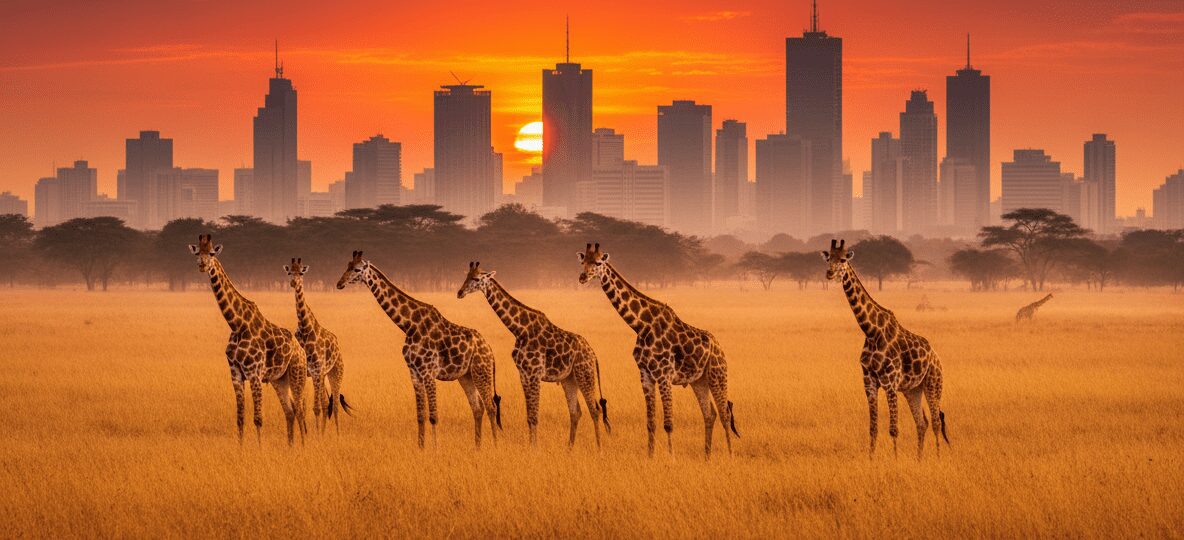
Imagine watching a lion stalk through golden savannah grass with a city skyline on the horizon. Office towers, cranes, and the faint hum of an urban capital – and twenty metres away, a pride of lions going about their morning. That image is not a composite. It is an ordinary Tuesday in Nairobi National Park, and it is unlike anything else on the African continent.
Nairobi National Park sits just 7 kilometres from the city centre, making it the only national park on earth that shares a fence line with a capital city. You can leave your Nairobi hotel after breakfast, be watching black rhino graze within the hour, and be back in time for a lunch meeting. No flights. No long overland drives. No two-day logistics. Just genuine, wild Africa – on your doorstep.
A nairobi national park safari is often the first wildlife experience travellers have in Kenya. It is also, for many, the one they remember longest. At Trunktrails Safaris, our Nairobi National Park tours and safaris are designed to give you exactly what this park demands: expert guidance, deep ecological knowledge, and the time to actually absorb what you are seeing.
This is your complete guide – from the wildlife to the seasons, from the walking safari experience to the conservation story that makes this park so important.
What Makes Nairobi National Park Unlike Any Other Safari Destination
Nairobi National Park covers 117 square kilometres of open grassland, acacia woodland, riverine forest, and rocky gorges. It was established in 1946, making it Kenya’s first national park. That history alone is remarkable. But what sets it apart from every other park in Africa is the juxtaposition – the visual, ecological, and almost philosophical tension of wild and urban sharing the same skyline.
The park is unfenced on its southern boundary. That open edge connects to the Athi-Kapiti plains, a vast stretch of semi-arid grassland that extends south towards Amboseli. For decades, this corridor was the park’s ecological lifeline. Wildebeest, zebra, kongoni, and eland migrated freely between the Athi plains and the park according to season, following rainfall and fresh pasture. The park functioned not as an isolated island of wildlife but as the northern anchor of a much larger ecosystem.
That corridor – known as the Kitengela migration corridor – is now under severe pressure from residential development, fencing, and road construction. The Kenya Wildlife Service and community conservation groups have spent years working to keep it open. What you are visiting when you enter Nairobi National Park is not just a wildlife reserve. It is a contested ecological space, a living argument for urban coexistence with nature, and a conservation battle being fought in real time.
That context makes every game drive here more meaningful. The lions you see are not convenient. They have survived in proximity to four million people. That is extraordinary.
Wildlife in Nairobi National Park – What Animals Will You See?
The diversity of wildlife packed into 117 square kilometres is genuinely surprising. First-time visitors frequently underestimate the park before they arrive, and are converted the moment they enter the gate.
The Big Five in Nairobi National Park
Nairobi National Park is home to four of the Big Five. Lion, leopard, buffalo, and rhino are all resident. Elephant is the only Big Five member absent – there is no established resident elephant population, though individuals occasionally wander in through the southern corridor.
Black rhino is the standout species. The park holds one of Kenya’s most important black rhino sanctuaries, with a population that has been carefully managed and protected since the 1980s. Nairobi National Park was instrumental in pulling Kenya’s black rhino back from the brink when poaching devastated populations continent-wide. Seeing a black rhino here is not a chance encounter – it is the product of forty years of concentrated conservation effort.
Predators – Lions, Leopards and Cheetahs
The lions of Nairobi National Park are well studied and closely monitored. The park’s population fluctuates between 30 and 50 individuals depending on season and corridor movement. These are not habituated tourist lions in the way of some high-traffic parks. They are genuinely wild animals living in a complex landscape. Their presence within earshot of a major international airport is one of the most startling ecological facts in East Africa.
Leopard sightings are less predictable but very real. The riverine forest sections along the Athi and Mbagathi rivers provide ideal leopard habitat – dense cover, elevated game trails, and reliable prey. Cheetah are present and, because the grassland here is open, often more visible than in parks with heavier bush.
Rare and Endangered Species
Beyond the big names, Nairobi National Park carries significant biodiversity value. The park is home to over 400 bird species – one of the highest counts for any park its size in Africa. Ostriches are common in the open grassland. Masai giraffe, plains zebra, wildebeest, eland, kongoni (Coke’s hartebeest), impala, Grant’s gazelle, warthog, baboon, and vervet monkey are all regularly encountered.
The black and white colobus monkey inhabits the forest sections near Ivory Burning Site and the Mokoyeti Gorge. Hippo are present in pools along the Athi River. During the wet season, the southern plains fill with migrating herbivores from the Athi-Kapiti corridor – wildebeest herds of several hundred animals are not unusual.
Best Time to Visit Nairobi National Park
Unlike parks further into the interior, Nairobi National Park is accessible and rewarding year-round. Its compact size means that even in the green season, game viewing in open grassland is productive. That said, the seasons do shape the experience.
Dry Season (June-October): Prime Game Viewing
The long dry season is the most reliable period for concentrating wildlife. Watercourses shrink, vegetation thins, and animals gather around permanent water sources – particularly along the Athi and Mbagathi rivers. Predator activity increases as prey animals cluster around predictable water points. Lion sightings are most frequent in this window.
The southern plains draw migrating herbivores back into the park as the Athi-Kapiti grasslands dry out. This is when you are most likely to see large herds of wildebeest and zebra on the open ground – a genuinely spectacular sight against the city backdrop.
July to October also coincides with the peak of the Great Migration in the Masai Mara, so international visitor numbers are high across Kenya. Book your Nairobi National Park safari with Trunktrails Safaris well in advance during this window.
Green Season (November-May): A Different Kind of Beauty
The short rains (November-December) and long rains (March-May) transform the park into a lush, green landscape that most safari photographs do not show. Grass is tall, the savannah is vivid, and the light during the overcast green season hours is extraordinary for photography.
This is calving season for many species. Young wildebeest, zebra foals, kongoni calves, and impala fawns are present in numbers that attract predators and create dynamic wildlife interactions. Bird life peaks during the migration months (November and April-May), with European and northern-African migrant species adding to the resident count. If birding is part of your interest, the green season is genuinely exceptional.
What to Expect on a Nairobi National Park Safari
Game Drive Experience
The standard Nairobi National Park safari is a game drive in a 4×4 vehicle, typically running three to four hours. Morning departures (06:00-07:00) are strongly recommended. This is when predators are most active, light is at its best, and the park is coolest. Most of the park’s main circuit is accessible on a single morning drive if you know where to go.
Trunktrails Safaris tours and safaris use open-sided, pop-top 4×4 vehicles for full visibility. Our guides carry detailed knowledge of lion territory ranges, seasonal rhino movements, and which sections of the park hold the best concentration of game on any given day. That local intelligence is not something a self-drive map provides.
The park has a clearly signed internal road network and is one of the few Kenyan parks where self-drive is permitted. But self-drive and guided safari are not comparable experiences here. The park’s small size rewards depth, not distance – knowing where to stop, where to wait, and what tracks on a dusty road mean is the difference between a wildlife encounter and a wildlife sighting.
Walking Safari in Nairobi National Park
Trunktrails Safaris offers guided walking safari experiences within designated areas adjacent to Nairobi National Park, including sections of the Kitengela corridor and community conservancy land on the park’s southern edge. Walking safari here is not something most Nairobi-based operators offer, and it fundamentally changes the experience.
On foot, you read the landscape differently. You notice the direction a giraffe is looking and understand what that means. You crouch beside a fresh lion track and feel the scale of it. You hear the alarm call of an impala before you see what triggered it. The city recedes entirely. The sounds of Nairobi disappear. What remains is pure bush – and it is right here, next to one of Africa’s great capitals.
Our walking safari guides hold Kenya Professional Safari Guides Association (KPSGA) certification and are supported by Kenya Wildlife Service rangers on all walks. Safety is embedded in how we operate, not bolted on as an afterthought.
The Nairobi Safari Walk and Animal Orphanage
Adjacent to the main park gate, the KWS-managed Nairobi Safari Walk is a raised boardwalk experience through three distinct habitat zones – wetland, savannah, and forest – containing rescued and rehabilitated animals. It is a separate facility from the main park, operated by Kenya Wildlife Service, and is particularly valuable for visitors who want guaranteed close encounters with species that can be elusive on a game drive – serval, caracal, tortoise, colobus monkey, and porcupine among them.
The Animal Orphanage, also managed by KWS, houses animals rescued from snares, roadkill, or poaching incidents that cannot be returned to the wild. It is a conservation facility, not a zoo, and the distinction matters. For visitors travelling with children or those with limited mobility who want to complement a game drive, the Safari Walk is well worth the additional hour.
How to Get to Nairobi National Park
The park’s main gate – Langata Gate – is located approximately 7 kilometres from Nairobi city centre and 10 kilometres from Jomo Kenyatta International Airport. In standard traffic conditions, transfer time from most Nairobi hotels is 20 to 30 minutes. From the airport, it can be as little as 15 minutes in light traffic.
Trunktrails Safaris provides hotel pickup for all Nairobi National Park tours and safaris. We collect from Westlands, Upper Hill, Kilimani, Karen, Langata, and all major airport hotels. If you are on a layover or have a tight schedule, we will time the pickup to your exact window and guarantee return transfers.
A secondary entry point, East Gate, provides access from the Mombasa Road side and is often faster for guests coming from the airport or hotels near Industrial Area and South B.
Practical Information – Entry Fees, Rules and Tips
Entry fees (Kenya Wildlife Service – confirm current rates at kws.go.ke before travel):
- Non-resident adults: US $43 per person per day
- Non-resident children (3-18 years): US $22 per person per day
- East African Community residents: KES 215 per adult
Fees are payable via the KWS Mfumo digital payment system. Cash is not accepted at the gate. Trunktrails Safaris handles all park fee payments for clients on our tours and safaris – there is nothing to pre-arrange.
Rules and guidelines:
- Stay inside the vehicle unless in a designated picnic or walk area
- No off-road driving
- Minimum distance from predators: 20 metres
- No litter – zero tolerance is enforced
- Photography is unrestricted within the park; drone use requires a separate KWS permit
- Opening hours: 06:00-18:00 daily
Practical tips:
- Bring layers. Morning game drives at altitude (Nairobi sits at 1,660 metres above sea level) are cool, even in the dry season
- Binoculars are essential – the open grassland rewards spotting from a distance
- The park café at the main gate is a pleasant stop for coffee before an early departure
- Black rhino are most reliably found in the western sections near the Impala Observation Hill and the Rongai Forest block – your guide will know current movement patterns
Why Choose Trunktrails Safaris for Your Nairobi National Park Tour
There is no shortage of operators running day trips into Nairobi National Park. What separates Trunktrails Safaris from the field is not the vehicle or the route – it is the knowledge behind the experience.
Our guides have spent years tracking wildlife in this park. They know the pride dynamics of the resident lion population, the seasonal movement patterns of the black rhino, and where the leopard in the Mbagathi sector tends to lie up on a warm afternoon. That depth of knowledge cannot be replicated by a driver following a map.
Trunktrails Safaris tours and safaris are also built around the conservation story. We do not just point out animals. We explain the Kitengela corridor, why it matters, and what is being done to protect it. We talk about the black rhino sanctuary programme – what it took to bring this population back, and what still threatens it. By the time you leave the park, you understand what you have seen, not just that you have seen it.
Our operations meet Kenya’s official safety, conduct, and professional standards. For all wildlife tours and safaris out of Nairobi, those credentials are non-negotiable.
Whether you have half a day on a layover, a full day before you head to Masai Mara, or you are building Nairobi National Park into a broader Kenya wildlife tour, we will design the experience around your schedule and your interests.
Ready to book your Nairobi National Park safari? Contact Micah directly: Email: info@trunktrailssafaris.com
- Website: https://trunktrailssafaris.com
We reply within the hour during business hours.
Frequently Asked Questions
Q: Can you see the Big Five at Nairobi National Park? A: You can see four of the Big Five – lion, leopard, buffalo, and black rhino. Elephant is the only absent Big Five member, as there is no established resident elephant population in the park. However, Nairobi National Park is Kenya’s most important black rhino sanctuary, and rhino sightings are among the most reliable in the country. For the full Big Five, combine your Nairobi visit with a trip to Amboseli, Tsavo, or the Masai Mara. Trunktrails Safaris tours and safaris can link your Nairobi National Park experience directly to an onward multi-park itinerary – contact us on WhatsApp to plan your route.
Q: How long does a Nairobi National Park safari take? A: A standard game drive is three to four hours. A full-day experience, including the Nairobi Safari Walk and a picnic lunch inside the park, runs six to seven hours. For layover visitors, Trunktrails Safaris offers a tailored two-to-three-hour express safari timed to your flight schedule. Morning departures (06:00-07:00) deliver the best wildlife activity.
Q: Is Nairobi National Park safe? A: Yes. The park is well managed by Kenya Wildlife Service, with ranger patrols operating daily. All Trunktrails Safaris vehicles carry a trained guide, and our walking safari experiences are accompanied by KWS rangers. The park has a strong safety record and is one of the most visitor-ready parks in Kenya. Standard wildlife precautions apply – stay in the vehicle on game drives and follow your guide’s instructions at all times.
Q: What is the best time of year to visit Nairobi National Park? A: The park delivers good wildlife viewing year-round. The dry season (June-October) is best for predator sightings and large herbivore herds as animals concentrate around water. The green season (November-May) is exceptional for birdwatching, calving season viewing, and lush photography. Unlike more remote parks, Nairobi National Park’s open terrain means game is visible even when vegetation is high.
Q: Can you do a self-drive in Nairobi National Park? A: Self-drive is permitted. The internal road network is signposted and manageable in a standard 4×4. However, a guided safari with Trunktrails Safaris delivers a fundamentally different experience – our guides provide real-time tracking knowledge, species identification, ecological context, and safety expertise that a map cannot replicate. For first-time visitors especially, guided is strongly recommended.
Trunktrails Safaris is based in Nairobi, Kenya. We specialise in Kenya wildlife tours and safaris, walking safaris, and conservation-led experiences across East Africa’s greatest parks.
Contact: WhatsApp https://trunktrailssafaris.com
Further reading
More safari planning resources
- Kenya national parks map from Valley Safaris
- Big Five safari parks guide on Touring Insights
- Big Five safari collection on FindMySafari
- Best time to visit Kenya month-by-month map from Valley Safaris
Contact Trunktrails Safaris
WhatsApp: +254 113 208888 Email: info@trunktrailssafaris.com Website: https://trunktrailssafaris.com