
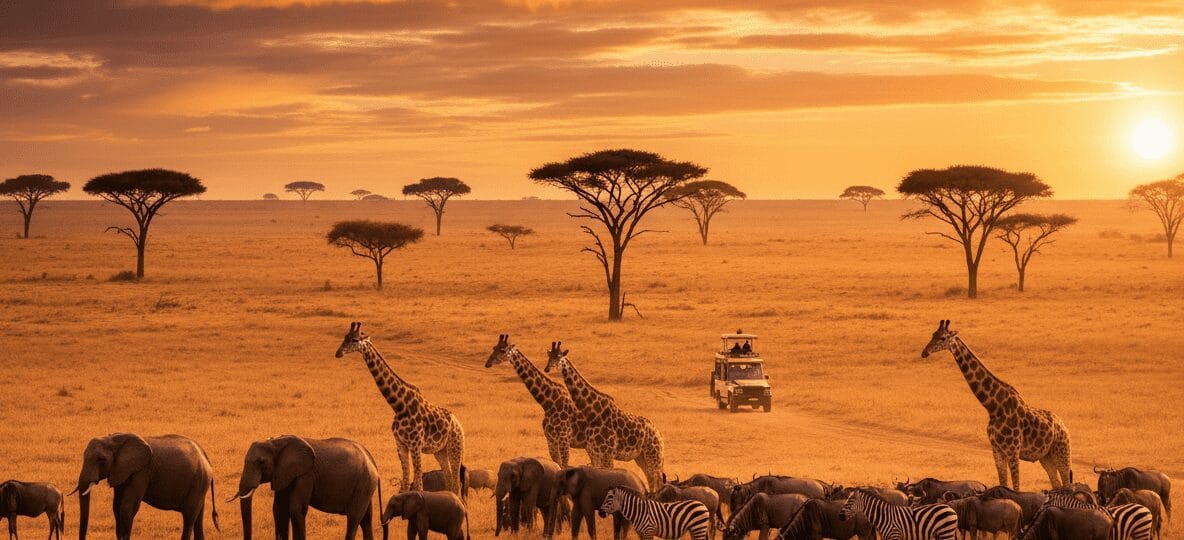
Wildlife Tours in Kenya: The Complete Guide to Kenya’s Best Animal Experiences
Kenya is not simply one of Africa’s great safari destinations. It is the benchmark against which every other wildlife destination on the continent is measured. When travellers search for the best wildlife tours in Africa, Kenya consistently leads the results – and for good reason. Nowhere else on Earth offers the same density of iconic species, the same diversity of ecosystems, and the same depth of conservation infrastructure all within a single country.
This guide is your complete kenya safari wildlife guide. It covers the nine headline animals every visitor should see, the parks where each species thrives, the seasons that unlock the best sightings, and the walking wildlife tours that take you beyond the vehicle and into the landscape itself. If you are serious about planning a wildlife tour in Kenya, this is where you start.
Wildlife Tours in Kenya: Why This Country Leads the World
Kenya’s wildlife advantage is structural, not accidental. The country protects more than eight per cent of its land area within national parks and reserves – and a further significant portion through private conservancies and community lands. The result is a connected web of habitats that supports extraordinary animal density year-round.
The Masai Mara alone hosts one of the highest concentrations of large predators on Earth. Amboseli delivers elephant herds against the backdrop of Mount Kilimanjaro. Samburu shelters endemic northern species that exist nowhere else in the country. Tsavo – East and West combined – forms the largest protected area in Kenya, where the famous red elephants roam ancient migration corridors.
Kenya animal tours also benefit from exceptional road infrastructure, a mature guide community trained through Kenya Wildlife Service accreditation, and a lodge and camp network that ranges from community-owned bandas to ultra-luxury tented camps. Whether you are planning a first wildlife safari in Kenya or returning to deepen your knowledge, the country rewards every level of engagement.
Kenya’s Big Nine: The Animals Every Safari Should Deliver
Most operators talk about the Big Five. Trunktrails Safaris talks about Kenya’s Big Nine – the complete roster of animals that define the genuine Kenya wildlife experience. Understanding each species ecologically, not just visually, transforms a game drive into a real encounter.
Lion
Kenya’s lions are predominantly pride animals. The Masai Mara holds some of Africa’s most studied prides, their territories mapped across decades of research. Dawn and dusk drives consistently outperform midday for active sightings. Lions are crepuscular hunters – they rest for up to 20 hours a day, which means timing and knowledge of pride territories is everything.
Leopard
Leopards are the most elusive of the Big Five, and Kenya’s riparian forests – the riverine belts along the Mara River and Ewaso Nyiro – are where your best chances lie. Patient, quiet game drives with an experienced guide who knows individual leopards by their rosette patterns produce encounters that vehicle-heavy operators simply cannot replicate.
Elephant
Kenya is home to some of Africa’s largest elephant populations, protected under the Kenya Wildlife Service. Amboseli’s families are among the most studied in the world, with individual animals known by name and life history to researchers at the Amboseli Elephant Research Project. In Tsavo, laterite-red soil stains the hides of bulls that roll in clay pans – a sight that has no equivalent elsewhere in East Africa.
Rhino
Both black and white rhino survive in Kenya, though numbers remain critically low following decades of poaching. Ol Pejeta Conservancy in Laikipia is the best single destination for rhino encounters in Kenya, hosting the world’s last two northern white rhinos alongside a substantial population of black rhino. A visit to Ol Pejeta is not just a big five kenya safari moment – it is a conservation reckoning.
Buffalo
Buffalo are the most dangerous animal in Africa by recorded kill statistics, yet they are frequently underestimated on game drives. Watch for the dominant bulls that separate from the main herd – solitary dagga boys with mud-caked horns and a temperament to match. In the Mara, buffalo herds can number in the thousands during the dry season when animals consolidate around permanent water.
Giraffe
The reticulated giraffe of Samburu and the Masai giraffe of the Mara and Amboseli are two distinct subspecies, both present in Kenya. Giraffes are keystone browsers – their feeding shapes the canopy structure of acacia woodlands and directly influences what other species can access. Watch them at water sources for a rare ground-level view of an animal whose anatomy makes drinking a vulnerable, studied act. Sunrise is the best time to watch them work: giraffes browse most actively in the cool early hours, and the low light silhouettes their long necks against the acacia canopy in a way midday’s flat sun never quite matches. It’s also when they’re most likely to be moving between feeding sites, giving you a longer window of activity than a static midday sighting.
Zebra
Kenya hosts both plains zebra and the endangered Grevy’s zebra, the world’s largest wild equid, found in Samburu and the northern rangelands. During the Great Migration, over 200,000 zebra move alongside the wildebeest columns – their digestive systems processing the coarse, long grass that wildebeest cannot yet eat, effectively preparing the pasture for the larger herds that follow.
Cheetah
The Masai Mara and the Amboseli-Tsavo ecosystem are Kenya’s cheetah strongholds. Cheetahs are diurnal hunters, which means mid-morning game drives – not just dawn and dusk – are productive for cheetah sightings. They favour open plains with sight-line advantage. A cheetah hunt is the fastest land predation event on Earth and one of the most sought-after sightings in all of big nine kenya wildlife viewing.
Hippo
Kenya’s rivers and lakes support some of Africa’s largest hippo pods. The Mara River, Mzima Springs in Tsavo West, and the channels of Lake Naivasha all offer excellent hippo viewing. Hippos kill more people annually than lions or leopards – they are territorial, fast on land, and unpredictable near water. Understanding this ecology makes boat-based or walking proximity encounters both safer and more meaningful.
Beyond the Big Nine: African Wild Dogs
One more species is worth watching for, even though it doesn’t make the Big Nine list: the African wild dog, one of the continent’s most endangered carnivores. Kenya’s population is small and concentrated in Laikipia’s conservancies, Ol Pejeta and Lewa among them, and increasingly in the Mara’s private conservancies, where packs have been recolonising in recent years. Their mottled black, tan, and white coats make every individual identifiable, and their cooperative hunting style gives them one of the highest success rates of any African predator, well ahead of lions. A wild dog sighting is rare enough that most guides will radio every vehicle in range the moment a pack is spotted.
The Best Parks for Wildlife Tours in Kenya
Masai Mara National Reserve
The Masai Mara is Kenya’s flagship wildlife destination and the epicentre of the annual Great Migration. July through October delivers wildebeest river crossings. The rest of the year, the Mara sustains resident lion prides, large elephant families, and the full suite of predator and prey species that make kenya wildlife experiences here unmatched globally.
Amboseli National Park
Amboseli offers the most photographically iconic landscape in Kenya – elephant herds in the foreground, Mount Kilimanjaro filling the sky behind. The park is relatively compact, which means high animal encounter rates. It is the best single park for elephant depth, lion sightings, and a reliable big five kenya safari checklist.
Tsavo East and Tsavo West
Together, Tsavo forms Kenya’s largest national park. Tsavo East is open savannah with the red-dusted elephants and the permanent Galana River. Tsavo West adds the volcanic Shetani lava flow, the crystal-fed Mzima Springs hippo pools, and dense bush that rewards patient, knowledgeable guides. For our complete Tsavo coverage, see the 3-day Diani Beach to Tsavo safari guide.
Samburu National Reserve
Samburu is Kenya’s northern wildlife secret. It is the only place to reliably see the Samburu Special Five: reticulated giraffe, Grevy’s zebra, Somali ostrich, Beisa oryx, and gerenuk. The gerenuk – a long-necked antelope that stands on its hind legs to browse – exists nowhere else in Kenya’s accessible park network.
Lake Nakuru National Park
Lake Nakuru is East Africa’s premier bird spectacle when flamingo populations are high, and a productive rhino sanctuary at all times. Both black and white rhino are present, and the park’s compact size means rhino sightings are among the most reliable in the country. Flamingo numbers here rise and fall with the lake’s water level and alkalinity, so when Nakuru is quiet, Lake Bogoria and Lake Elementaita, both a short drive further into the Rift Valley, usually hold the bigger flocks. Across all three lakes, the dry months from June through October and January through February bring the algae blooms that draw flamingos in the greatest numbers, turning the shoreline pink for kilometres.
The Big Nine covers the mammals, but Kenya’s bird list runs past 1,000 species, one of the richest counts on the continent. The Rift Valley lakes deliver more than flamingos: expect pelicans, African fish eagles patrolling the shoreline, and yellow-billed storks working the shallows. In the Mara and Amboseli, watch for the secretary bird striding through the grass on hunting patrol and the lilac-breasted roller, whose turquoise-and-violet plumage makes it one of the most photographed birds on the continent. Kakamega Forest in western Kenya, outside the standard safari circuit, holds species found nowhere else in the country for travellers building a dedicated birding itinerary.
Ol Pejeta Conservancy
Ol Pejeta is where conservation safari kenya becomes most tangible. The conservancy is home to the world’s last northern white rhinos, a substantial chimpanzee sanctuary, and one of the most progressive community-benefit models in East Africa. A kenya wildlife tour that includes Ol Pejeta is not just a wildlife holiday – it is an active contribution to species survival.
How Your Camp Shapes the Sighting
Where you sleep is not incidental to what you see. Camps inside private conservancies, bordering the Mara, Amboseli, and Laikipia’s core reserves, hold exclusive traversing rights on their own land. That means off-road driving to follow a hunt, night drives for nocturnal species like genet and aardvark, and walking access that the main public reserves simply don’t permit. Fewer vehicles per sighting is the other half of the advantage: a conservancy camp caps guest numbers, so you’re rarely sharing a leopard with a dozen other vehicles.
Camps inside the public reserves themselves, the main Masai Mara, Amboseli, and Tsavo blocks, trade some of that exclusivity for proximity to the highest animal density and, usually, a lower nightly rate. Mobile tented camps split the difference again: several operators relocate seasonally to track the Great Migration itself, putting you inside the migration corridor at its peak rather than driving to meet it. None of these formats is objectively better. The right one depends on whether your priority is density, exclusivity, or budget, and a good operator will match the camp type to what you actually came to see.
Seasonal Wildlife Guide: What to See and When
July to October (Dry Season – Peak Wildlife): The Great Migration wildebeest crossings in the Masai Mara reach their height. Vegetation is low, water sources are concentrated, and predator activity is at its annual peak across all parks. This is the best period for world safaris kenya-level spectacle.
January to February (Short Dry Season): Excellent wildlife viewing across Amboseli, Tsavo, and Samburu. Calving season in the Mara ecosystem produces predator activity as big cats and wild dogs exploit the vulnerable young. Lower visitor numbers than the main season.
March to May (Long Rains): Parks are quieter and more affordable. Tsavo’s landscapes are dramatically green. Bird diversity peaks as migratory species are present. Wildlife sightings require more patience but offer greater solitude.
November to December (Short Rains): The transition into the short rains brings fresh vegetation and the beginning of migratory bird arrivals. Samburu and Laikipia remain productive for northern species. Shoulder season pricing applies.
Walking Wildlife Tours: The Deeper Kenya Experience
A vehicle is a tool for covering ground. A walking wildlife tour kenya experience is where genuine connection with the ecosystem begins. On foot, your senses recalibrate. You read tracks, identify scat, understand wind direction, and move within the landscape rather than across it. The scale of Africa shifts – what looks flat from a Land Cruiser reveals itself as layered, breathing terrain.
Trunktrails Safaris specialises in walking wildlife tours across Kenya’s ecosystems. Our walks are led by Kenya Wildlife Service-certified walking guides with intimate knowledge of the specific reserves we operate in. Every walk is risk-assessed, fully briefed, and structured to deliver ecological depth that no game drive can match. We cover animal behaviour, plant-animal relationships, tracking methodology, and the broader conservation story of each landscape.
Walking safaris also reveal the smaller details that vehicles roll past – the geometric precision of a dung beetle’s work, the warning call of a fork-tailed drongo alerting every species within earshot to a predator’s approach, the way a herd of impala orientates itself downwind before committing to a waterhole. These observations accumulate into a complete picture of the ecosystem that no amount of vehicle-based game driving can replicate. For guests who want the full Kenya wildlife experience – not just the checklist – a walking wildlife tour is the defining difference between a holiday and a genuine encounter.
Conservation-Led Wildlife Tours: Safari With Purpose
The kenya wildlife experiences that stay with guests longest are the ones that carry meaning beyond the sighting. Trunktrails Safaris builds conservation education into every tour we operate.
On a conservation safari kenya guests learn the real pressures on each species – not the sanitised version. They understand why elephant corridors matter, what ivory demand does to family structures, why rhino numbers are only recovering through armed conservancy protection, and how community land agreements determine whether wildlife survives or disappears on the boundaries of every national park.
We partner exclusively with camps and conservancies that run measurable community benefit programmes. A portion of every Trunktrails booking supports community conservancy operations directly. This is not a marketing footnote – it is the operational model. To learn more about Kenya’s official conservation framework, visit the Kenya Wildlife Service at https://www.kws.go.ke.
For a deeper introduction to Kenya’s full wildlife roster, read our guide to African safari animals and the Big Five.
How to Choose the Right Wildlife Tour in Kenya
Not all wildlife tours in kenya deliver the same experience. Here is how to evaluate any operator before you book.
Guide quality is everything. Ask whether guides are Kenya Wildlife Service-certified. Ask how many years they have worked the specific parks on your itinerary. A guide with 15 years in the Mara will find you a leopard. A generalist guide will show you the road.
Vehicle configuration matters. Pop-top 4x4s with a maximum of six passengers per vehicle preserve the quality of every sighting. Minibuses with ten passengers and a fixed roof produce a fundamentally different experience.
Walking safari availability. If an operator cannot offer a certified walking wildlife tour kenya option, they are limiting your access to Kenya’s most authentic wildlife experience.
Conservation credentials. Ask which conservancies your stays support and what percentage of your accommodation fee goes directly to community benefit. The answer reveals the operator’s real values.
Flexibility. The best wildlife sightings are rarely scheduled. An operator who can extend a game drive, change a route, or hold at a sighting has the operational freedom that produces extraordinary experiences.
Frequently Asked Questions
What is the best time for wildlife tours in Kenya? July to October is the peak season for big predator and migration activity. January to February is excellent for calving-season predator encounters with lower visitor numbers. Each season has distinct advantages – contact Trunktrails Safaris at to match your preferred dates to the best wildlife events.
What animals can I see on a Kenya wildlife tour? Kenya offers the full Big Nine: lion, leopard, elephant, rhino, buffalo, giraffe, zebra, cheetah, and hippo. Depending on which parks you visit, you may also encounter chimpanzee (Ol Pejeta), Grevy’s zebra and gerenuk (Samburu), wild dog, and more than 1,000 bird species across the country.
Are walking wildlife tours in Kenya safe? Yes, when conducted by Kenya Wildlife Service-certified walking guides with proper safety protocols. Trunktrails Safaris only operates walking safaris in parks and conservancies that permit and regulate them. Every walk is fully briefed and risk-assessed before departure.
What is the difference between the Big Five and the Big Nine? The Big Five (lion, leopard, elephant, rhino, buffalo) is a historical hunting term now used in safari marketing. The Big Nine adds giraffe, zebra, cheetah, and hippo – animals that are equally iconic, ecologically essential, and consistently deliverable on a Kenya wildlife tour. Trunktrails Safaris uses the Big Nine framework because it reflects what guests actually experience.
How do I book a wildlife tour in Kenya with Trunktrails Safaris? Contact Micah directly on WhatsApp or by email. Share your travel dates, group size, budget range, and priority wildlife experiences. We will design a tailored kenya wildlife tour itinerary within 48 hours. Reach us at.