
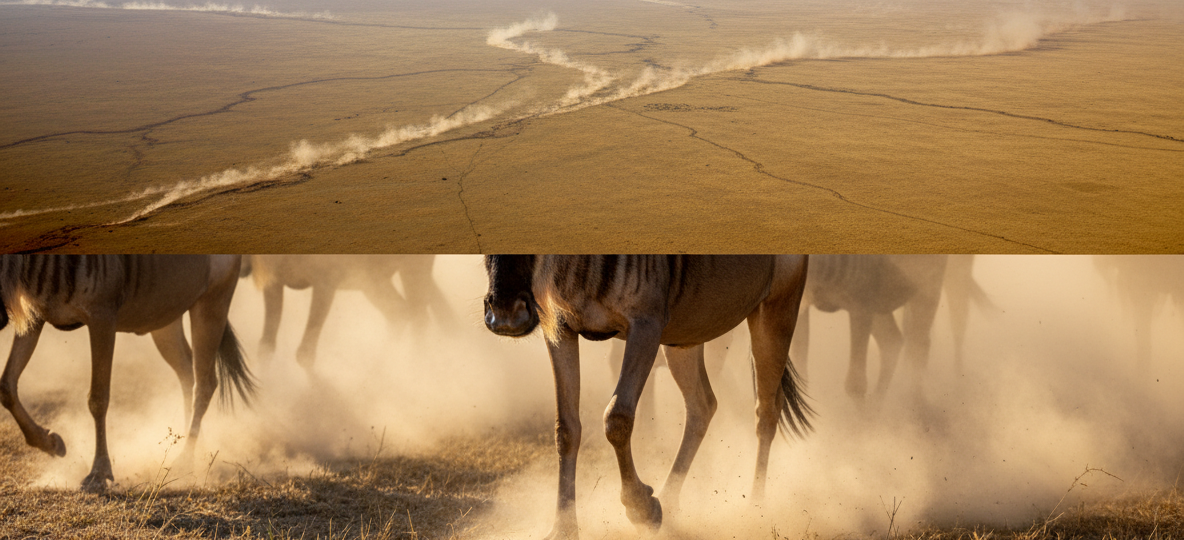
Wildebeest Migration Facts: 20 Things That Will Genuinely Stun You 🌍
Before you go, you think you know what the wildebeest migration is. You have seen the documentaries. You have watched the river crossing clips on social media. You know it is big.
Then you arrive in the Masai Mara and nothing you knew was big enough.
The wildebeest migration facts that follow are not the basics you have already read. These are the numbers, the behaviours, and the biological truths that the guides at Trunktrails Safaris share at the campfire — the things that shift how you see the animal in front of you, and the ecosystem beneath your feet.
The Numbers: How Big Is This Thing?
1. 1.5 Million Wildebeest — But That Is a Rough Estimate
The commonly cited number is 1.5 million wildebeest. But the actual count fluctuates significantly year to year. Aerial census surveys have returned figures ranging from 1.2 million to 1.7 million depending on the year, rainfall patterns, calf survival rates, and predation levels.
How many wildebeest are there in Africa? The vast majority of the world’s blue wildebeest population is in this single ecosystem — the Serengeti-Mara. The East African subspecies (Connochaetes taurinus mearnsi) found here accounts for roughly 90% of the global blue wildebeest population. Outside this ecosystem, wildebeest numbers drop dramatically.
2. 200,000 Zebra and 350,000 Gazelle Travel With Them
The wildebeest herds are not just wildebeest. The migration is a multi-species movement. Approximately 200,000 plains zebra and 350,000 Thomson’s and Grant’s gazelle travel the same circuit. They are not an afterthought — the three species are ecologically interdependent in ways that make the whole migration more efficient.
3. 1,800 Kilometres Per Year — Minimum
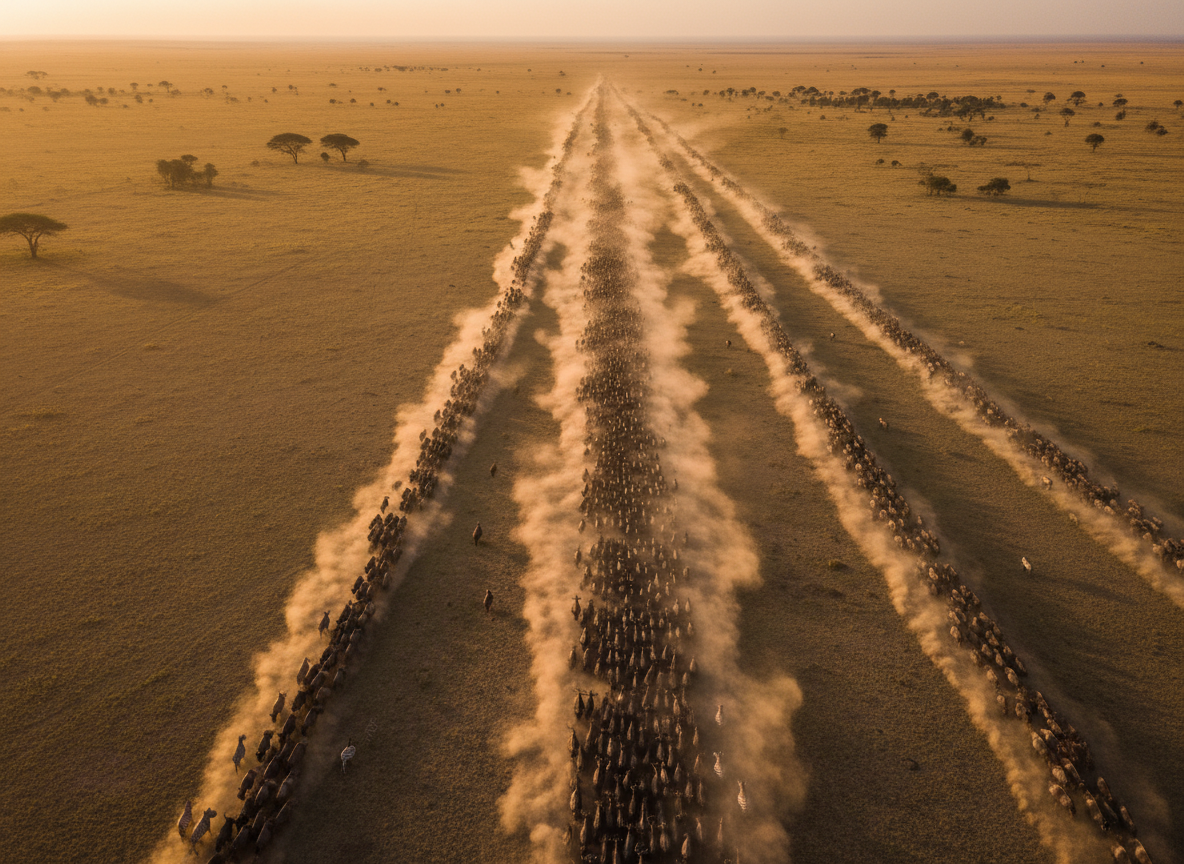
Each wildebeest covers approximately 1,800 kilometres during a full annual circuit. That is a conservative estimate for animals following the main route. Individual animals that move back and forth within sections of the route, or that are displaced by predator pressure, can cover considerably more. Over a lifespan of 20 years, a wildebeest that survives to old age may walk 36,000 kilometres — roughly the circumference of the Earth.
The Biology: Understanding the Animal
4. Blue Wildebeest Are Not What They Look Like
The blue wildebeest (Connochaetes taurinus) has one of the most deceptive appearances in the animal kingdom. Its dark grey-brown coat has a faint bluish sheen in certain light — which is where the name comes from. But it does not look graceful. Its head is too large, its hindquarters too low, its gait somewhere between a trot and an awkward gallop. And yet this animal can sustain speeds of 80 km/h in a burst sprint and outlast most predators in a long chase.
5. Wildebeest Mass and Build
An adult blue wildebeest weighs between 180 and 270 kg — males heavier than females. They stand approximately 1.4 metres at the shoulder. Despite their front-heavy, ungainly appearance, they are extraordinary swimmers. A wildebeest in the Mara River is not struggling — it is working. Animals that survive a Nile crocodile attack and make the far bank typically shake off the water and begin grazing within minutes.
6. Wildebeest Lifespan: 20 Years in the Wild
In protected environments, blue wildebeest can live up to 20 years. In the wild, few reach this age. The migration itself is the most dangerous period — river crossings, predators, drowning, injury, and exhaustion all take a toll. Most wildebeest that survive their first year have a realistic lifespan of 10–15 years in the wild.
7. Wildebeest Speed: Faster Than You Think
Wildebeest speed in a sprint can reach 80 km/h. Their sustained running pace — the speed they maintain when moving the herd — is 40–50 km/h. This is faster than a lion’s sustained pace, which is why lions typically take wildebeest through ambush rather than open pursuit. The preferred lion strategy is to isolate one animal from the herd and cut off its escape, not to outrun it.
The Movement: Why Do They Migrate?
8. They Follow Rainfall, Not Instinct
Why do wildebeest migrate? The simple answer — instinct — is incomplete. The movement is driven by a remarkably sophisticated tracking of rainfall and grass quality across a 30,000-square-kilometre ecosystem.
Wildebeest can detect rain from up to 50 kilometres away using a combination of atmospheric pressure changes, smell, and possibly low-frequency sound from distant thunderstorms. They move toward moisture before it is visible. This ability is what makes the migration self-correcting — if rain falls early in the south, the herds return early. If the north dries early, they leave early.
9. The Wildebeest Type of Migration Is Nomadic, Not Migratory
Technically, what wildebeest do is not seasonal migration in the bird sense. The wildebeest type of migration is classified as nomadic movement — opportunistic, driven by resource availability, without a fixed schedule. This is why no expert can give you a guaranteed date for a Mara River crossing. The herds move when conditions demand it. Their internal calendar is rainfall, not the Gregorian one.
10. The Clockwise Circuit Has Never Been Reversed
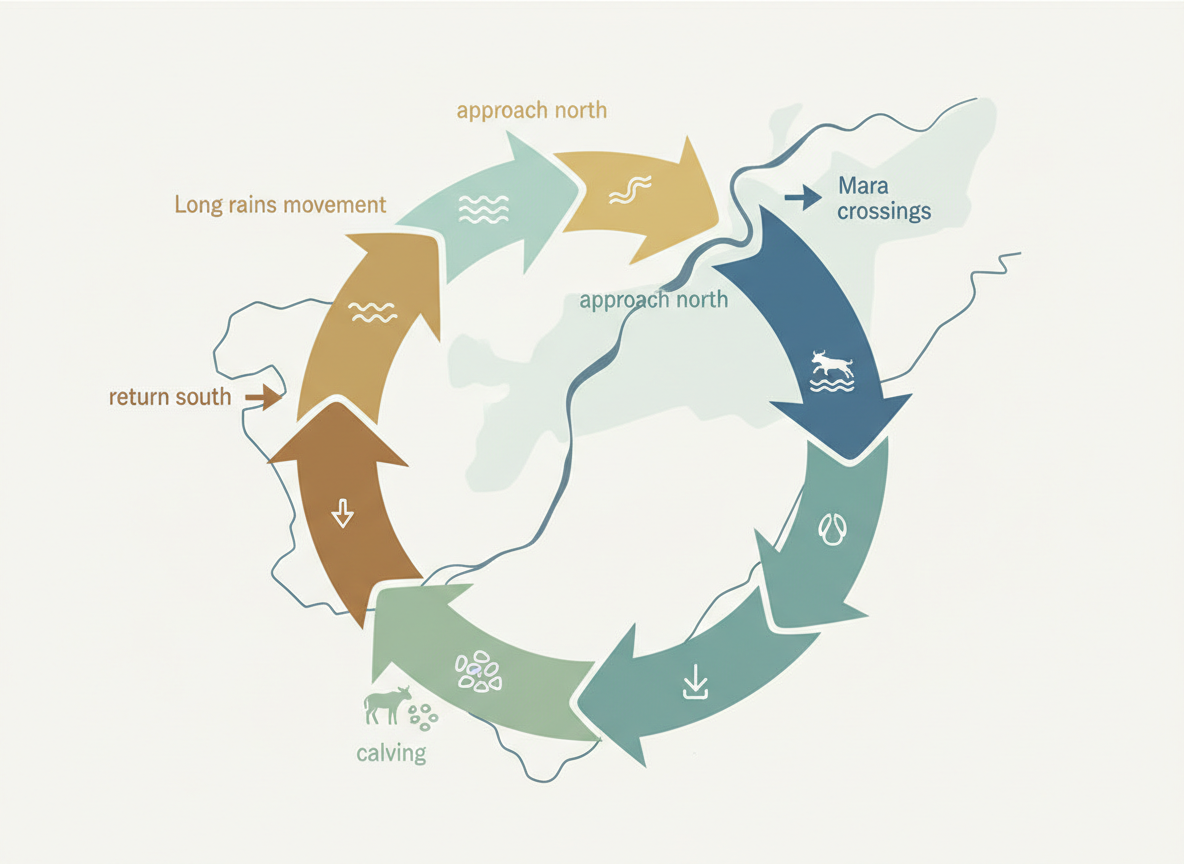
The wildebeest always travel the Serengeti-Mara circuit in a clockwise direction. Southern Serengeti, then north through the central Serengeti, then into Kenya, then back south. In all documented history of the migration, this direction has never been reversed. The prevailing theory is that the circuit evolved to track the movement of the seasonal rain belt — which follows the same clockwise pattern across East Africa.
The Drama: Crossings, Predators, Calving
11. 500,000 Calves Are Born in Six Weeks
The calving season in the southern Serengeti (January to March) produces approximately 500,000 wildebeest calves within a six-week window. This is the “predator swamping” strategy — by giving birth simultaneously, the wildebeest overwhelm the capacity of every predator in the ecosystem to take calves. Individual calves are extremely vulnerable. The species survives because there are too many of them to eat.
A wildebeest calf can stand within minutes of birth and run with the herd within hours. This is not a coincidence — it is an evolutionary requirement. Any calf that cannot keep up within hours does not survive.
12. Nile Crocodiles Wait Weeks in Advance
The Nile crocodiles in the Mara River do not simply react to the wildebeest arriving. They position themselves at crossing points days or weeks before the first herds appear, moving from their usual basking spots to concentrate near the known entry and exit banks. How they know the migration is coming is not fully understood — current theories point to vibration sensing through the water and memory of the seasonal pattern.
The largest Mara River crocodiles can exceed 5–6 metres in length and weigh over 1,000 kg. Their predatory success rate during crossings is estimated at 3–5% of animals attempting a crossing.
13. The Crossing Decision Is Made by One Animal
When wildebeest stack on a river bank before crossing, they can wait for minutes or hours. The tension is visible — they pace, approach the edge, turn back. When a crossing finally happens, it is triggered by a single animal reaching a tipping point and committing to the water. Every animal behind it follows within seconds. The individual who triggers a crossing is rarely the largest or oldest animal in the group — it appears to be a random threshold event rather than a leadership decision.
14. Facts About Wildebeest Migration: The Calving Ground Is the Whole Circuit’s Foundation
The southern Serengeti calving grounds are not just where calves are born — they are why the entire ecosystem exists in its current form. The volcanic soils of the Ndutu plains produce short-grass that is exceptionally high in phosphorus and calcium — exactly the minerals that lactating wildebeest need. The migration route evolved around this nutritional anchor point. Remove the calving grounds and the circuit loses its foundation.
The Scale: Seen from Space
15. The Wildebeest Migration Is Visible from Orbit
Wildebeest migration from space is not a metaphor. NASA satellite imagery of the Serengeti-Mara ecosystem during peak migration has captured the movement of the herds as visible changes in the landscape — the darkening of grassland areas, the visible tracks and dust plumes from concentrated animal movement. The migration is one of the few biological events on Earth detectable from low Earth orbit.
16. The Ecosystem Produces 1.4 Million Tonnes of Wildebeest Dung Per Year
The wildebeest herds are a nutrient delivery system on a continental scale. It is estimated that the combined wildebeest population deposits approximately 1.4 million tonnes of dung per year across the Serengeti-Mara ecosystem. This fertilises the soil, supports grass regeneration, and creates the conditions for the next cycle of the migration. The wildebeest do not just depend on the ecosystem — they build it.
The Conservation Context
17. The Migration Requires All 30,000 Square Kilometres to Function
The blue wildebeest migration only works because the entire Serengeti-Mara ecosystem remains connected. Remove any section — fence it, farm it, or develop it — and the circuit breaks. This has already happened in parts of East Africa. The Mara-Loita corridor, which historically connected the Mara to additional dry-season grazing areas, has been narrowed significantly by agricultural encroachment.
Every hectare of Maasai community conservancy land that remains open is a direct contribution to keeping the circuit intact.
18. The Migration Has Been Running for at Least 1.2 Million Years
Fossil and geological evidence suggests that wildebeest or wildebeest-like animals have been migrating across East Africa for at least 1.2 million years. The specific Serengeti-Mara circuit has existed in broadly its current form since the last major geological changes to the region — approximately 10,000–12,000 years ago. The animals moving past your safari vehicle have been making this circuit, in an unbroken line of ancestors, for longer than modern humans have existed.
Experience the Facts in Person
No screen version does justice to the scale of what you have just read. The facts are impressive. Standing in the middle of it is something different.
Trunktrails Safaris places Kenya safari tours and safaris in the conservancy areas where vehicle numbers are controlled, where guides know the crossing points by name, and where the migration experience is what it was before the crowds arrived. Our native Kenyan-owned team has been tracking these herds for years — and every migration season teaches us something new about these extraordinary animals.
5% of every Trunktrails Safaris booking goes directly to Mara wildlife and community conservation — keeping the wildebeest herds and their circuit intact for the next million years. ✨
The Trunktrails Advantage
Trunktrails Safaris is Kenya-owned, Kenya-operated, and built on deep local knowledge of the Mara ecosystem. Our guides do not read about the migration — they track it, season after season, learning which crossing points are active, which conservancy sections the herds are using this week, and what the signs of an imminent crossing look like.
What you get when you book your wildebeest migration safari with us:
- Expert positioning at the most productive crossing points — not just the most popular ones
- Conservancy access with strict vehicle limits — the experience the national reserve cannot match
- Tailor-made Kenya safari tours and safaris for every budget and group size
- Real-time migration updates as your travel date approaches
- 24/7 direct support from a native Kenyan operator — no middlemen, no call centres
- KATO certified | TRA licensed for full accountability and professional standards
📞 WhatsApp: +254 113 208888
📧 Email: info@trunktrailssafaris.com
🌍 Website: https://trunktrailssafaris.com
✅ KATO Member | TRA Licensed