
Wildebeest Migration Facts: 20 Things That Will Genuinely Stun You 🌍
Before you go, you think you know what the wildebeest migration is. You have seen the documentaries. You have watched the river crossing clips on social media. You know it is big.
Then you arrive in the Masai Mara and nothing you knew was big enough.
The wildebeest migration facts below are not the basics you have already read. These are the numbers, the behaviours, and the biological truths that guides at Trunktrails Safaris share at the campfire. The details that shift how you see the animal in front of you, and the ecosystem beneath your feet. If you want to see it properly, our Masai Mara safari packages are built around these moments. For more detail, read our Zebra Plains Mara Camp Open Plains Maasai Mara. For more detail, read our Prideinn Mara Camp Talek River Near Oloolaimutia Gate Maasai Mara.
The Migration by the Numbers: How Big Is This Thing?
1. 1.5 Million Wildebeest, But That Is a Rough Estimate
The commonly cited number is 1.5 million wildebeest. The actual count fluctuates significantly year to year. Aerial census surveys have returned figures ranging from 1.2 million to 1.7 million depending on rainfall patterns, calf survival rates, and predation levels.
How many wildebeest are in the migration? The vast majority of the world’s blue wildebeest population is in this single ecosystem, the Serengeti-Mara. The East African subspecies (Connochaetes taurinus mearnsi) accounts for roughly 90% of the global blue wildebeest population. Outside this ecosystem, numbers drop dramatically.
2. 200,000 Zebra and 350,000 Gazelle Travel With Them
The wildebeest herds are not just wildebeest. Approximately 200,000 plains zebra and 350,000 Thomson’s and Grant’s gazelle travel the same circuit. These three species are ecologically interdependent in ways that make the whole movement more efficient. Zebra eat the long, coarse grass first. Wildebeest follow, cropping the mid-level grass. Gazelle clean up the short, protein-rich shoots behind them. Kenya Wildlife Service monitors these population dynamics annually across the ecosystem.
3. 1,800 Kilometres Per Year, at a Minimum
Each wildebeest covers approximately 1,800 kilometres during a full annual circuit. That is a conservative estimate. Individual animals displaced by predator pressure can cover considerably more. Over a lifespan of 20 years, a wildebeest that survives to old age may walk 36,000 kilometres, roughly the circumference of the Earth.
The Annual Circuit: Wildebeest Migration Facts on the Route
The wildebeest migration route follows a clockwise loop across a 30,000-square-kilometre ecosystem. In all documented history, this direction has never been reversed.
| Month | Location | Key Event |
|---|---|---|
| January to March | Southern Serengeti, Tanzania | Calving season |
| April to May | Central and Western Serengeti | Herds disperse after rains |
| June | Western Corridor, Serengeti | Grumeti River crossings begin |
| July to August | Northern Serengeti, moving into Kenya | Mara River crossings peak |
| September to October | Masai Mara, Kenya | Peak Great Migration Kenya viewing |
| November to December | Herds turn south | Return to Serengeti calving grounds |
The herds move when conditions demand it. No expert can give you a guaranteed date for a Mara River crossing. Their internal calendar is rainfall, not the Gregorian one. These wildebeest migration facts about timing are why booking with a local operator who monitors conditions daily makes such a difference.
4. They Follow Rainfall, Not Pure Instinct
Why do wildebeest migrate? The movement is driven by a sophisticated tracking of rainfall and grass quality. Wildebeest can detect rain from up to 50 kilometres away using atmospheric pressure changes, smell, and possibly low-frequency sound from distant thunderstorms. They move toward moisture before it is visible. This is what makes the migration self-correcting: if rain falls early in the south, the herds return early.
The Biology: What You Are Actually Looking At
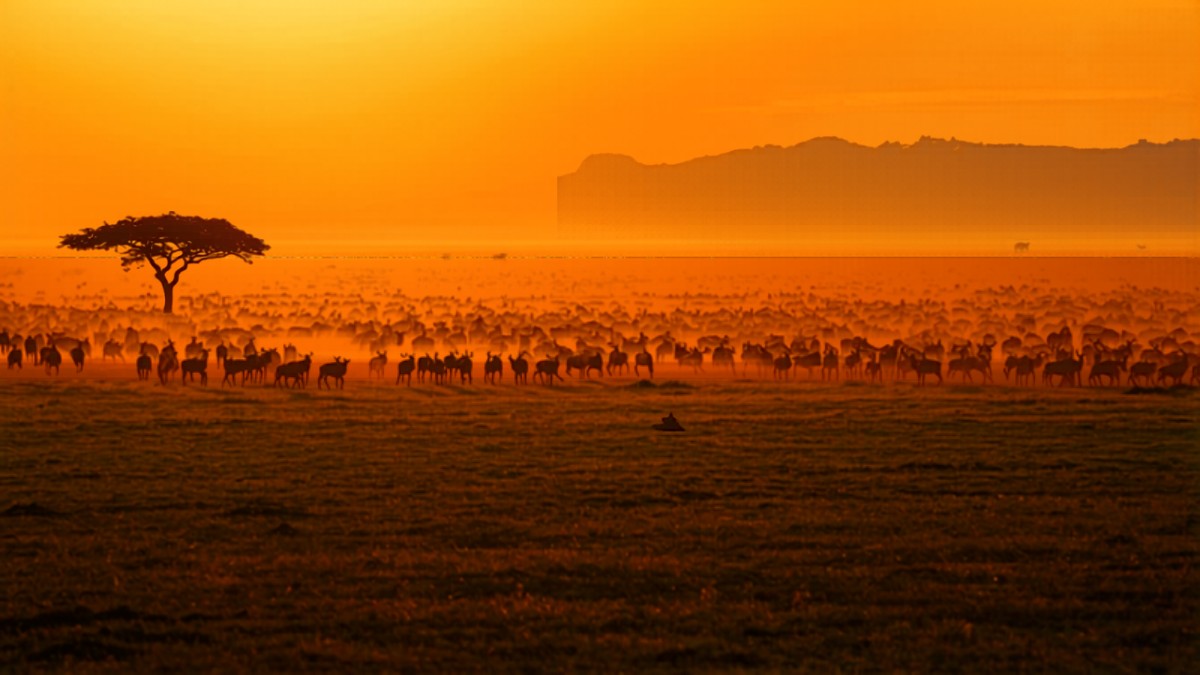
5. Blue Wildebeest Are Not What They Look Like
The blue wildebeest (Connochaetes taurinus) has one of the most deceptive appearances in the animal kingdom. Its dark grey-brown coat has a faint bluish sheen in certain light. It does not look graceful. Its head is too large, its hindquarters too low, its gait somewhere between a trot and an awkward gallop.
And yet this animal can sustain speeds of 80 km/h in a burst sprint and outlast most predators over distance.
6. Wildebeest Speed Is Faster Than Most Expect
Wildebeest speed in a full sprint reaches 80 km/h. Their sustained running pace during herd movement sits at 40 to 50 km/h. This is faster than a lion’s sustained pace, which is why lions take wildebeest through ambush rather than open pursuit. The preferred lion strategy is to isolate one animal and cut off its escape, not to outrun it.
7. An Adult Wildebeest Weighs Up to 270 kg
An adult blue wildebeest weighs between 180 and 270 kg, males heavier than females. They stand approximately 1.4 metres at the shoulder. Despite their front-heavy appearance, they are extraordinary swimmers. A wildebeest that survives a Nile crocodile attack and makes the far bank typically shakes off the water and begins grazing within minutes.
8. Wildebeest Lifespan: 20 Years in Protected Conditions
In protected environments, blue wildebeest can live up to 20 years. In the wild, few reach this age. The migration is the most dangerous period: river crossings, predators, drowning, injury, and exhaustion all extract a constant toll. Most animals that survive their first year have a realistic lifespan of 10 to 15 years.
The Drama: Crossings, Calving, and Predator Pressure 🦁
9. 500,000 Calves Are Born in Six Weeks
The calving season in the southern Serengeti runs from late January through early March. Approximately 500,000 wildebeest calves are born within a six-week window. This is the “predator swamping” strategy: by synchronising births so tightly, the herds flood the system with more calves than predators can consume. A calf born outside this window faces dramatically higher mortality odds.
A newborn wildebeest can stand within seven minutes of birth and run with the herd within hours. It has to. The southern Serengeti during calving season draws the highest concentration of cheetahs, hyenas, lions, and wild dogs anywhere in Africa. These wildebeest migration facts about calving are what make a Tanzania-Kenya combined safari so compelling for P5 wildlife travellers. For more detail, read our Best Time To Visit Northern Kenya Month By Month Safari Conditions.
10. What Triggers a Mara River Crossing
The Mara River crossing is not a scheduled event. Herds can gather on the bank for hours or days, testing the water and retreating, before a single animal commits and the rest follow. The triggers are not fully understood. Crowd density on the bank, water level, crocodile activity, and the presence of a “lead” animal all appear to play a role.
Crossings can also happen multiple times at the same point in the same season. Once the herds move into the Masai Mara, they may cross the river northward, graze in Kenya for weeks, then cross southward again. A single stretch of river can host dozens of crossings between July and October.
11. Nile Crocodiles Can Weigh 750 kg
The Mara River holds one of the densest populations of Nile crocodiles anywhere in Africa. Individual crocodiles in this river have been documented at weights exceeding 750 kg. They do not ambush every crossing: they are selective, waiting for the maximum density of animals in the water before striking. A single large crocodile may take several wildebeest in one crossing event.
12. Predator Pressure Never Stops
The wildebeest’s predator list includes lions, leopards, cheetahs, spotted hyenas, African wild dogs, Nile crocodiles, and martial eagles targeting calves. Predation is estimated to account for approximately 25 to 30% of annual mortality. The other major causes are drowning during crossings, disease (particularly anthrax in dry years), and starvation during drought.
13. The Clockwise Circuit Has Never Been Reversed
The wildebeest always travel the Serengeti-Mara circuit clockwise: southern Serengeti first, then north through the central Serengeti, into Kenya, then back south. The prevailing theory is that the circuit evolved to track the movement of the seasonal rain belt, which follows the same clockwise pattern across East Africa.
More Facts Your Guide Will Tell You Around the Fire
14. The Herd Has No Leader
There is no lead animal directing the migration. The movement is a product of collective behaviour: each individual responds to the animals immediately around it. When one animal moves toward fresh grass or water, its neighbours follow, and the signal cascades through the herd. This is why crossings can start and stop unpredictably. It takes one animal to commit, but nothing guarantees that the one to commit is nearby.
15. Wildebeest and Acacia Trees Have a Relationship
Wildebeest grazing pressure shapes the Serengeti’s tree cover. By cropping grass short, large herds reduce the fuel for fires that would otherwise kill young acacia trees. More wildebeest = more short grass = fewer fires = more trees. Fewer wildebeest (as happened after rinderpest outbreaks in the 20th century) = taller grass = more fires = fewer trees. The wildebeest migration facts extend well beyond the animals themselves. They are an ecosystem process.
16. Wildebeest Groan, Constantly
The sound of the migration is not drumming hooves. Up close, it is a constant, low croaking groan. Male wildebeest produce this call continuously during movement and during the rut. The sound carries for several kilometres. Guides at Trunktrails Safaris sometimes describe arriving at a crossing site by sound before the herd is visible.
17. The Rut Happens on the Move
Unlike most ungulates, wildebeest do not stop migrating to breed. The rut happens during the northward movement, typically between May and July. Males establish temporary territories lasting only hours, mate, and then the territory dissolves as the herd moves on. This is one of the most energetically demanding periods for males, who may lose 25% of their body weight during the rut.
18. Not All Wildebeest Migrate
A small resident wildebeest population lives year-round in the Masai Mara without completing the full circuit. These animals do not participate in the main migration. Researchers are not certain what separates the migratory from the resident individuals.
19. Wildebeest Bones Feed the Ecosystem for Years
Hundreds of thousands of wildebeest die each year during the migration. Many drown in river crossings. Their carcasses are a critical nutrient pulse for the Serengeti-Mara ecosystem: vultures, hyenas, jackals, marabou storks, and beetles all feed on them. Submerged carcasses in the Mara River feed aquatic insects that feed fish that feed the river’s ecology downstream. A dead wildebeest keeps feeding the system for years.
20. The Migration Is Not Guaranteed Forever
The wildebeest migration is under pressure. Fencing along the Kenya-Tanzania border disrupts movement corridors. Agricultural encroachment reduces dry-season range. Climate change is altering the rainfall patterns the herds depend on. The International Union for Conservation of Nature (opens in new tab) lists blue wildebeest as Least Concern, but the specific migratory population of the Serengeti-Mara depends on decisions being made right now about land use and conservation. ✨
The Trunktrails Advantage: See the Migration Properly
Trunktrails Safaris is a native Kenyan-owned operator based in Nairobi. We have been running tours and safaris in the Masai Mara for years, and we know the difference between watching a migration and understanding one.
Here is what sets us apart:
- Local knowledge no algorithm can replace. Our guides grew up near these ecosystems. They know which crossing points are active, which stretches of the river hold the largest crocodiles, and where the herds are on any given morning. No app gives you that.
- Tailor-made itineraries for all budgets. Budget tours and safaris from $650. Mid-range packages from $850. Premium experiences from $1,835. Every budget gets the same depth of guiding.
- No middlemen. When you contact us, you speak directly to the operator. No agency markup, no communication delays, no surprises at the gate.
- Conservation contribution built in. Five percent of every booking goes directly to wildlife conservation programs in the ecosystems we operate in. You watch the migration. You help protect it. Read more about our conservation approach.
- TRA licensed. certified. Tourism Regulatory Authority licensed. Book with confidence.
The wildebeest migration is one of the most complex wildlife events on Earth. These wildebeest migration facts only scratch the surface of what you will see on the ground. It deserves a guide who can read it in real time. Trunktrails Safaris puts that guide in the seat next to you.
Plan Your Migration Safari Now 📸
The Mara River crossings peak between July and October. The calving season in the Serengeti runs January through March. Both are extraordinary. Neither waits.
Trunktrails Safaris offers migration tours and safaris across all three peak windows: calving in the Serengeti (January to March), Grumeti crossings (June), and Mara River crossings in Kenya (July to October). Tell us which moment you want to be there for.
Reach out to Trunktrails Safaris to build your migration itinerary:
WhatsApp: +254 113 208888 Email: info@trunktrailssafaris.com Website: trunktrailssafaris.com
TRA Licensed
Word count: 1,810