Kenya Safari Cost: Why Fuel Prices Move What You Pay — And What You Actually Get
Kenya safari costs have climbed in the last two years. If you have been comparing quotes from different operators and wondering why prices look so different – or why the same itinerary can cost more in 2026 than it did in 2023 – fuel is one of the most honest answers you will get.
At Trunktrails Safaris, we believe a client who understands what they are paying for makes better decisions. We are a Nairobi-based safari company, and we have been running tours and safaris across Kenya’s national parks and conservancies for years. This blog is the first in our 10-part series on fuel costs and Kenyan tourism. Here, we break down exactly how fuel prices feed into your safari package price, what every line item covers, and why transparent pricing is the only kind we offer. 🌍
How Much Does a Safari in Kenya Cost? The Honest Starting Point
This is the question every traveler types into Google at some point in the planning process. The real answer: it depends on duration, destination, accommodation tier, and group size. But here is a realistic starting range based on current market rates:
| Safari Type | Duration | Price Per Person (USD) |
|---|---|---|
| Budget (camping / basic lodges) | 3-4 days | $650-$1,100 |
| Mid-range (tented camps / standard lodges) | 5-7 days | $850-$1,500 |
| Premium (luxury camps / fly-in) | 8-10+ days | $1,835-$2,200+ |
These figures include park fees, accommodation, meals, game drives, and ground transport. They do not include international flights, visas, or travel insurance.
What most operators do not tell you is that roughly 15-25% of a mid-range safari budget goes directly to fuel. That percentage shifts every time the pump price changes at the Kenya Pipeline Corporation forecourts in Nairobi.
Why Fuel Is One of the Biggest Drivers of Kenya Safari Package Costs
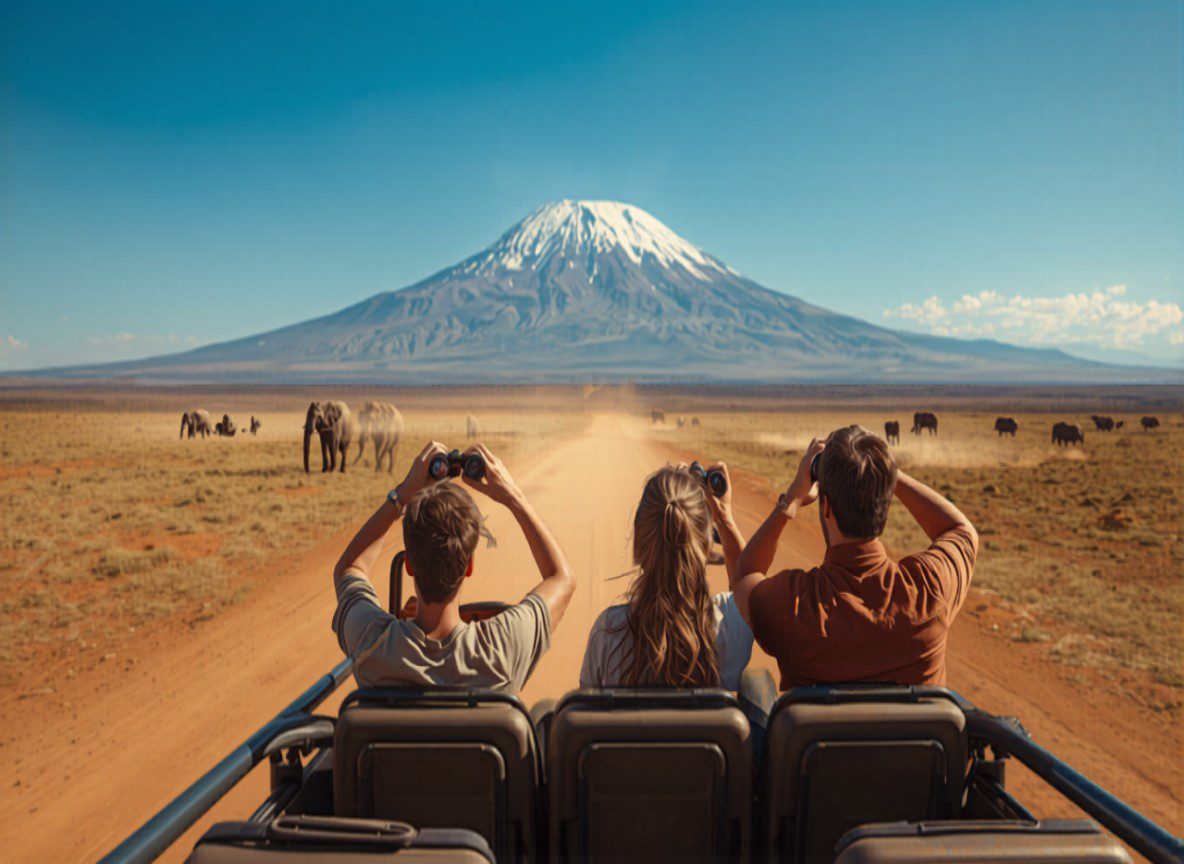
Kenya is a large country. The Masai Mara is a five-to-six hour drive from Nairobi. Amboseli is four hours. Samburu is five hours north. Tsavo East and West span thousands of square kilometres. Safari vehicles do not use motorway fuel. They use heavy 4WD diesel Land Cruisers and Land Rovers, often in low gear on rough corrugated tracks, averaging 5-7 kilometres per litre.
A single 7-day Masai Mara and Amboseli circuit can cover 1,800-2,200 kilometres of road. At current diesel prices (hovering around KES 180-195 per litre as of early 2026), that vehicle’s fuel bill alone reaches KES 50,000-75,000 per trip before a single park gate fee is paid.
Fuel cost hits your safari bill in three places:
- Road transfer costs – Nairobi to Mara, Mara to Amboseli, and back
- Game drive fuel – every morning and evening drive inside the park burns fuel on bush tracks
- Support vehicle costs – some packages include a second vehicle for equipment, crew, or larger groups
When the global oil price rises or the Kenya shilling weakens against the dollar, operators face a choice: absorb the cost or adjust quotes. Most adjust quotes. The ones who do not are either cross-subsidising or cutting corners somewhere else.
What Is Actually Included in a Kenya Safari Package Price?
Safari in Kenya cost comparisons are meaningless unless you are comparing the same components. Here is what a genuine full-service package from Trunktrails Safaris covers:
Ground Transport
A dedicated, well-maintained 4WD safari vehicle with pop-up roof and a licensed professional driver-guide. This is not a shared shuttle. Your vehicle, your schedule.
Park Entry Fees
Kenya Wildlife Service (KWS) park fees are set by the government and non-negotiable. For the Masai Mara, non-resident adults pay USD 200 per person per day during peak season (July-October). These fees are real conservation funding – 75% goes directly to the county government for community and wildlife programs. [External: Kenya Wildlife Service – kws.go.ke]
If you are planning a Masai Mara safari, our Masai Mara safari packages include all KWS fees, full board, and game drives with no hidden add-ons.
Accommodation
This is where the biggest price gap appears between operators. A licensed tented camp with full board, hot water, and a professional camp manager costs far more than an unlicensed guesthouse that calls itself a safari lodge. At Trunktrails Safaris, we use vetted properties. We will tell you the name, the category, and the rating – before you book.
Meals and Activities
Full-board is standard on our tours and safaris: breakfast, packed lunch, and dinner at camp. Bush breakfasts, sundowners, and cultural village visits are included where specified. We do not charge extra for game drives that are listed as part of your itinerary.
Guide Fees and Tips
Your driver-guide is the most important person on your safari. Our guides are Kenya Professional Safari Guides Association (KPSGA)-trained, with an average of 8-12 years of field experience. Their professional fee is built into the package price. Tipping is at your discretion and always separate.
The Fuel Surcharge: What It Is and When Operators Apply It
Some operators add a fuel surcharge as a line item on top of quoted package prices. This can range from $50 to $200 per person depending on itinerary length. It is not necessarily dishonest – it reflects genuine operational costs. But it can feel like a surprise if it appears after you thought you had an agreed price.
At Trunktrails Safaris, we do not use a separate fuel surcharge model. Fuel cost is built into our package pricing at the time of quotation, using current market rates. If you book six months in advance and fuel prices spike significantly before your travel date, we will flag this transparently in writing and discuss options. We have never cancelled a confirmed booking over a fuel cost dispute. We will not start now.
What to ask any operator before you book:
- Is fuel included in this price or billed separately?
- What happens if fuel prices rise between booking and travel?
- Is this a firm price or an estimate subject to adjustment?
Any reputable safari company should answer these three questions without hesitation. If they cannot, that tells you something.
Safari Cost Kenya vs Tanzania: Does Fuel Make Kenya More Expensive?
Travelers planning an East African safari often compare Kenya and Tanzania side by side. Tanzania’s northern circuit (Serengeti, Ngorongoro, Tarangire) covers similar distances. The cost comparison depends heavily on currency, park fee structures, and road conditions.
Kenya’s park fees are USD-denominated and have risen sharply since 2022. Tanzania’s fees are comparable at premium parks. The real fuel-cost difference appears in road quality: Kenya’s A104 and B3 to the Masai Mara have improved significantly, but Mara North and the conservancies still require serious off-road driving that increases fuel burn.
For families planning Kenya tours and safaris, the practical advantage is proximity: Nairobi is closer to more parks than Arusha is to the Serengeti. A family can reach Ol Pejeta Conservancy in 3.5 hours, Amboseli in 4, the Masai Mara in 5. That means fewer long transfer days and more time in the bush – which, per day of actual safari, is often better value. 🐘 See our Kenya family safari holidays guide for sample itineraries built around school holiday dates.
How Group Size Affects Your Kenya Safari Tours Cost
Fuel cost is largely fixed regardless of how many people are in the vehicle. A Land Cruiser going from Nairobi to the Masai Mara burns the same diesel whether it carries two passengers or six. This means group size has a direct and significant impact on your per-person cost.
| Group Size | Per-Person Cost Impact |
|---|---|
| 1-2 travelers | Highest per-person cost – vehicle cost split by 2 |
| 3-4 travelers | Optimal balance of cost and space |
| 5-6 travelers | Lowest per-person cost within a single vehicle |
| 7+ travelers | Requires a second vehicle – introduces a new fixed cost |
Solo travelers and couples often prefer a private vehicle even at the higher per-person price, because it means a fully personalised pace: stop when you want, stay longer at a sighting, adjust the itinerary mid-drive. That is what Trunktrails Safaris builds – flexible tours and safaris that move at your pace, not at a shared schedule.
The Trunktrails Advantage: Transparent Pricing From a Team You Can Call

Most travelers who have been burned by hidden safari costs were burned by a third party. A booking platform. An international aggregator. An agency that resells Kenya packages without ever having been to Kenya.
Trunktrails Safaris is a direct operator. We own and maintain our vehicles. We employ our guides directly. We have longstanding relationships with the camps and lodges we use. When you book with us:
- You talk to the people who will actually run your safari
- Your quote includes every cost we can foresee, including fuel at current market rates
- If something changes, we tell you – in writing, before it affects your bill
- 5% of every booking goes directly to wildlife conservation programs in Kenya
We are a member and operator. These credentials require annual inspection and compliance – they are not just logos. They mean that when you hand us your trip, you are working with a regulated professional, not an aggregator with a safari-themed website.
We design every itinerary around your group: your ages, your fitness level, how much time you want to spend driving versus game-watching, what your children need, and what your budget actually is. Not what we wish it was. What it actually is. ✨
Cost of 3-Day Safari in Kenya: What You Get at Each Price Point
A 3-day safari is one of the most searched entry points for first-time travelers and families testing the waters. Here is what different budgets actually buy:
Budget (3 days, from $650 per person):
- Masai Mara or Amboseli
- Camping or basic guesthouse accommodation
- Shared game drive vehicle (possible)
- Self-catering or basic meals
- Standard park fees included
Mid-range (3 days, from $950 per person):
- Masai Mara, Amboseli, or Nakuru
- Tented camp with full board
- Private vehicle and guide
- Park fees, game drives, bush breakfast
- Standard transfers from Nairobi
Premium (3 days, from $1,500 per person):
- Masai Mara conservancy (Naboisho, Mara North, Olare Motorogi)
- Luxury camp, exclusive game drives
- Private vehicle, elite guide, fly-in option
- Conservation fee on top of park fees
- Sundowners, bush dinners, walking safaris
At every level, Trunktrails Safaris offers tailor-made packages – we will not force you into a fixed group tour if a private arrangement fits your budget. Tell us your numbers and we will show you what is honestly achievable.
Planning Around Fuel-Driven Price Fluctuations: Practical Tips
For retirees planning a major once-in-a-lifetime trip, and for families working to a fixed holiday budget, price fluctuation is a real planning concern. Here is how to protect yourself:
- Book and deposit early – most Kenya safari operators lock in pricing at the time of deposit. A deposit paid 6-9 months out protects you from intervening fuel cost increases.
- Ask for an itemised quote – a line-by-line breakdown tells you what the fixed costs are (park fees, accommodation) versus the variable ones (transport, fuel). You can see exactly where any increase would come from.
- Travel in shoulder season – May, June, and November offer lower accommodation rates. Park fees are fixed year-round, but lodge rates can drop 20-30% outside peak season, which offsets fuel costs on a per-day basis.
- Choose a route that consolidates driving – the most fuel-efficient safaris combine parks within a logical circuit. Nairobi to Nakuru to Masai Mara is a tighter loop than Nairobi to Amboseli to Tsavo to Mara. Ask your operator to show you the driving map.
- Go direct – every booking platform and aggregator adds a margin. Booking directly with Trunktrails Safaris means that margin stays in your pocket or goes toward a better camp. Contact us here and we will send you a no-obligation itemised quote.
What This Series Will Cover Next
This is Blog 1 of 10 in our series on fuel costs and Kenyan tourism. Over the coming weeks, we will cover:
- How fuel prices affect domestic flight costs (Nairobi to Masai Mara by air vs road)
- Park fee increases and their relationship to fuel-driven operating costs
- How conservancy fees compare to standard park fees – and why they are worth it
- Budget safari planning in a high-fuel-cost environment
- What the fuel levy means for Kenyan tourism businesses and the communities they support
Each blog in this series is written to give you the information you need to plan a Kenya safari with confidence – not just excitement.
Ready to Get a Transparent Kenya Safari Quote From Trunktrails Safaris?
You now know what drives safari costs in Kenya, what fuel means for your budget, and how to read a quote intelligently. The next step is putting real numbers against your real trip.
At Trunktrails Safaris, we design every safari around your group: your dates, your pace, and your actual budget. No hidden surcharges. No vague estimates. A direct line to the team running your trip – before, during, and after.
Send us your travel dates and we will build you an itemised quote within 24 hours.
Further reading
More safari planning resources
- Kenya tour packages from Valley Safaris
- Maasai Mara National Reserve guide on Touring Insights
- Compare Kenya safari packages on FindMySafari
- Interactive Maasai Mara map from Valley Safaris
📞 WhatsApp: +254 113 208888 📧 Email: info@trunktrailssafaris.com 🌐 Website: https://trunktrailssafaris.com