Haller Park Mombasa: Wildlife, Rehabilitation and Your Coastal Safari Guide
Imagine walking through a dense palm forest, a giraffe feeding from the canopy above your head, the distant grunt of hippos carrying through warm coastal air. Now imagine that this forest was, just a few decades ago, a barren moonscape – a limestone quarry scraped clean by industrial machinery. That is the story of Haller Park Mombasa, and it is one of the most remarkable wildlife rehabilitation stories on the continent.
Haller Park is not a zoo. It is not a theme park. It is a living, breathing ecosystem that was built from nothing – a testament to what nature can do when it is given the tools, the time, and the right human hands. For travellers exploring Kenya’s coast, it is also the most underrated stop on any Mombasa itinerary.
Whether you are spending a week on the beach in Diani, transiting through Mombasa on your way to Tsavo, or looking for a genuinely educational morning excursion, a visit to Haller Park belongs in your plans. At Trunktrails Safaris, we include it as a coastal itinerary option for guests who want depth alongside the beach – and it consistently earns some of the strongest reactions of any stop on Kenya’s coast.
This Haller Park Mombasa wildlife guide covers everything you need to know: the park’s history, the animals you will encounter, the famous Owen and Mzee story, and how to weave it into a wider Kenya coast safari experience.
From Limestone Quarry to Wildlife Sanctuary: The Story of Haller Park
How René Haller Transformed a Wasteland
In 1971, a Swiss agronomist named René Haller arrived at the Bamburi Cement plant north of Mombasa and looked at what the quarrying operations had left behind: 2,000 acres of compacted limestone rubble, stripped of all topsoil and incapable of supporting plant life. The average person would have seen a write-off. René Haller saw a project.
Over the following decades, Haller developed a meticulous ecological rehabilitation programme that became a model studied by conservation scientists around the world. The first step was establishing pioneer plants – specifically the nitrogen-fixing casuarina tree (Casuarina equisetifolia) – that could take root in the crushed limestone and begin rebuilding soil chemistry from scratch. Casuarinas are not native to East Africa, but they are extraordinary pioneers. Their needle-like leaves shed a thick litter, which breaks down into humus. That humus feeds fungi and invertebrates. Those invertebrates feed birds. Soil begins to form. The food chain knits itself back together, one link at a time.
From there, Haller introduced native plant species in stages, reading the soil’s recovery at each phase before moving to the next. Calliandra trees followed the casuarinas. Then native palms, figs, and riverine species. Each new wave of planting attracted new insects, which attracted new birds, which spread seeds further into the recovering ground. Within fifteen years, what had been a sterile quarry floor had become a self-sustaining forest.
Wildlife was introduced progressively as the habitat matured – first fish, then reptiles, then large mammals. By the early 1990s, the site had become a functioning wildlife sanctuary. Haller’s work earned him the United Nations Environment Programme Global 500 Award, and the park was renamed Haller Park in his honour.
Bamburi Cement and the Rehabilitation Mission
Bamburi Cement – now part of the LafargeHolcim group – funded the entire rehabilitation programme and continues to maintain Haller Park as a conservation and education facility. This is not greenwashing. The quarrying operations at Bamburi produced some of the most severe landscape degradation in East Africa’s coastal zone, and the company’s sustained investment in Haller’s rehabilitation work represents a genuine commitment to ecological restoration that spans more than fifty years.
Today the park covers approximately 81 hectares of the original quarry site. The rest of the rehabilitated land has been integrated into agriculture and community use, demonstrating that productive land use and ecological recovery are not mutually exclusive goals.
Wildlife at Haller Park: Every Animal You Will Encounter
Haller Park is home to a collection of resident wildlife that would be extraordinary in any setting – let alone on a reclaimed quarry at the edge of a city.
Hippos and the Resident Herd
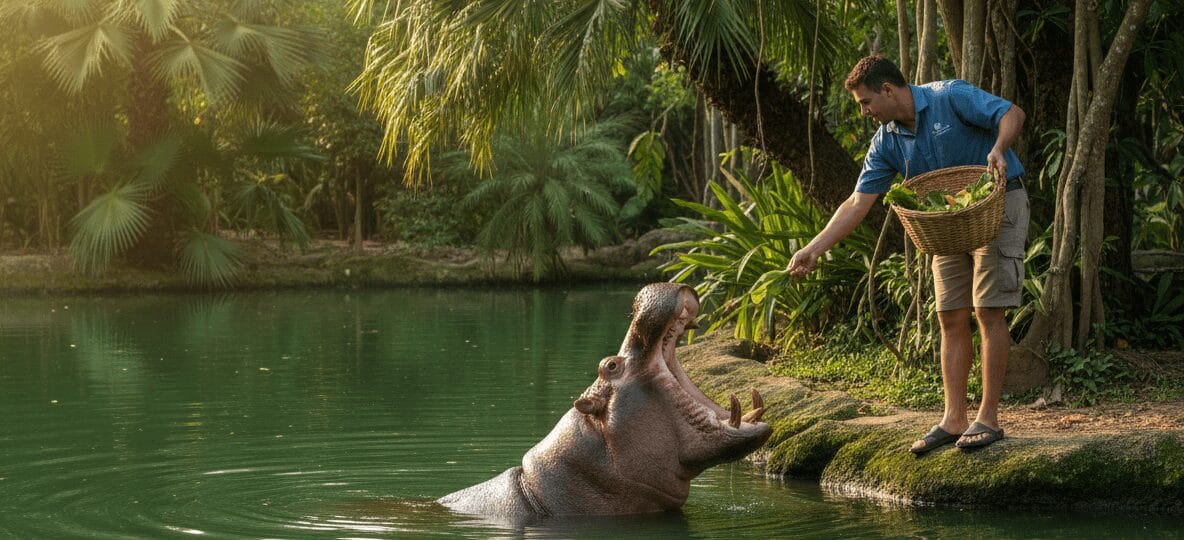
The hippopotamus (Hippopotamus amphibius) herd at Haller Park is one of the most accessible in Kenya. Unlike sightings at lakes and rivers – where hippos are typically observed from a distance, partially submerged – the Haller Park hippos are habituated and can be observed from close-range purpose-built viewing platforms. Feeding sessions held each morning allow visitors to watch these animals at their most animated. A fully grown male hippo can weigh over 1,800 kilograms and cover 30 kilometres on land in a single night. Watching one of these animals at the Haller Park pool, you begin to understand why they are considered one of the most dangerous animals in Africa – and why their ecological role as fertilisers of riverine systems is so critical.
Giraffes, Buffaloes and the Palm Forest Trails
The palm forest trails at Haller Park offer one of Kenya’s most intimate large-mammal encounters. Rothschild’s giraffes (Giraffa camelopardalis rothschildi) – one of the rarest giraffe subspecies on the planet, with fewer than 2,500 individuals remaining in the wild – move freely through the canopy, and on a quiet morning you can stand close enough to hear them tearing leaves from the treetops. African buffaloes graze the open areas of the park alongside waterbuck, eland, and oryx. The diversity of herbivores present is a direct reflection of the habitat variety that Haller’s restoration work created – each animal occupying a slightly different ecological niche within the same reclaimed landscape.
Crocodiles, Fish Eagles and the Aquatic Zone
The aquatic section of Haller Park hosts Nile crocodiles (Crocodylus niloticus) in a managed environment with a dramatic feeding display. Crocodiles are ambush predators with a bite force measured at over 5,000 pounds per square inch – the strongest of any living reptile. The crocodile programme at Haller Park also serves a conservation function: the park maintains a breeding population and has participated in wild release programmes along the Kenyan coast.
The fish ponds – a key feature of the original Haller rehabilitation design – support tilapia and catfish farming and attract a remarkable variety of waterbirds. African fish eagles, hammerkops, herons, and kingfishers are regular visitors. Birders visiting the Kenya coast for the first time are often surprised by the diversity at Haller Park, which sits within the East African coastal forest biome – one of the world’s 35 biodiversity hotspots.
Owen and Mzee: The Most Famous Friendship in Kenya
No account of Haller Park Mombasa is complete without the story of Owen and Mzee.
In December 2004, the Indian Ocean tsunami struck the East African coast. Among the many animals displaced was a juvenile hippopotamus, estimated to be around one year old, who had been separated from his herd near Malindi and swept into the ocean. Villagers found the calf stranded on a coral reef near Malindi and alerted wildlife authorities. After a dramatic rescue operation involving hundreds of volunteers and a fishing net, the hippo – subsequently named Owen – was transported to Haller Park.
On arrival, the terrified and disoriented calf immediately ran toward the first large creature he could find and pressed himself against its flank. That creature was Mzee – a 130-year-old Aldabra giant tortoise (Aldabrachelys gigantea) who had been a resident of the park for decades. Mzee, whose name means “old man” in Swahili, was initially unimpressed. He was observed trying to walk away. Owen simply followed.
Within days the pair was inseparable. Owen slept beside Mzee, fed beside him, and followed him to the water. Mzee – who had shown no social bonding behaviour toward any other animal in his decades at the park – began to reciprocate. He waited for Owen. He responded when Owen called. Ethologists were astonished. Cross-species bonding at this depth and duration between animals as phylogenetically distant as a hippo and a tortoise had not been documented before.
The bond between Owen and Mzee became an international story. Books were written, a documentary was produced, and scientists studied the pair’s communication patterns, identifying a set of sounds that Owen and Mzee appeared to have developed exclusively between themselves. Conservation educators around the world adopted their story as a teaching tool about resilience, adaptation, and the capacity for empathy across species boundaries.
Owen was eventually integrated with a female hippopotamus named Cleo, as his growing size posed a risk to Mzee. But Mzee remains a resident of Haller Park to this day – one of the oldest living tortoises in the world and a symbol of what this extraordinary place represents.
Planning Your Visit: Practical Guide to Haller Park
Opening Hours, Entry Fees and Getting There
Haller Park is located on Mombasa’s north coast, approximately 10 kilometres from Mombasa city centre along the Malindi Road (the A7), adjacent to the Bamburi Cement plant. It is accessible by road from central Mombasa, Nyali, and the north coast beach hotels.
- Opening hours: Daily, 08:00 to 17:00
- Entry fees: Fees are updated periodically – confirm current rates directly with the park or your tour operator before your visit. Adult and child rates apply, with discounts for Kenyan residents
- Hippo feeding: Mornings – confirm timing on arrival
- Crocodile feeding: Afternoons – confirm timing on arrival
- Guided walks: Available on request and strongly recommended for ecological context
Getting there independently is straightforward by tuk-tuk or taxi from the north coast hotel strip. If you are staying in Diani or further south, your best option is to arrange transport through your tour operator. Trunktrails Safaris can incorporate Haller Park into a day tour or coastal itinerary transfer – WhatsApp us on to arrange.
Best Time to Visit and What to Expect
Haller Park is a year-round destination. The coastal climate means temperatures remain warm throughout the year, though the long rains (April-May) can make the trails muddy. The best visiting conditions are during the dry periods: January-March and June-October. Early morning visits (08:00-10:00) are ideal – the hippos are active, the light is good for photography, and the trails are cooler before the midday heat builds.
Allow three to four hours for a full visit. Wear light, breathable clothing and closed-toe shoes for the forest trails. Sun protection is essential. The park has a café and gift shop on site.
Haller Park as Part of Your Mombasa Coastal Safari Itinerary
Combining Haller Park with Diani Beach and Tsavo
Haller Park sits naturally within a Kenya coast safari itinerary as a morning or half-day wildlife experience that complements rather than competes with the big-park experiences at Tsavo East or Tsavo West. Here is how Trunktrails Safaris typically structures a coastal safari that includes the park:
Sample 5-Day Kenya Coast Itinerary with Haller Park:
- Day 1: Arrive Mombasa or Diani Beach. Settle in and explore the coast
- Day 2: Morning at Haller Park (half day). Afternoon on the beach or snorkelling at Diani’s coral reefs
- Day 3-4: Drive to Tsavo East for a 3-day safari from Diani Beach – red elephants, Galana River, walking safari
- Day 5: Return to Mombasa or Nairobi departure
This structure gives guests a genuine ecological arc – from the intimate, rehabilitated wildlife sanctuary environment of Haller Park to the vast open wilderness of Tsavo’s red-dust savannah. It is a story that begins in human hands and opens into something entirely wild. Trunktrails Safaris tours and safaris are designed to create exactly these kinds of layered, purposeful wildlife journeys.
The park also pairs well with a visit to Mombasa Old Town, Fort Jesus, or the Wasini Island snorkelling experience – creating a full cultural and natural coastal programme that can be spread across a week-long stay.
Why Trunktrails Safaris Is Your Ideal Coastal Safari Partner
Most tours and safaris operators on the Kenya coast treat Haller Park as a checkbox item – forty-five minutes, a selfie with a tortoise, back on the bus. Trunktrails Safaris approaches it differently. We brief our guests on the rehabilitation science before they arrive. We guide the visit with ecological context. We connect what they see at Haller Park to what they will encounter in Tsavo or Amboseli – the food chains, the predator-prey dynamics, the conservation models that underlie every Trunktrails experience.
Our guides are not just drivers. They are conservation storytellers trained to turn a morning at a coastal wildlife sanctuary into the opening chapter of a safari journey that will stay with you for years.
Trunktrails Safaris operates fully certified tours and safaris from the Kenya coast to every major wildlife destination in the country. Contact us on (WhatsApp) to start planning your coastal safari today.
Frequently Asked Questions About Haller Park Mombasa
Q: Is Haller Park worth visiting? Yes – especially for travellers who want more than a beach holiday. The rehabilitation history, the Owen and Mzee story, and the diversity of resident wildlife make it one of the most educational and emotionally engaging wildlife experiences on Kenya’s coast. Trunktrails Safaris recommends it as a morning visit that adds genuine depth to any coastal itinerary. Reach us on to include Haller Park in your Kenya coast tour.
Q: Can children visit Haller Park? Absolutely. Haller Park is one of the most family-friendly wildlife experiences in Kenya. The controlled environment, the accessible viewing platforms, and the feeding sessions make it ideal for younger visitors. The Owen and Mzee story is particularly powerful for children – it is a conservation story told without any loss of scientific accuracy.
Q: What animals live at Haller Park? The park’s resident wildlife includes hippopotamuses, Rothschild’s giraffes, African buffaloes, Nile crocodiles, waterbuck, eland, oryx, vervet monkeys, and a wide variety of coastal forest birds including African fish eagles, herons, kingfishers, and hammerkops. The fish ponds also support tilapia, catfish, and freshwater turtles.
Q: How long does a visit to Haller Park take? Allow three to four hours for a full visit, including the hippo feeding, crocodile display, palm forest walk, and fish ponds. A rushed visit of ninety minutes will miss much of what the park offers. If you are including it in a Trunktrails tours and safaris coastal day programme, we typically allocate a half day.
Q: How do I book a Haller Park visit with Trunktrails Safaris? WhatsApp Micah directly on. We arrange all transport, guide briefing, and entry fees as part of your wider Kenya coastal safari package. Visit our website at https://trunktrailssafaris.com to explore full itinerary options.
Book Your Kenya Coast Safari with Trunktrails Safaris
Haller Park Mombasa is proof that nature, given the right conditions, can reclaim what industry has taken. It is also proof that the Kenya coast has far more to offer than a sun lounger and a cocktail – though we would never ask you to choose.
Trunktrails Safaris specialises in building Kenya coast itineraries that combine beach, cultural heritage, and wildlife in a way that no single attraction could deliver alone. From a morning at Haller Park to three days tracking red elephants through Tsavo East, from a sunrise walk through the Tsavo bush to an evening dhow sunset off the Diani reef – every Trunktrails Safaris experience is designed to be genuinely unforgettable.
Contact Micah and the Trunktrails Safaris team today:
- WhatsApp: – Email:
- Website: https://trunktrailssafaris.com
- Location: Nairobi, Kenya
Your Kenya coast safari starts with a conversation. Let us build yours.
Conservation-led tours and safaris across Kenya’s coast, savannah, and highlands.
Further reading
More safari planning resources
- Kenya tour packages from Valley Safaris
- Tsavo complete guide on Touring Insights
- Diani Beach guide on FindMySafari
- Map of Tsavo from Valley Safaris
Contact Trunktrails Safaris
WhatsApp: +254 113 208888 Email: info@trunktrailssafaris.com Website: https://trunktrailssafaris.com