
Best Time to Visit Tsavo National Park: Month-by-Month Wildlife and Weather Guide 🌍
Tsavo is not one park. It is two, and together they cover approximately 20,812 km² of Kenyan wilderness, making this one of Africa’s largest protected ecosystems. Tsavo East alone stretches across roughly 13,747 km², while Tsavo West adds another 7,065 km² of volcanic hills, lava flows, and palm-fringed rivers. That scale matters for planning. Weather patterns, wildlife concentrations, and road conditions shift dramatically from January to December, and choosing the right month can mean the difference between watching 200 red elephants at Aruba Dam and driving through empty scrubland in thick rain.
At Trunktrails Safaris, we run tours and safaris to Tsavo throughout the year. Our guides have driven both parks through every season. This is the honest, month-by-month breakdown you need to plan your visit with confidence.
What Is the Best Time to Visit Tsavo National Park?
June to October is Tsavo’s peak dry season and the best time for game viewing overall. Waterholes concentrate wildlife, vegetation thins out dramatically, and tracks are firm enough for comfortable game drives. Temperatures sit between 22°C and 30°C, warm and sunny but not extreme.
January and February offer an excellent secondary window. These months fall between the two rainy seasons. Vegetation is not fully parched, visitor numbers stay low, and wildlife viewing is consistently good without the July-August price premiums.
The table below maps conditions across the full year at a glance:
| Month | Season | Wildlife Viewing | Road Conditions | Visitor Numbers |
|---|---|---|---|---|
| January | Short Dry | Very Good | Good | Low |
| February | Short Dry | Excellent | Good | Low |
| March | Long Rains Begin | Moderate | Muddy sections | Very Low |
| April | Peak Long Rains | Poor-Moderate | Difficult | Very Low |
| May | Long Rains End | Moderate | Improving | Very Low |
| June | Early Dry Season | Very Good | Good | Moderate |
| July | Dry Season | Excellent | Excellent | High |
| August | Peak Dry Season | Excellent | Excellent | High |
| September | Dry Season | Excellent | Excellent | High |
| October | Late Dry Season | Very Good | Good | Moderate |
| November | Short Rains | Moderate | Muddy sections | Low |
| December | Short Dry Spell | Good | Improving | Low-Moderate |
What Is Tsavo’s Dry Season Like for Wildlife (June to October)?
This is Tsavo at its most dramatic. Vegetation retreats across both parks, animals cluster around permanent water sources, and game drives produce sighting after sighting. Aruba Dam in Tsavo East draws elephants, buffalo, zebra, and hippos in numbers that feel almost theatrical: on a good morning in August you can count more than a hundred elephants moving in convoy to water.
At Mzima Springs in Tsavo West, hippos gather in the clear, spring-fed pools. An underwater viewing chamber lets you watch them from below the surface, one of Kenya’s most extraordinary wildlife moments. Lions become easier to track because tall grass has retreated. Leopards drape across bare rock outcrops. Cheetahs cross open plains in the early light. 🐆
Dry-season highlights include:
- Elephant herds of 50-200 at Aruba Dam (Tsavo East)
- Hippos and crocodiles visible at Mzima Springs (Tsavo West)
- Lions resting on kopjes and rocky ridges at Voi Safari Lodge viewpoints
- Clear views from the Yatta Plateau, the world’s longest lava flow at ~290 km
- Lugard Falls accessible and dramatic as the Galana River drops through narrow rock channels
July and August carry the highest visitor numbers, though Tsavo remains far quieter than the Masai Mara during those same months. Book camps 3 months ahead for peak-season travel, particularly at Satao Camp (Tsavo East) and Finch Hattons (Tsavo West).
What Happens in Tsavo During the Long Rains (March to May)?
Kenya’s long rains typically arrive in March and build through April before easing in May. In Tsavo, this means afternoon downpours that can be intense, tracks that turn slippery, and some remote access roads requiring 4WD or temporary closure. Visitor numbers fall to their lowest point of the year.
Wildlife does not disappear. Tsavo’s resident elephants stay in the park all year. Lions, leopards, and the park’s large buffalo herds remain. What changes is visibility and dispersal: animals spread across a much wider area when water is plentiful everywhere.
Green season advantages:
- Indicative lodge rates drop 20-40% versus peak season (confirm with Trunktrails Safaris for current packages)
- Newborn animals appear from March onward: impala, zebra, and warthog calves
- Bird populations peak as intra-African migrants join year-round residents: Tsavo records over 600 bird species 📸
- Landscapes turn lush and dramatically green, spectacular for landscape photography
Green season challenges:
- Afternoon rain can shorten evening game drive windows
- Some tracks to remote areas in Tsavo East’s northern sector close temporarily
- Dense vegetation reduces open sightlines on drives
How Does the Short Rains Season Affect Tsavo (November to December)?
November brings Kenya’s short rains. In Tsavo, these are generally lighter and more predictable than the April peak. Mornings are often clear with good game viewing before afternoon showers arrive. By mid-December, Tsavo typically enters a brief dry spell that produces solid wildlife conditions through Christmas and New Year.
December is increasingly popular with travelers who want school-holiday timing without the premium rates of the Masai Mara peak. Tsavo delivers reliable game viewing, lower camp rates than mid-year, and road conditions that improve steadily through the month. For a broader view of how Tsavo fits into Kenya’s overall seasonal calendar, see our guide to the best time to visit Kenya.
What Wildlife Can You See in Tsavo Each Month? 🐘
Tsavo holds one of Kenya’s most diverse wildlife rosters. This table shows when each species is easiest to find:
| Species | Best Months | Where to Look |
|---|---|---|
| Red Elephants | Year-round; peak Jun-Oct | Aruba Dam (East), Mzima Springs (West) |
| Lions | Jun-Oct (peak visibility) | Rocky kopjes, open plains near Voi |
| Leopards | Year-round | Ngulia Hills (West), riverine areas |
| Cheetah | Jul-Sep | Open grasslands, Tsavo East southern sector |
| Buffalo | Year-round | Herds of 300-500 on Tsavo East plains |
| Hippos | Year-round | Mzima Springs (West), Galana River (East) |
| Crocodiles | Year-round | Lugard Falls, Galana River |
| Reticulated Giraffe | Year-round | Northern Tsavo East |
| Migratory Birds | Nov-Apr | Ngulia Ringing Station (West) is world-famous |
| Elephant Calves | Mar-May | Breeding herds disperse into lush areas |
| Wild Dog | Occasional | Tsavo East (rare but recorded) |
The Ngulia Ringing Station in Tsavo West is worth noting. Every November, hundreds of thousands of Palearctic migrants pass through, and the station has ringed over a million birds since 1969, making Ngulia one of the most important bird-ringing sites in Africa.
When Is the Best Time to See Tsavo’s Famous Red Elephants?
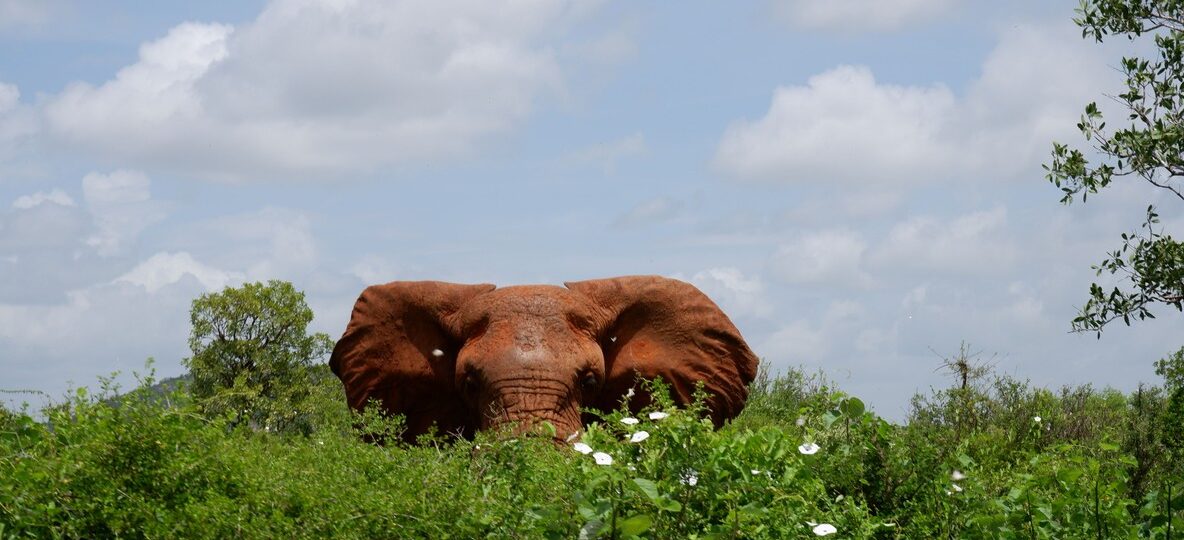
Tsavo’s elephants are a different experience from Amboseli’s calmer, well-habituated herds. Here the animals are wilder, the herds larger, and the signature rust-red color comes from the laterite-rich soil they roll in to cool and protect their skin. This is year-round behavior: you can find red elephants in both parks in any month.
For the most concentrated sightings, plan for June to October. As water sources shrink, hundreds of elephants converge on Aruba Dam and the Galana River each day. A single morning drive can produce encounters with breeding herds, bachelor groups, and solitary bulls moving in the same direction toward water.
During the wet season, elephants disperse widely. Individual family groups appear in green clearings across the park, sometimes at close range and in spectacular surroundings. For a direct comparison of Tsavo’s herds against Amboseli’s, see our Amboseli elephants vs Tsavo elephants guide.
Is Tsavo East or Tsavo West Better for Your Safari?
This is the most common planning question our team at Trunktrails Safaris receives. The two parks share a boundary but deliver distinctly different landscapes and experiences. For the full breakdown, see our Tsavo East vs Tsavo West guide. Here is the quick comparison:
| Size | ~13,747 km² | ~7,065 km² |
|---|---|---|
| Landscape | Open semi-arid savannah | Volcanic hills, forests, lava flows |
| Key Features | Aruba Dam, Lugard Falls, Yatta Plateau | Mzima Springs, Ngulia Hills, Chyulu border |
| Top Lodges | Satao Camp, Voi Safari Lodge, Galdessa | Finch Hattons, Kilaguni Serena, Severin Safari Camp |
| Best For | Elephant herds, open plains, birds of prey | Varied landscapes, hippos, bird ringing |
| Main Gate | Voi Gate (A109 highway) | Mtito Andei Gate |
| Distance from Nairobi | ~330 km, approx. 4.5-5 hours by road | ~240 km, approx. 3.5-4 hours by road |
| Fly-In | Wilson Airport to Voi airstrip, ~1 hour charter | Wilson Airport to Tsavo West airstrip |
Many of our Tsavo tours and safaris combine both parks on a single itinerary, crossing through the Tsavo Gate that connects them. If you plan to pair Tsavo with Amboseli, the road through Chyulu Hills takes 2-3 hours and is a spectacular drive in its own right. See our Amboseli and Tsavo road link guide for the full route breakdown and logistics.
What Does a Tsavo Safari Cost?
Tsavo is one of Kenya’s most accessible parks for budget and mid-range travelers. Kenya Wildlife Service (KWS) sets park entry fees annually via KWS eCitizen; confirm current non-resident rates before you book, as they are subject to annual review.
Indicative Trunktrails Safaris package ranges for Tsavo:
| Safari Type | Duration | Indicative Price Per Person |
|---|---|---|
| Budget Safari | 2-3 nights | From $650 |
| Mid-Range Safari | 4-5 nights | From $950 |
| Premium Safari | 6-8 nights | From $1,835 |
| Tsavo + Amboseli Combo | 6-7 nights | From $1,200 |
All prices are indicative and vary by dates, group size, and accommodation. Our Tsavo tours and safaris are fully tailor-made: contact Trunktrails Safaris for a personalised quote. See our full Tsavo safari packages page for more itinerary options.
The Trunktrails Advantage
Trunktrails Safaris is a native Kenyan-owned operator. We do not sub-contract your safari to a third party or add agency markups. When you book with us, you deal directly with the team that designs, drives, and delivers your experience on the ground.
What that means for a Tsavo safari:
- Local knowledge: Our guides know Tsavo’s seasonal rhythms from years of driving both parks. They know which Tsavo East waterholes hold elephants in October and which Tsavo West tracks to avoid after rain.
- Tailor-made itineraries: We build your schedule around your travel dates, budget, and priorities, whether that is red elephant photography at Aruba Dam or dawn game drives in the Ngulia Hills.
- 24/7 direct support: No call centers. No intermediaries. A direct line to the person running your safari.
- Conservation commitment: 5% of every booking goes directly to wildlife conservation in Kenya.
- All budgets welcome: From budget tented camps to the luxury of Finch Hattons, we cover the full spectrum.
Further reading
More safari planning resources
- Map of Tsavo from Valley Safaris
- Tsavo complete guide on Touring Insights
- Tsavo destination guide on FindMySafari
- Best time to visit Kenya month-by-month map from Valley Safaris
Ready to Plan Your Tsavo Safari?
Tsavo delivers year-round. Plan for the dry season if you want drama at the waterhole. Choose January or February for great game viewing without the high-season rates. Come in the green season if you want an uncrowded park and the thrill of a landscape that very few visitors see.
Before you pack, check our Kenya safari packing list, which covers exactly what you need for Tsavo’s warm, dusty conditions and the occasional afternoon downpour.
At Trunktrails Safaris, every Tsavo tour is built from scratch around your window, your budget, and the wildlife encounters that matter most to you. No cookie-cutter packages. Just a direct line to a team that knows this park from the inside out.
📞 WhatsApp: +254 113 208888 📧 Email: info@trunktrailssafaris.com 🌐 Website: https://trunktrailssafaris.com

