Chyulu Hills Safari: Kenya’s Green Hills, Lava Caves and Big Skies 🌍
Between the red plains of Tsavo and the elephant dust bowls of Amboseli, a dark green ridge rises from the savanna like a held breath. The Chyulu Hills are young by geological standards, barely a million years old, still venting steam in places. Ernest Hemingway called this landscape the “Green Hills of Africa.” Most safari travelers drive past on the road to Amboseli without stopping. That is exactly why a Chyulu Hills safari belongs on your itinerary.
This is not a destination for game-count maximalists. The Chyulus deliver something rarer: a sense of being genuinely alone in wild Africa, with Kilimanjaro filling the southern sky and lava tubes running beneath your feet. Trunktrails Safaris has been running tours and safaris here for clients who have already done the Mara, who want a Kenya that most operators don’t offer.
What Are the Chyulu Hills?
The Chyulu Hills form a 100-kilometre volcanic ridge in Makueni and Kajiado counties, officially protected as Chyulu Hills National Park (741 sq km). The range is classified as one of the youngest mountain chains on Earth. Rain falling on the hills percolates through porous volcanic rock and re-emerges 50 kilometres away as the Mzima Springs in Tsavo West, which supply much of Mombasa’s freshwater. The ecology is accordingly rich: moist montane forest on the higher ridges, open grassland on the slopes, and dry Commiphora bush at the base where the land transitions into Tsavo’s classic red-soil terrain.
Wildlife across the Chyulus includes lion, leopard, elephant, buffalo, and the secretive sable antelope. The park holds no cheetah to speak of, but the predator density relative to visitor numbers is extraordinary. You can walk here in a way that is genuinely impossible in Amboseli or the Mara. That structural difference shapes every aspect of what a Chyulu Hills safari feels like.
Leviathan Cave and the Lava Tubes 🐘
The Chyulu Hills contain the longest known lava tube system in the world. Leviathan Cave stretches more than 12 kilometres, carved by ancient flows that drained and left hollow basalt tunnels behind. The ceiling reaches 40 metres in sections, and the air holds a steady 18 degrees Celsius year-round.
Guided exploration runs from both Campi ya Kanzi and Ol Donyo Lodge. Your guide distinguishes lava tube geology from limestone caves, pointing out lava stalactites formed by re-melted rock dripping from the ceiling while the tube was still active. There is nothing else like it in East Africa, and it is the feature that most surprises first-time lava caves Kenya safari visitors.
| Cave Feature | Detail |
|---|---|
| Total length | 12+ km (world’s longest lava tube system) |
| Ceiling height | Up to 40 m in main chambers |
| Air temperature | 17-19 degrees C year-round |
| Access point | Guided tour from Campi ya Kanzi or Ol Donyo |
| Difficulty | Moderate; some crawling sections, no technical gear required |
| Best time | Any season; caves are not affected by rainfall |
Walking and Horseback Safaris in the Chyulu Hills
The Chyulus are the only national park in Kenya where the Kenya Wildlife Service actively permits walking safaris on the open ridge. Combined with the horseback programme run from the private conservancies adjoining the park, this creates one of the most varied non-vehicle safari menus in the country.
Horseback safari Kenya options from Ol Donyo Lodge range from two-hour morning rides across open volcanic grassland to multi-day trail rides toward the Tsavo corridor. Lion and elephant register horses as familiar shapes and allow closer approach than they grant vehicles. It is not a gimmick. The sound of hooves on volcanic soil, a herd of eland parting around you — these are sensory details no vehicle safari produces.
Walking safaris with an armed KWS ranger go into the montane forest zones where the bird list shifts to forest specialists. The Hartlaub’s turaco, Narina trogon, and African green broadbill are recorded in the upper Chyulus. Guides here tend to be ecologists first, trackers second.
Kilimanjaro Views from Kenya
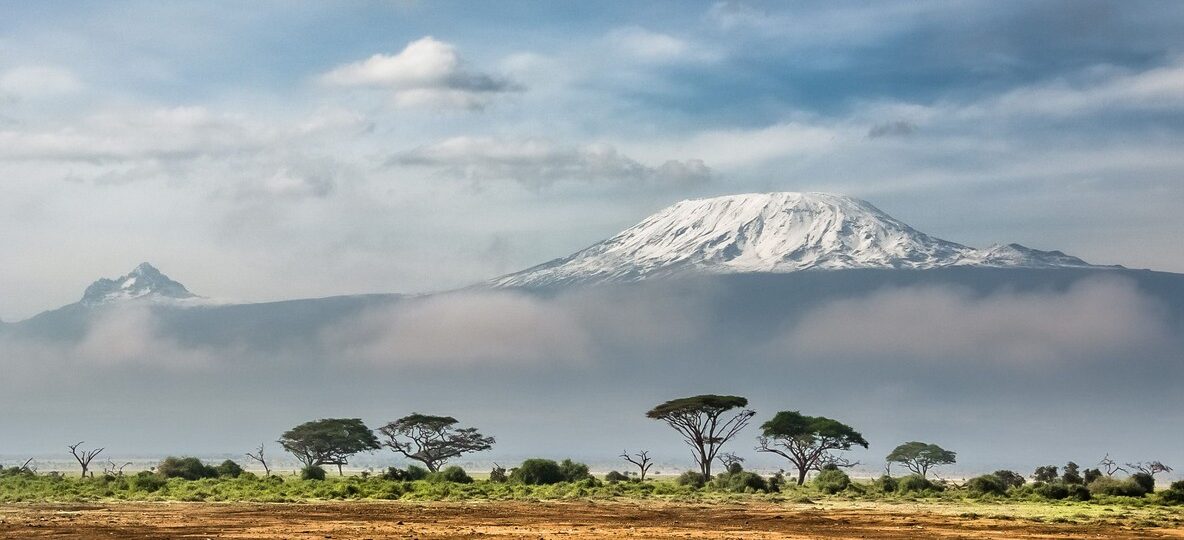
On a clear morning, particularly between June and October after the long rains, Kilimanjaro appears from the Chyulu ridge in a way that is simply unlike any view from the Amboseli floor. From Amboseli you look up at the mountain across a flat dust plain. From the Chyulus you look across at it from a similar elevation, with the mountain rising from a sea of green and red-brown bush. The perspective is horizontal rather than supplicant.
The best window is 5:30 to 8:00 am before cloud forms. Ol Donyo Lodge is positioned at 1,600 metres and has been designed specifically around this view: the main deck faces due south, and the infinity pool creates a water-mirror effect that photography guides consistently rank among the top five safari photography setups in Kenya. The kilimanjaro view Kenya experience here is an architectural statement as much as a natural one.
Where to Stay: Campi ya Kanzi and Ol Donyo Lodge
Two lodges define the high end of the Chyulu Hills, and they are genuinely different in character.
Campi ya Kanzi sits on the 280,000-acre Kuku Group Ranch, which is Maasai community land. The lodge was co-founded with Maasai landowners and operates on a profit-sharing model that returns a significant percentage of every bed-night to the community land trust. It has 10 cottages, each with stone walls and thatched roofs, positioned to face Kilimanjaro. The conservation credentials are deep: Campi ya Kanzi has been a Relais and Chateaux member since 2003 and carries LEED Platinum certification for its solar and rainwater systems.
Ol Donyo Lodge (Great Plains Conservation) takes 10 tented suites positioned higher on the ridge. The design language is different, more architectural, with glass-front suites that frame Kilimanjaro as a living painting. The Maasai Warrior Night Run, a guided moonlit walk with Maasai ilchamus, is exclusive to this property. Great Plains has a strong conservation science programme running in the Chyulus, including a lion monitoring project that guests can participate in during morning activities.
Both properties cap at 10 guests, making a full buyout realistic for a private group of four to six.
| Property | Style | Capacity | Standout Activity | Conservation Model |
|---|---|---|---|---|
| Campi ya Kanzi | Cottages, stone and thatch | 10 | Lava cave exploration | Kuku Group Ranch community profit-share |
| Ol Donyo Lodge | Tented suites, architectural | 10 | Maasai Night Run, horseback | Great Plains lion monitoring programme |
The Maasai Conservation Story: Kuku Group Ranch
The Chyulu Hills are surrounded by Maasai group ranches, and the conservation model here differs from the concession model used in the Mara. The Kuku Group Ranch covers 280,000 acres, managed by Maasai families who chose to dedicate land to wildlife corridors rather than convert it to agriculture. Wildlife-based tourism generates more per hectare than livestock, and the community retains land title.
Campi ya Kanzi’s conservation levy funds the Kuku Group Ranch trust directly: community rangers, school bursaries, and water infrastructure. When you stay at Campi ya Kanzi, roughly 10% of your bed-night goes to the families on whose land the lodge sits. This is the kenya conservation safari model at its most legible. The Kuku Ranch also functions as a critical elephant corridor: approximately 1,600 elephants move between Amboseli and Tsavo West through this land each year.
Planning Your Chyulu Hills Safari: When to Go and How to Combine
The Chyulu Hills work in every season, but the character shifts. June to October is the classic dry season: short grass, concentrated wildlife, reliable Kilimanjaro views, and the best walking and horseback conditions. November to December brings fast greening after the short rains and peak birding. January to March is dry and clear, ideal for Kilimanjaro photography. April to May is the low season: rates drop 30-40%, the hills are at peak green, and lava tube exploration is unaffected by rain.
For routing, the Tsavo-Amboseli-Chyulu circuit is the most efficient structure: three nights Amboseli, two nights Chyulu Hills, two nights Tsavo West. Fly-in connections between all three operate via Wilson Airport. Road transfer from Amboseli to Chyulu Hills takes roughly two hours on the C103.
| Season | Ridge Condition | Kilimanjaro Visibility | Game Viewing | Walking/Horse | Rate Level |
|---|---|---|---|---|---|
| Jun-Oct | Dry, short grass | Excellent | High | Optimal | Peak |
| Nov-Dec | Green, lush | Moderate | Good | Good | Mid |
| Jan-Mar | Dry, warm | Excellent | High | Optimal | Mid |
| Apr-May | Peak green | Good | Moderate | Unaffected | Low (-30-40%) |
The Trunktrails Advantage: Chyulu Hills Done Right ✨
Most Kenya safari operators know Amboseli and the Mara. Far fewer know how to build a Chyulu Hills itinerary that justifies the trip on its own terms rather than just adding a single night as a novelty stop between bigger parks.
Trunktrails Safaris has run tours and safaris in the Chyulu Hills long enough to know the details that matter: which guide at Campi ya Kanzi has the deepest lava tube knowledge, which morning of the week the Ol Donyo horseback trail takes the ridge route above 1,700 metres for the best Kilimanjaro angle, and how to time the Kuku Ranch community visit so it does not feel like a performance staged for tourists.
We are a Kenya-owned operator. Our guides hold Kenya Professional Safari Guides Association (KPSGA) certification. When you book a Chyulu Hills safari with Trunktrails Safaris, you are booking with people who run tours and safaris in this specific ecosystem, not a general Africa aggregator routing your query to a ground handler.
The Chyulus are a destination where insider knowledge genuinely changes the quality of the trip. We bring that knowledge. The question is when you are ready to go.
Your Chyulu Hills Safari Starts Here 🌅
A Chyulu Hills safari suits travelers who have moved past the standard Kenya tick-list and want something that requires a little more context to fully appreciate: volcanic geology, community conservation, the specific pleasure of being on foot or horseback in a park that most visitors fly past.
Trunktrails Safaris builds these itineraries from scratch: two nights as part of a Kenya circuit or a dedicated five-day stay combining lava caves, walking, horseback work, and community engagement on the Kuku Group Ranch.
Contact us now to start planning:
Further reading
More safari planning resources
- Map of Amboseli from Valley Safaris
- Amboseli National Park guide on Touring Insights
- Amboseli destination guide on FindMySafari
- Big Five safari collection on FindMySafari
WhatsApp / Phone: +254 113 208888 Email: info@trunktrailssafaris.com Website: https://trunktrailssafaris.com
Message us today with your travel dates and we will build your Chyulu Hills package within 24 hours.