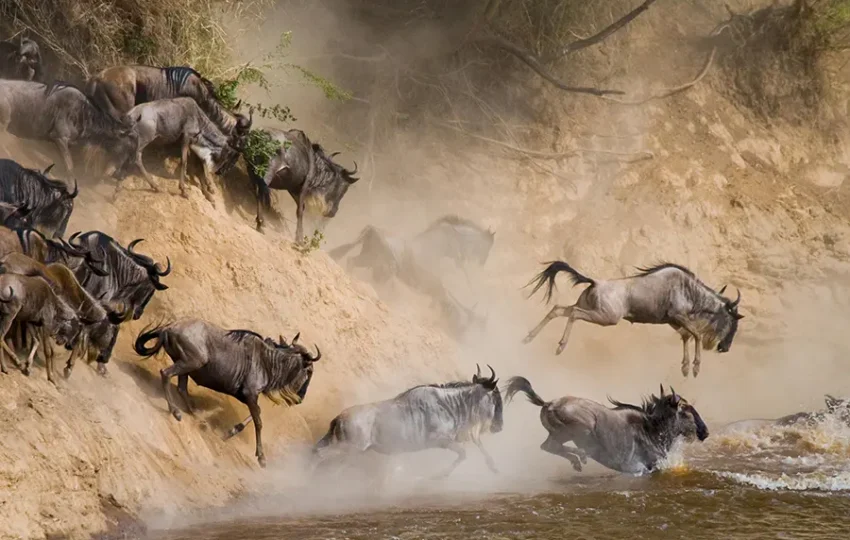


The Wildebeest Migration Safari Masai Mara was included as one of the seventh greatest wonders of the modern world.” It is now officially known throughout the world. Many have come back time and again. They have witnessed this mass movement of wild animals roaming free through the unspoiled and savage wilderness. The air fills with the click-click of the cameras. You have not seen something like this before.
Key Facts to Remember About the Wildebeest Migration
If you're planning to witness this awe-inspiring event, here are a few essentials to tuck in your safari hat:
- The majority of the migration takes place across the Serengeti plains, with the Mara River crossings typically stealing the show in the Masai Mara.
- It’s not a one-day spectacle, but a year-round, circular odyssey—so don’t worry if your trip isn’t set in July or August.
- While river crossings are iconic, they’re not scheduled affairs. They usually happen between May and August, but timing can be unpredictable (wildebeest don’t keep calendars).
- The herds stretch out over vast distances, so in any season, you’ll find outriders in the lead and a few stragglers lagging behind.
- Eager photographers, take note: Capturing the action-packed crossings sometimes means waiting patiently at a promising spot—often during the midday sun, when light and dust add drama to your shots. Bring extra memory cards, a sense of adventure, and plenty of water.
Armed with these insights, your chances of experiencing this extraordinary natural drama skyrocket—just be ready for a little unpredictability.
Why Travelers Flock to Kenya and Tanzania for the Migration Safari
Every year, travelers flock to Kenya and Tanzania, drawn by the sheer spectacle of the wildebeest migration—an untamed procession that remains one of the world’s last epic wildlife gatherings. This isn’t just about ticking off an item on your bucket list. It’s about witnessing a natural phenomenon where over a million wildebeest, zebras, and gazelles thunder across the plains, charting age-old routes and painting the savanna with life and motion.
The chance to see this incredible journey up close is what brings people back, season after season. Whether you are scanning the horizon from a Land Cruiser in Masai Mara or catching your breath as thousands of hooves churn up the Serengeti dust, you’ll quickly understand why this is widely considered one of nature’s greatest events. The drama, suspense, and breathtaking encounters make it not just a trip, but a main reason travelers choose Kenya and Tanzania as their safari destination of a lifetime.
Africa is changing quickly, and human encroachment into the wildlife reserves has continued erasing traditional migration routes. In association with the development and changes in the way of life, the image of wildlife roaming free is slowly getting deleted. Fortunately, Masai Mara National Reserve retains its charisma of open, limitless land. It is one of the places in Africa that still prides itself on wildlife concentration.
Wildebeest Migration Safari Masai Mara
Masai Mara is located in the southwestern of Kenya, 290 kilometers from Nairobi. The abundance of wildlife and the remoteness of the reserve implants memories that no money can buy.
Migration is a recent phenomenon (the ’60s and ’70s was the biggest boom), with about 250,000 individuals. Gradually, with time, the number has risen to the current population of over 3,000,000 individuals. Add to it an estimated 1,500,000 Zebras, and the result is one of the most magnificent scenes in the world. The massive display attracts hundreds of big cats as the populations provide abundant prey. The giant African crocodiles lie in wait, patiently, as the big herds come to cross the river or to drink.
It is the Masai community who are not so pleased with the whole phenomenon. The wildebeests compete with their vast herds of Borana cattle for the grasslands. To them, it is a big calamity, especially because the wildebeests transmit diseases to their flocks and poison the waters with their fetal sacs.
How Does the Great Wildebeest Migration Work?
Much like an enigmatic dance, the Great Wildebeest Migration is a spectacle guided less by a set schedule and more by nature’s whims. The drama unfolds over the seas of grass stretching from the plains of Tanzania’s Serengeti to Kenya’s Masai Mara, with over two million wildebeest, zebras, and gazelles in a tireless search for greener pastures and lifegiving water.
It’s a question many travelers ponder: can you predict when and where those infamous river crossings will happen? The honest answer—neither experts nor wildebeest can say for sure. At times, a herd may gather at the banks of the Mara or Grumeti rivers, muster their courage, and plunge in without hesitation. On other occasions, they may mill about for days on end, only to retreat and try again later. This delightful unpredictability is one reason seasoned safari veterans often recommend giving yourself plenty of time in the bush—the longer your stay, the higher the odds of witnessing this pulse-quickening moment.
The Circular Journey
Many assume that the migration happens only from July through October, but the great trek is actually a year-round, clockwise circuit. There’s no clear starting line or finish tape—the herds drift perpetually, driven by the promise of rain and fresh shoots of grass. Following ancient instincts, they course across the Serengeti, navigate river obstacles teeming with crocodiles, venture into the Masai Mara, and then bow back toward Tanzania when the seasons shift once again.
Why Do Wildebeest Migrate?
At the heart of this grand migration is a simple catalyst: survival. The movement is all about finding food and water, with the wildebeest following the rains, guided—so some say—by a mysterious, almost sixth sense. Some wildlife experts speculate they react to distant thunder or the scent of new grass on the wind, but the truth is wilder still: this journey remains one of nature’s authentic marvels, shaped by forces both obvious and arcane.
This world-famous migration is a circle of life, which, in simple terms, means that there isn’t a start or an end. Only where the herds are located at a particular time. The significant determinant is the availability of pastures.
Unlike a parade with a set beginning and finish, the Great Wildebeest Migration is a fluid, year-round journey—an ever-turning wheel in the wilderness. The movement is triggered by East Africa’s rains, as nearly two million wildebeest, along with countless zebras and gazelles, follow ancient routes in search of fresh grass and water. The herds can be found strung out across vast distances, with eager front-runners forging ahead and stragglers trailing behind, all perpetually in motion.
At any given moment, some portion of the herd will be scattered across the Serengeti-Mara ecosystem—from the sweeping plains of Kenya’s Masai Mara, down through Tanzania’s Serengeti, and even skirting the edge of the Ngorongoro Crater, always circling clockwise in an endless quest for sustenance. This constant movement means the drama and spectacle of the migration can be witnessed in different forms throughout the year, not just during the famed river crossings.
The rhythm of the migration is set not by calendars but by the rains and the promise of green, nourishing grass.
What Drives the Wildebeest Migration?
So, what sets these hooves in motion across the savannah? The core trigger for the wildebeest migration is astonishingly pragmatic: the search for greener pastures. Guided by the rhythm of East Africa’s rains, wildebeest herds are always in pursuit of fresh, nourishing grass and reliable water sources. When the southern plains dry out and the promise of rain-touched new growth beckons elsewhere, the great migration surges forth.
Some say wildebeest possess an uncanny knack for sensing distant thunderstorms—perhaps a sixth sense or a finely tuned nose for petrichor on the breeze. While scientists have yet to confirm this safari superpower, there’s no denying that the timing of the rains shapes their route and pace. In essence, it’s a dance choreographed by nature: rainfall patterns, emerging grasslands, and the relentless instinct to survive are the primary conductors that set this grand spectacle into motion. The plains of Ngorongoro Conservation Area in Serengeti are a favored spot as grass abounds and the wildebeest find a safe place to graze. It is also here that over 500,000 new calves are born, and the nearby waiting jackals or hyenas take many.
Newborns have little time to strengthen their legs. As soon after birth, the “pilgrim” continues. By April, the rains are over in southern Serengeti, and the plains have dried up. The vast herds then gather and face the long march northwards and westwards. The natural lawnmowers abandon the exhausted grasslands of southern Serengeti to head for the already tall grass of the Western corridor, near the shores of Lake Victoria.
The pioneers of the migration movement are the majestic herds of zebras. They prefer the long stems of the coarse grass. This way, they leave behind shorter grass, which the wildebeests favor.
Key Events of the Wildebeest Migration
The migration of the wildebeest isn’t simply a northward march; it’s a year-round spectacle marked by several dramatic episodes that paint the grasslands with life, struggle, and renewal. Although predicting nature’s exact timing is like trying to schedule a thunderstorm, some patterns have emerged that offer eager travelers a sense of what to expect—and when.
- Calving Season:
The first major event of the year typically unfolds between February and March in the southern stretches of the Serengeti and Ngorongoro Conservation Area. Here, the herds gather for a mass birthing—hundreds of thousands of calves join the world within a few weeks. The air is thick with anticipation (and, of course, new life), attracting lions, hyenas, and jackals, ready for an easy meal. - Rutting Season:
As April rolls into May, the herds slowly edge west and north, and the mood turns—literally—frantic. This is the peak of breeding, commonly referred to as the rut. Males square off, hooves flying and horns locked, all amid the fresh grasses of the Western and Central Serengeti. - River Crossings:
Perhaps the most pulse-pounding chapter of the migration takes center stage from May through August. The herds start testing the Grumeti River in the west, and then, as July approaches, set their sights on the formidable Mara River along the Kenya-Tanzania border. Here, lines of wildebeest and zebra charge down dusty banks and plunge into crocodile-infested waters—a scene straight out of an Attenborough documentary. The timing of these crossings is impossible to pin down to the day; sometimes a lull lingers, then chaos erupts as multiple crossings happen seemingly at once. - On the Move:
After the grass thins and the rains return, typically from November into January, the mass begins its retreat from the Mara and northern Serengeti southwards once more, wrapping up their vast circuit and beginning again.
In truth, the migration never has a true beginning or end—just a continuous dance dictated by rain, grass, and instinct. No matter when you arrive, there’s always a story unfolding somewhere on the savannah.
Where Does the Great Migration Begin, and What Path Does It Take?
Pinning down a precise “starting line” for the Great Migration is a bit like trying to find the end of a circle—it simply doesn’t exist. The journey unfolds in a continuous loop, dictated by the pursuit of rain and fresh grass rather than calendars or maps.
Typically, enormous herds of wildebeest, joined by zebra and gazelle, are first spotted in the short-grass plains of the Ngorongoro Conservation Area in Tanzania, just southeast of the famous Serengeti. Here, nourished by the early rains, they calve in vast numbers, turning the savannah into a nursery for new life (and a buffet for lurking predators like hyenas and jackals).
As the rains fade, the plains lose their luster and pastures are quickly cropped down. By late April and early May, the migration stirs. The herds funnel west and north, drawn toward the lush grasses of the Serengeti’s Western Corridor and eventually on toward the Masai Mara in Kenya.
- Ngorongoro and Southern Serengeti: Calving and grazing
- Western Serengeti: The great march and gathering of numbers
- Grumeti and Mara Rivers: Dramatic river crossings filled with lurking crocodiles
- Masai Mara, Kenya: Prime grazing and mingling with resident populations
Throughout the year, the herds travel in a clockwise pattern, always seeking the promise of rain and renewal. There is no beginning or end—only the timeless rhythm of hooves meeting earth, with the ever-present drama of survival set against Africa’s breathtaking wilderness.
When Do the Wildebeest Migrate Each Year?
One common misconception is that the wildebeest migration is a brief, dramatic episode limited to a few months—but the reality is far more enthralling. The migration is a year-round, ever-shifting cycle, not a simple start-to-finish saga. At any point in the year, somewhere across the vast Serengeti-Mara ecosystem, herds are on the move, spurred by the search for fresh grazing and precious water.
The Cycle of the Migration
- January – March: The herds tend to mass in the southern plains of the Serengeti near Lake Ndutu, gorging themselves on nutritious grass. It’s also calving season here, with thousands of calves born each day—much to the delight of local predators.
- April – May: The end of the short rains prompts the herds to gather and begin a slow, sweeping march northwest towards richer grasses and waterholes. This is peak rutting season—a festival of jousting males, echoing snorts, and dust.
- June: The wildebeest, zebras, and antelopes advance steadily through the central Serengeti, the now-steadier calves trotting beside their mothers, occasionally leaping at imaginary lions.
- July – October: This is the time most people picture—the headline-grabbing river crossings into the Masai Mara, often through crocodile-infested waters that make for legendary photographs and nail-biting stories. However, these crossings don’t run on clockwork; rainfall and local conditions can shift timing every year.
- November – December: As fresh rains breathe life back into the Serengeti, the herds begin their return trek southwards, again dividing into smaller groups that roam the north-eastern plains before finally consolidating around Ndutu.
No True Beginning or End
There’s no single date to circle on the calendar; instead, the herds follow the whims of the rain and grass, weaving an ancient route across Tanzania and Kenya. This ongoing journey supports not only the vast number of wildebeest, zebras, and antelopes, but also the countless predators and scavengers that shadow them—lions, hyenas, jackals, and those famously patient crocodiles.
What you witness depends entirely on the timing of your visit, the unpredictability of the rains, and a dash of luck. A few nights on safari might reward you with charging columns, newborn calves wobbling on uncertain legs, or even the high drama of a river crossing. But whether it's the calving grounds of the southern Serengeti or the game-rich grasslands of the Masai Mara, the migration is always on the move—so there is truly never a dull moment.
The Great Migration by Month: A Year in Motion
The story of the Great Migration is an ever-turning wheel—never truly beginning or ending, only shifting with the land’s moods and the call of rain. Let’s take a look at how this epic unfolds month by month:
January:
The herds find themselves in Tanzania’s southern Serengeti, grazing near the Ndutu area. The land is unfenced and open, allowing thousands to scatter in smaller groups. The primary focus is one thing: good grass, and January delivers in abundance after the short rains.
February – March:
Now comes the birthing season. If you visit during these months, you’ll witness an astonishing spectacle—thousands of calves being born each day. This abundance of new life lures in big cats, jackals, and hyena packs, all hoping for an easy meal. The drama that unfolds between predator and prey turns the plains into a stage for nature’s most gripping stories. If the grass is hearty after earlier rains, the herds linger, fattening up before the journey resumes.
April:
With the arrival of the long rains, the herds start pressing northward and westward across the Serengeti. This is a time of restless movement and competitive displays—male wildebeest locking horns, each jostling for a chance to mate. The herds head towards the lusher Moru and Simba Kopjes, propelled by instinct and the need to feed.
May:
By now, the young calves have found their legs and the long march resumes in earnest. Massive columns snake through the landscape on their way through the central Serengeti. It isn’t uncommon to see their lines stretching to the horizon, hooves stirring dust along the migratory highway.
June:
Central Serengeti teems with wildebeest gathering for the next big challenge: the river crossings. Some brave souls have already tackled the Grumeti River, where enormous crocodiles lie in ambush beneath the surface. These moments are the stuff of legend, patience, and heart-stopping anticipation.
July:
The migration pushes into the north of the Serengeti, where the Mara River presents a daunting test. Many herds fan out along the riverbanks, hesitating and gathering courage before taking the plunge. This is a crescendo moment—giant crocodiles await, and the crossing is perilous. Travellers who wish to witness this spectacle often stake out for days, hoping for a front-row seat to this battle of survival.
August:
The spectacle continues as wave after wave of wildebeest enter Kenya’s Masai Mara National Reserve. While they need no passport, you might—if you wish to follow in their footsteps! By now, the herds are scattered: some still battling the rivers in Tanzania, others already exploring the Mara’s rich grasslands.
September:
Although the biggest gatherings have moved into the Masai Mara, not all the wildebeest head north. Some remain on the Serengeti side, favoring the renewed grasses. If you’re after the grandest action, though, the Mara is your place—just be prepared to share your view with plenty of other spectators.
October:
The Masai Mara still hosts the greatest numbers, but the pace is more relaxed. The herds graze in smaller groups and the tourist traffic often peaks. For a quieter experience (and a little privacy for your safari), the neighboring Maasai-run conservancies are a solid alternative. Here, you can often enjoy night drives or bush walks—activities reserved only for areas outside the main reserve.
November:
Short rains return and the migration doubles back. Wildebeest begin to leave the now overgrazed Mara and trek southward, crossing back into the rejuvenated Serengeti. The weather is unpredictable; sometimes the rains come early, sometimes late, and the migration adjusts accordingly. Herds may fragment for a time—some pressing on, others content to linger where grass springs back first.
December:
Fresh growth carpets the northern and eastern Serengeti. The herds return, feasting and regaining strength for yet another circuit of the endless journey—a living river surging forward, driven by the pull of rain and the promise of green pasture. And so the cycle continues, as it has for millennia, under the watchful eyes of ancient baobabs and waiting predators alike.
Serengeti vs. Masai Mara During Migration
While both the Serengeti and Masai Mara offer extraordinary front-row seats to the spectacle of the Great Migration, each presents its own unique experience, flavor, and rhythm as the herds surge through East Africa’s wild heart.
The Serengeti, sprawling and majestic, offers vast horizons with endless plains. Here, you’re treated to a feeling of true wilderness—open spaces where the horizon shimmers and wildlife abounds in staggering numbers. In the southern and central regions, especially from February to June, the migration’s key milestones unfold: calves take their first wobbly steps, predators prowl in dramatic pursuit, and the big herds thunder over the Grumeti River, sometimes in lengthy queues stretching into the dust.
As the journey for grazing lands continues, anticipation builds for the pulse-raising Mara River crossings—truly the stuff of legend. By late July and August, the focus shifts northward, and it’s the turn of the Masai Mara to host this natural pageant.
The Masai Mara, with its slightly smaller span and lusher, mineral-rich grass, becomes the last great refuge when much of the surrounding savanna dries up. Here, sightings grow denser, with vast herds bottling up near river crossings, while lions, hyenas, and crocodiles lie in wait, shaping a real-life “survival of the fittest.” Because the Mara is more compact and accessible, you may find wildlife viewing a little more concentrated, though this also means sharing vantage points with other eager travelers—especially during peak migration months.
A distinguishing feature in the Mara is the network of community-run conservancies surrounding the reserve. These offer a more exclusive experience: here, you can roam off-road, enjoy night drives under a starlit sky, or join Maasai-guided walking safaris far from the crowds—options not available in the core reserve territory of either park.
In essence, the Serengeti’s sweeping scale delivers a sense of solitude and the vastness of the animal kingdom in motion, while the Masai Mara offers intimacy and intensity, drawing all the drama to one spectacular stage. Both are unforgettable; each appeals in a different way, depending on whether you crave the sheer endlessness of wilderness or prefer immersive, up-close encounters at the Migration’s climax.
Why Do Wildebeest Migrate Across the Serengeti-Mara Ecosystem?
So, what drives these rumbling millions to traverse hundreds of perilous kilometers each year? The answer, fittingly, is grass. The rhythm of this grand journey is set by rain—wherever the showers fall, fresh grazing follows, and the wildebeest are hot on its heels. Their migration is a timeless dance between hunger and hope, following the green flush from the Serengeti’s southern plains to the lusher expanses of the Masai Mara.
While some folk tales attribute this movement to signs in the sky—like distant flashes of lightning—not even the scientists can agree on a single trigger. What they do know is that survival is at the heart of it. The herds move to ensure their bellies are full and their young have the best chance of making it, always chasing the next patch of life-giving pastures. This epic journey keeps both predator and prey on edge and helps preserve the delicate balance of the ecosystem.
The Challenge of Predicting the Migration
Herein lies one of safari’s ultimate lessons in patience: neither man nor wildebeest has a foolproof calendar. The herds themselves are famously unpredictable—some charge across the river with barely a glance, while others mill along the banks for days before making up their collective minds. Sometimes, on a whim, they double back the way they came, adding another twist to nature’s epic drama.
Add to this natural indecision the increasing variability of the rains. Climate change has jumbled what was once a fairly reliable rhythm. Where once the long and short rains followed steady patterns in Tanzania and Kenya, now they may arrive early, late, or not at all. This throws the whole migration schedule into glorious, chaotic disarray.
Planning Your Safari: Flexibility Is Key
For travelers set on witnessing a river crossing or the great herds on the march, this unpredictability becomes both a challenge and an opportunity. It means:
- There’s no crystal ball for pinpointing the exact day or location of crossings.
- Quick, fly-in, fly-out trips come with a high chance of missing the main event.
- Flexibility in travel dates—and a willingness to stay longer—increases your odds of catching the migration’s most dramatic moments.
It’s a dance with nature, not a visit to the zoo. Those who treat it as such, allowing for extra days and choosing mobile camps that follow the herds, give themselves a better chance to be in the right place at the right time.
From late June to July, the mass starts pouring into the Kenya Masai Mara reserve, where fresh, tender, and mineral-rich grass is already waiting. Here, they meet the resident Mara populations of about 150,000. Also commonly referred to as the Loita plains herds, they spend most of the season northeast of the Mara. When it gets dry, they pour into the interior of the Mara in search of greener pastures.
The migrating herds spend roughly 3 to 3 and a 1/2 months in the Mara, crossing through Sand River, which is a tri...
Climate Change and the Unpredictable Rhythms of Migration
Over recent decades, the migration’s timetable—once as reliable as the sunrise—has become far more unpredictable. Shifting rainfall patterns across Tanzania and Kenya have thrown what used to be a well-orchestrated natural phenomenon into occasional disarray. The long and short rainy seasons no longer follow a set calendar. Sometimes the rains linger, or arrive unexpectedly late or early, and with them, the promise of fresh pasture shifts.
As a result, the wildebeest herds now adjust their movements according to these new realities. What this means for those hoping to witness the great migration is simple: patience and flexibility are more important than ever. Nature refuses to be rushed or neatly scheduled. Rather than timing your trip to the minute in hope of seeing a dramatic river crossing, it pays to give yourself a little wiggle room. The spectacle is still here, but now, it refuses to be predictable—just like the land that hosts it.
From late June to July, the mass starts pouring into the Kenya Masai Mara reserve, where fresh, tender, and mineral-rich grass is already waiting. Here, they meet the resident Mara populations of about 150,000. Also commonly referred to as the Loita plains herds, they spend most of the season northeast of the Mara. When it gets dry, they pour into the interior of the Mara in search of greener pastures.
The migrating herds spend roughly 3 to 3 and a 1/2 months in the Mara, crossing through Sand River, which is a tributary of the Mara along the boundary of Kenya and Tanzania. They trek westwards and cross the Mara River and sometimes the Talek River. Usually, around this time, heavy rains on the Mau Escarpment (the origin of the Mara River) fill the Mara River to the brim.
This is a good time to watch the trunk-looking crocodiles while they await the forthcoming feast. Finally, the gnus (wildebeests) venture into the river. This gregarious, coordinated behavior of the herds, usually teamed with zebras, creates an incredible scene. That’s just what the cameras have been waiting for.
They wander along the river looking for a convenient crossing point. This moment is filled with tension for both the gnus(wildebeests) and the audience. They survey for a less steep part of the river bank and with no obvious danger. Finally, one takes courage and plunges into the river, and magically, the rest fall into the footsteps and, in one organized line, cross the river.
What makes this spectacle even more dramatic is its unpredictability. No, not even the wildebeest know when they're going to cross! Some arrive at the water and swim over immediately; others linger on the banks for days, grazing, hesitating, or sometimes even turning back the way they came. This uncertainty keeps everyone—wildlife and watchers alike—on edge, as no one can truly predict when the herds will commit to the crossing. It's why spending more time on safari gives you the best chance to witness this breathtaking event.
In addition to the crocodiles, accidents also occur. The river’s current can be too strong for some, especially the young ones. Or getting stuck between the rocks in the river and breaking limbs, a direct ticket to the jaws of the giant crocodiles. Finally, the crossing is done, and the trek to their unknown (or known) destiny continues.
Maximizing Your Chances: Witnessing Migration Drama Up Close
If there’s one thing as unpredictable as a wildebeest on migration, it’s the very spectacle itself. Neither wildebeests nor guides can precisely say when or where those legendary river crossings will unfold. Some herds approach the banks, take one look, and plunge right in. Others linger nervously, cropping grass, undecided, for days. Still others simply turn back, as if they have just remembered a more pressing appointment elsewhere.
For travelers hoping to catch this heart-pounding scene, patience is the main ingredient. Allocating several days in the region greatly increases your chances—nature does not perform on cue, and these crossings are anything but scheduled. The longer you stay, the higher the odds you’ll be there for that sudden, collective dash into crocodile-filled waters.
Weather, too, holds its sway here. Climate change has upended the old patterns—rains can arrive early, late, or skirt entire regions, sending the migration calendar into a tumble. If you have your heart set on witnessing river crossings, flexibility is your friend. Plan your trip to allow enough time to adapt to the wildebeest’s whims and the unreliable weather.
Prime viewing isn’t just about luck and timing; choosing your base makes a world of difference. The most sought-after lodges and camps rim the rivers or follow along with the herds. Booking one of these (and doing so well in advance—up to a year is prudent) places you as close to the action as possible, sparing you long daily drives to the lookout points. Mobile camps, for example, shadow the migration’s path, maximizing your chances of being in the midst of the action without missing a beat.
And then, there’s the unfiltered reality of nature. Calving season, from February through March, brings its own drama: thousands of wobbly wildebeest calves take their first steps even as predators like lions, hyenas, and jackals circle. It’s a dizzying, heartbreaking dance—new life and imminent peril played out across the sunlit plains.
Photographers, especially, be forewarned: the best vantage points may mean hours of waiting under the relentless midday sun, as the herds gather and the drama slowly builds. Come prepared, stay patient, and keep a keen eye on the tension at the riverbanks.
With thoughtful planning, flexibility, and a generous allotment of time, your chances of witnessing these mesmerizing Migration moments—from thundering river crossings to predator chases—increase exponentially. The spectacle is wild, raw, and never twice the same, rewarding the patient observer with a front-row seat to Africa's greatest natural drama.
Timing Your Migration Safari: Nature’s Calendar
If you’re plotting your own adventurer’s journey to witness the wildebeest migration, fret not—there is no “wrong” time, only the question of which spectacle in this natural drama you most wish to see.
Here’s a little compass to navigate by:
- Birthing Season (February–March): In the southern stretches of the Serengeti, life begins anew. Picture over half a million wobbly newborn wildebeest calves hitting the ground running (quite literally, survival depends on it). Hungry eyes—those of jackals and hyenas—never stray far off, ensuring that only the most sprightly make it.
- The Rut (April–May): As the long rains fade, the Western and Central Serengeti echo with the snorts and crashes of head-to-head battles for dominance. Clouds gather; so do love-struck gnus, each trying to secure the next generation.
- Early River Crossings (May–June): The herds rally in the Central Serengeti and inch towards the Grumeti River. It’s a mix of anticipation and gamble—crocodiles lie unmoved in chocolate-brown waters, savoring the imminent bonanza.
- The Great Mara Crossings (July–August): For drama that would make any wildlife photographer’s heart race, this is the moment to be in the Northern Serengeti or at Kenya’s famed Masai Mara. The spectacle of thousands braving the churn of the Mara River—some plunging heroically, others hesitating at the banks—never fails to create a breathless hush across an entire vehicle.
- On the Move Again (November–January): The wandering herds circle back south, returning to the refreshed plains of the Serengeti in search of new pasture and another chance at life’s great cycle—always in sync with the unpredictable rains.
Keep in mind, the bush follows its own mysterious rhythm. Sometimes the wildebeest dawdle in a patch for weeks; at other times, they leap into a river multiple times a day just to show us who’s really calling the shots. There’s no clock in the Serengeti—just movement, hunger, hope, and that relentless search for grass.
Choose your adventure by the drama you most want to witness—there’s magic in every season.
Maasai Mara Serengeti wildebeest migration safari in the month of October, they are already heading to Serengeti, where the rains have treated the southern grasslands to a lush, green carpet of rich grass. Once again, they are heading to the southern plains, where a new generation will be born to start the life cycle all over again.
Why Booking Migration Safari Accommodation Early Matters
If you’re considering witnessing the world-famous wildebeest migration up close, timing isn’t the only thing to get right—securing your spot in advance is equally crucial. The Masai Mara’s charm lies in its exclusive camps and lodges, most with just a handful of tents or suites, offering a front-row seat to breathtaking river crossings and dramatic wildlife encounters. This intimacy, however, means space is at a premium.
The busiest months, when the herds plunge into the Mara or Talek rivers, are especially popular. Travelers from all corners of the globe flock here for the action, often reserving their accommodations as much as twelve months before their travel dates. Family groups or those craving connecting tents and suites need to be even swifter—specialty rooms are limited and vanish quickly, much like the morning mist over the savannah.
Booking early doesn’t just guarantee a bed; it means you’ll have more choices in style, comfort, and location. Whether you dream of a luxurious tent perched above the riverbanks or a family-friendly lodge close to migration hotspots, a prompt reservation puts the magic of the migration within your reach—and lets you focus on the adventure, not the logistics.
What to Look for in Migration Safari Accommodation
Selecting the right base for your migration adventure requires a little strategic thinking—after all, availability can be as elusive as a leopard in tall grass. Here are some key pointers to guide your decision:
- Plan with Swift Precision: Migration season lodges and camps, much like Nairobi traffic, can fill up before you know it. The earlier you decide and book, the better your chance of securing a coveted spot.
- Chase the Action: If spectating a river crossing is a top priority, consider lodging as close as possible to the Mara or Talek Rivers. During peak season (typically mid-year), the riverside accommodations are snapped up quickly, so booking well in advance is wise—sometimes a year out is just enough.
- Family-Friendly Extras: Travelling with little explorers in tow? Look for properties offering inter-connecting tents or family suites, and prioritize those with perimeter fencing, babysitting, or private safari vehicles—peace of mind pairs well with adventure.
- Mobility Matters: For those who’d prefer not to wrestle with miles of soft sand en route to breakfast, it’s worth requesting rooms close to communal areas.
- Stretching the Budget: The beauty of the Mara is for everyone. If your purse is feeling a little light, choose properties that offer great value without skimping on safari hours. More time in the bush boosts your odds of witnessing nature’s headline moments—be it a wobbly wildebeest calf’s first steps or the thunder of hooves at a river crossing.
With these considerations, you’ll be well-equipped to find a restful oasis—ready for each dawn’s drama and every evening’s wild serenade.
Special Considerations for Families and Travelers with Unique Needs
When planning a Migration safari, families and those with special requirements can enjoy the adventure just as much—provided they make a few smart choices ahead of time. Here are some key pointers to ensure everyone has a smooth and unforgettable journey:
- Families with Young Children: For those traveling with little ones, opt for accommodations that offer secure, fenced premises. Many lodges provide babysitting or childcare services, so parents can soak in the wilderness knowing their kids are in good hands. Ask about the availability of private safari vehicles—the flexibility is a game-changer for family comfort and spontaneous animal sightings.
- Travelers with Limited Mobility: Certain camps and lodges are better suited for guests who prefer to minimize walking. Request rooms as close as possible to dining and communal areas; some properties offer golf cart shuttles or paved walkways, easing those softer sand strolls between tents and breakfast.
- Booking Early for Specific Needs: Migration season can turn even the dustiest tent into prime real estate. If your group wants interconnecting family suites, or accessible rooms with ramps and grab rails, an early reservation is your best friend—think a year or more in advance, especially for river crossing season.
- Maximizing Every Safari Moment: Those seeking extra hands-on help or privacy often benefit from booking exclusive-use safari vehicles with reputable operators like &Beyond or Asilia Africa. This gives you full control of your schedule—ideal if naps, snack breaks, or spontaneous photo ops are high on the agenda.
- Budget-Friendly Choices: Don’t feel pressured to spend on luxury—many mid-range options such as Basecamp Explorer or Porini Camps balance comfort, value, and accessibility, so you can extend your stay and increase your odds of epic wildlife moments.
A little extra planning goes a long way. With the right setup, families and travelers with particular needs can immerse themselves in the drama and spectacle of the Migration—without missing a beat.
The Perks of Private Conservancies
Opting to stay in a private conservancy next to the Masai Mara or Serengeti takes your Migration experience up a notch. While the national reserves are the main stage for the epic wildebeest crossings, these conservancies offer a few game-changing extras.
First, you’ll swap the crowds for tranquillity. These exclusive areas limit the number of vehicles, so you can witness the drama of the Migration in peace—no jostling for a prime view or sharing space with endless convoys of safari vans. That means your encounters with Mara’s wildlife are up-close, uncrowded, and deeply personal.
Private conservancies also unlock activities that simply aren’t allowed in the public reserves: think adventurous night drives under the stars, guided walking safaris to track wildlife on foot, or even bush breakfasts surrounded by birdsong. It’s all about immersion—hearing the distant roar of a lion after sunset, or following fresh animal tracks across open grasslands.
By choosing a conservancy, your visit also directly supports Maasai communities. Most neighboring sanctuaries are run in partnership with local families, so your fees go toward education, healthcare, and wildlife conservation efforts. This way, your safari leaves a lasting positive footprint—both for the people who have called these plains home for generations, and for the animals that roam there.
In short: more privacy, more adventure, and a much deeper connection to the landscape and its people—just a few reasons seasoned safari-goers consider private conservancies the “insider’s pick” for the Migration.
Mobile Camps vs. Permanent Lodges: Weighing Your Options
When plotting your Migration safari adventure, the choice between mobile camps and permanent lodges can shape your entire experience. Both options come with their own set of quirks and creature comforts, so here’s what to expect from each.
Mobile Camps:
Mobile camps are the nomads of the safari world, shifting their locations to follow the herds and put you right in the midst of the Great Migration action. Staying here is as close as you’ll get to the wild—and that shows in the comforts on offer. Tents typically have en suite bathrooms with flush toilets, but showers might be of the “bucket and pulley” variety, and running water could be more of a “bring your own jug” affair. Power is often solar or from generators, so you’ll likely find just a communal charging point for your electronics. Wi-Fi? Sometimes, if the stars align.
Pros:
- Unbeatable proximity to wildlife
- Immersive bush atmosphere
- Flexible locations that move with the migration
Cons:
- Modest bathroom facilities compared to home
- Limited charging options
- Wi-Fi is hit-or-miss
- Running water and in-room luxuries can be basic
Permanent Lodges:
If you prefer a sturdy roof and a few more modern comforts after your game drives, permanent lodges fit the bill. These offer en suite rooms—often featuring piping hot showers, flush toilets, and sometimes even bathtubs (yes, out here!). Outdoor showers for the bold at heart aren’t uncommon. Lodges run on solar or generator power, but charging points are usually right in your room. Most have reliable Wi-Fi for dispatching Mara memories home.
Pros:
- More luxurious bathrooms and hot showers
- Consistent in-room charging
- Enhanced amenities and privacy
- Usually reliable Wi-Fi
Cons:
- Fixed location might mean a bit more travel to see the action
- Less “in-the-thick-of-it” atmosphere
- Can fill up even quicker during peak crossing season
A Few Final Tips:
- Book early—the best spots vanish fast, especially if you’re visiting for the iconic river crossings.
- Traveling with kids? Fenced lodges tend to offer added safety and family-friendly perks like babysitting or private vehicles.
- If mobility is a concern, request rooms nearer to central areas—bush walks can be sandy and surprising in length.
- On a budget? Opt for value lodging but extend your time in the bush. Extras days boost your odds of witnessing unforgettable moments.
With your accommodation lined up, you’re ready to dive into the heart of the action and not miss a hoofbeat.
What to Pack for Your Migration Safari
Packing for a migration safari calls for a bit of practical thinking. While visions of the African plains might conjure images of relentless sunshine, the reality often serves up a surprising range of weather. Early mornings and evenings can be refreshingly crisp, especially following a rain shower.
To stay comfortable, be sure to include:
- A pair of long trousers—great for layering and navigating cool or buggy evenings.
- Closed-toe shoes—think sturdy sneakers or walking boots that can handle damp, muddy conditions.
- A warm layer such as a fleece or light sweater.
- A waterproof or windproof jacket—a must for unpredictable showers and those brisk dawn game drives.
Remember, the secret is in layers. It’s far better to peel off a sweater when the sun climbs than to wish you’d packed an extra one as the mist rolls over the Mara. A wide-brimmed hat, sunglasses, and sunscreen also go a long way under Africa’s shifting skies.
Planning Tips for Your Wildebeest Migration Safari
Embarking on a migration safari in the Maasai Mara or Serengeti is the adventure of a lifetime—but a little planning goes a long way to making it unforgettable for all the right reasons.
- Book Well in Advance: The migration draws wildlife lovers from around the globe, and lodges—especially those along the river—can fill up as quickly as a cheetah on the hunt. If you know your travel dates, lock in your spot early, especially for peak river crossing months.
- Consider Accommodation Needs: Families traveling together or those wanting interconnecting tents should secure their bookings as soon as possible. These options are few and in high demand.
- Traveling with Kids or Individuals Needing Extra Care: Look for camps with fenced grounds for added peace of mind and inquire about babysitting services or private guides and vehicles for personalized attention. If mobility is an issue, request accommodations close to main areas to avoid long treks over sand or rough ground.
- Mind Your Budget: Choosing budget-friendly lodges or tented camps not only saves on costs but might give you the flexibility to extend your safari by a night or two. More time means more opportunities for memorable encounters—perhaps even a front row seat to a river crossing or the thrill of a predator at work.
- Stay Flexible: The migration doesn't run on a strict schedule—as any wildebeest will tell you—so staying a bit longer dramatically increases your chances of catching the jaw-dropping action you’re after.
With these tips in your safari hat, you’ll be perfectly poised to plan a migration adventure that’s as seamless as it is spectacular.