Mara River Crossing: Boat vs Vehicle Position: How to Get the Best View
Mara river crossing boat changes the day one way. Vehicle position changes it another way. Time, comfort, flexibility, and stress all move with that decision, often more than travellers expect. That is why mara river crossing boat vs vehicle position matters before the safari even starts.
Trunktrails Safaris coordinates these logistics every week. We are Nairobi-based and Kenyan-owned. We know which setups run smoothly, where delays usually creep in, and when paying more actually protects the trip. That is the difference between a clean handoff and a frustrating day.
Here is the honest comparison, the way we explain it to clients.
How a Mara River Crossing Works
The Great Migration wildebeest crossings happen multiple times throughout July to October, at several different crossing points along the Mara River. A single crossing can involve hundreds to thousands of animals at once, triggered by a lead animal reaching the water’s edge and the herd following.
Crossings are unpredictable. A herd may build at a crossing point for hours before committing. They may cross at dawn, or at 11am, or not at all on a given day. Reading the crossing: understanding when and where the herd is likely to cross: is a skill that experienced guides develop over years.
Vehicle Positioning on the Riverbank
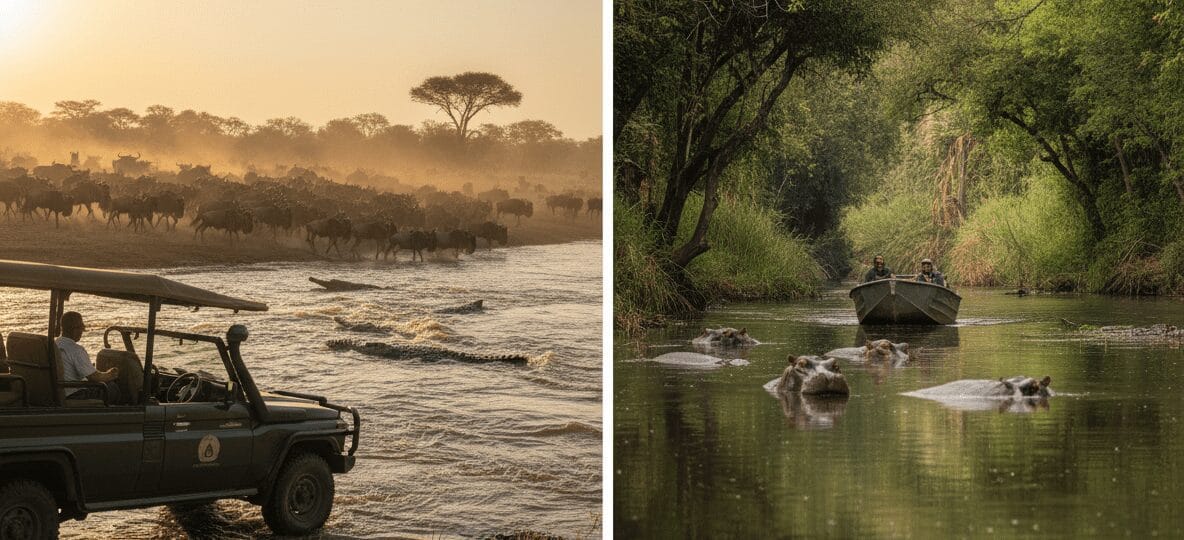
The standard approach to the best place to watch mara river crossing is vehicle positioning on the riverbank. Your game drive vehicle parks at or near an active crossing point while the herd builds on the opposite bank.
What it offers:
- Eye-level view of the crocodiles in the water and the wildebeest on the bank
- The sound of the crossing: hooves, splashing, crocodile strikes, panic calls
- The full chaos of thousands of animals in motion at close range
- Photography from a stable vehicle platform with the crossing as the backdrop
The challenge: During peak season (August to September), popular crossing points attract many vehicles: sometimes 20 to 40 at once. The Mara River has specific crossing points (the Sand River Crossing, the Lookout Crossing, and others) that guides communicate via radio. A popular crossing can become crowded quickly, affecting both the atmosphere and photography.
Best practice for vehicle positioning:
- Arrive early: before the herd builds: to secure a front-row position
- Stay at the crossing even if the wait is long: patience is the key attribute
- Trust your guide’s reading of the herd behaviour rather than following other vehicles
- Position the vehicle at the correct angle for the light (early morning light comes from the east)
Boat-Based Viewing on the Mara River
Some camps along the Mara River offer boat-based viewing of the river: not exactly “watching the crossing from a boat” but rather using a small boat to position on the river during quieter periods or to observe hippo, crocodile, and bird life.
Important clarification: Full wildebeest river crossing viewing from within a boat is not a standard or widely available option during active crossings: the crossings happen across the full river width and at pace. What boat-based viewing offers is:
- Excellent hippo and crocodile observation from water level
- A different perspective on the river corridor
- Birdwatching along the riverine vegetation
- Pre-crossing observation: positioning on the river while the herd builds on the bank
- At some camps (Little Governors Camp, Governors’ Camp), a boat crossing to the camp itself gives a taste of the river that vehicle camps do not offer
The Elevated Bank Advantage
A key vehicle positioning insight for the best view mara river wildebeest crossing is using elevated ground. Several crossing points have high-bank viewpoints where vehicles park above the action, looking down across the river and the crossing. This elevated perspective:
- Allows you to see the full scale of the herd
- Provides a photographic angle that captures the breadth of the crossing
- Reduces the noise and congestion of being at water level with other vehicles
- Is particularly effective for wide-angle photography of the landscape
The tradeoff: you lose the immediacy and raw sensory intensity of being at water level during the crossing itself. Some photographers and travellers prefer to start elevated and then move down as the crossing begins.
Masai Mara River Crossing Tips
The best wildebeest crossing mara river best position is ultimately the one your guide secures through experience and timing. What you can control:
- Camp location: Staying close to the Mara River (inside the main reserve or at a Mara River-fronting conservancy camp) means faster access to crossing points
- Early starts: Crossings can happen at dawn: being at the river by 6:30am during migration season is essential
- Multi-day commitment: Being at the Mara for five or more days during July to October significantly increases the probability of witnessing a crossing
- Guide communication: Your guide will be in radio contact with the wider guide network. Experienced guides know which crossing points are active on any given day
- Patience: A crossing can take four hours to trigger. Leaving before it happens is the most common missed experience. Stay.
Quick Comparison: Boat vs Riverbank Vehicle
| Factor | Boat-Based Viewing | Riverbank Vehicle Positioning |
|---|---|---|
| Direct crossing view | Limited during active crossings | Yes: primary viewing method |
| Crocodile viewing | Excellent (water level) | Good (bank level) |
| Hippo viewing | Excellent | Good |
| Photography | River-level perspectives | Vehicle-level crossing shots |
| Availability | Select camps with boats | All camps near Mara River |
| Crossing probability | Not the best for crossings | Best option for crossings |
| Atmosphere | Intimate, quiet | Intense, loud, potentially crowded |
Watching a Mara River Crossing: Best Position
There are no boats on the Mara River for crossings; viewing is from a vehicle at a designated crossing point. Position and patience are everything.
| Factor | Vehicle at the bank | Wider plains view |
|---|---|---|
| Proximity | Close to the action | Broader context |
| Crowds | Can be busy at hot spots | Quieter angles |
| Season | Jul-Oct only | Jul-Oct only |
| Tip | Arrive early, hold position | Read the herd’s nervous build-up |
Crossings are unpredictable: herds can mass for hours then turn back. A good guide reads the build-up and holds a clean line of sight at a likely crossing point.
Which Should You Choose?
For seeing the Great Migration crossing: Riverbank vehicle positioning is the standard and most reliable method. Choose a camp within the reserve or in a river-fronting conservancy. Trust your guide’s positioning and timing.
For the river experience more broadly: If hippo, crocodile, and bird life on the Mara River interest you as much as the crossing itself, a camp with boat access adds a genuinely different layer to the experience.
At Trunktrails Safaris, our tours and safaris team selects Mara-based camps with optimal proximity to active crossing points and guides with deep crossing experience. We also advise on the right timing windows for the best crossing probability.
Plan Your Mara River Crossing Safari with Trunktrails Safaris
Witnessing a wildebeest crossing is one of the most powerful natural experiences available anywhere. Trunktrails Safaris designs Masai Mara itineraries specifically around migration season timing and optimal crossing access. Our tours and safaris team will position you in the right camp, with the right guide, at the right time of year.
- 📞 WhatsApp: +254 113 208888
- 📧 Email: info@trunktrailssafaris.com
Website: https://trunktrailssafaris.com Contact Trunktrails Safaris today and let us plan your Mara River crossing experience.
Further reading
- Magical Kenya (Kenya Tourism Board)
- African Wildlife Foundation
- Maasai Mara Wildlife Conservancies Association
More safari planning resources
- Wildebeest migration route map from Valley Safaris
- Mara River crossing guide on Touring Insights
- Great Migration safari collection on FindMySafari
- Best time to visit Kenya month-by-month map from Valley Safaris
Ready to Plan Your Kenya Safari? Talk to Trunktrails Safaris
Trunktrails Safaris designs tailor-made tours and safaris for every traveller and every budget. From green-season adventures to private luxury camps, our tours and safaris are built by a Nairobi-based team that speaks to you directly, not through a call centre. Most WhatsApp enquiries about our Kenya tours and safaris get a reply from Trunktrails Safaris within the hour.
WhatsApp: +254 113 208888 Email: info@trunktrailssafaris.com 🌍 Website: https://trunktrailssafaris.com
✅ | Native Kenyan Owned | Conservation First | 24/7 Support