
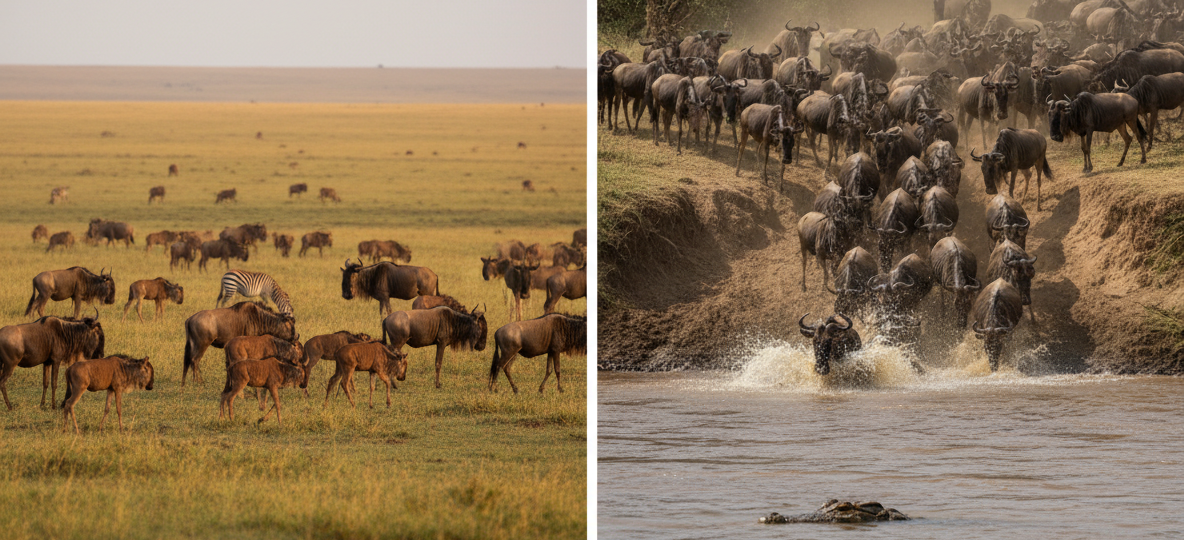
Serengeti Wildebeest Migration vs Masai Mara: Which Side of the Border Should You Be On? 📸
The wildebeest do not care about national borders.
They cross between Tanzania and Kenya twice a year, following the rains and the grass with the same indifference to passports that they have had for a million years. The border is a human invention. The migration is not.
But you have to be on one side of it — and the side you choose matters. The serengeti wildebeest migration and the Masai Mara chapter of the same circuit are different experiences, at different times of year, with different drama and different logistics. This guide gives you the honest comparison so you can make the right call for your trip.
The Same Migration, Two Different Stages
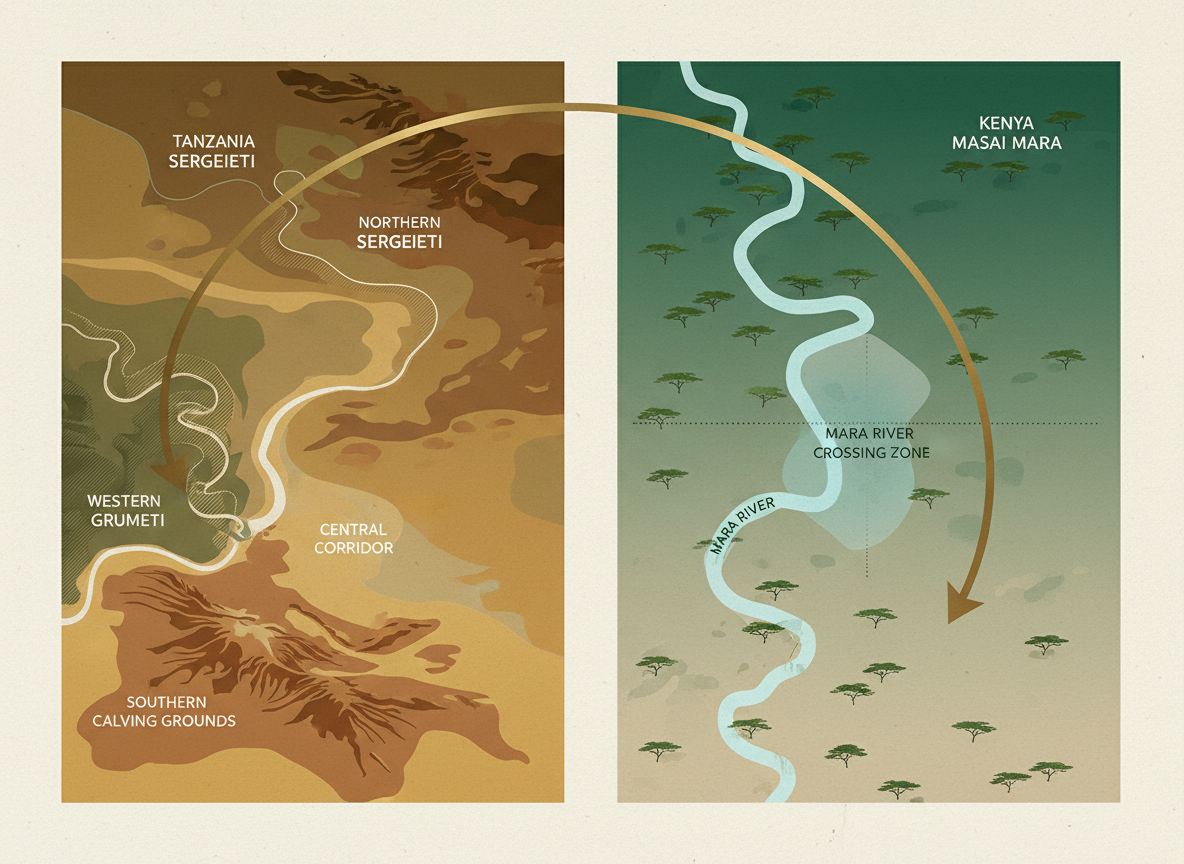
First, the most important thing to understand: the serengeti migration and the Masai Mara migration are not competing products. They are two chapters of the same year-round circuit.
The wildebeest move in a broadly clockwise loop:
- January–March: Calving in the southern Serengeti and Ndutu plains (Tanzania)
- April–May: Northward movement through the central Serengeti (Tanzania)
- June: Leading herds reach the Kenya border through the northern Serengeti
- July–October: Mara River crossings in the Masai Mara (Kenya)
- November–December: Return south through Tanzania
If you go to Tanzania, you are watching one chapter. If you go to Kenya, you are watching another. The animals in your viewfinder are the same 1.5 million wildebeest — they are just at a different point in the circuit.
The Tanzania Chapter: Serengeti National Park Migration
Calving Season — January to March
The serengeti national park migration reaches its most dramatic Tanzania moment from January to March, when the herds are on the short-grass Ndutu plains in the south. This is calving season.
Approximately 500,000 wildebeest calves are born within a six-week window. The calving ground is the most predator-dense phase of the entire circuit — lions, cheetah, leopard, and hyena are all actively hunting the vulnerable newborns. A calf that cannot stand and run within a few hours does not survive.
What makes calving season extraordinary:
- The sheer density of newborn animals — calves everywhere, across every horizon
- Predator activity at its annual peak — multiple kills visible in a single morning’s drive
- Cheetah performance: the Ndutu plains in February offer some of the best cheetah hunting in East Africa
- Fewer tourists than the Mara in August — calving season is less well-known, which means fewer vehicles
The catch: The Ndutu area, in the Ngorongoro Conservation Area adjacent to the Serengeti, has road access that can be difficult in the wet season. And the herds are stationary — not crossing any rivers. The drama is different from the Mara’s crossing drama. Equally intense; different in character.
The Grumeti River Crossing — May to June
Before the wildebeest serengeti herds reach Kenya, they must cross the Grumeti River in the western Serengeti. This is the Serengeti’s own river crossing — less famous than the Mara crossings, but equally intense in close-up encounters.
The Grumeti River is narrower and shallower than the Mara. Its crocodiles are enormous — some of the largest in Africa, with less competition for food than the Mara’s population. Grumeti crossings tend to involve smaller groups of animals and happen over a shorter window (typically May-June), but the crocodile encounters are up close and dramatic in a way that the Mara’s wider crossings can sometimes dilute.
When is migration in the Serengeti by month:
| Month | Location in Serengeti | Key Events |
| January | Ndutu / southern plains | Peak calving — predator frenzy |
| February | Southern Serengeti | Calving continues |
| March | Southern to central Serengeti | Northward movement begins |
| April | Central Serengeti | Long rains — herds moving north |
| May | Western Serengeti | Grumeti River crossings |
| June | Northern Serengeti | Herds approaching Kenya border |
The Kenya Chapter: Masai Mara Migration
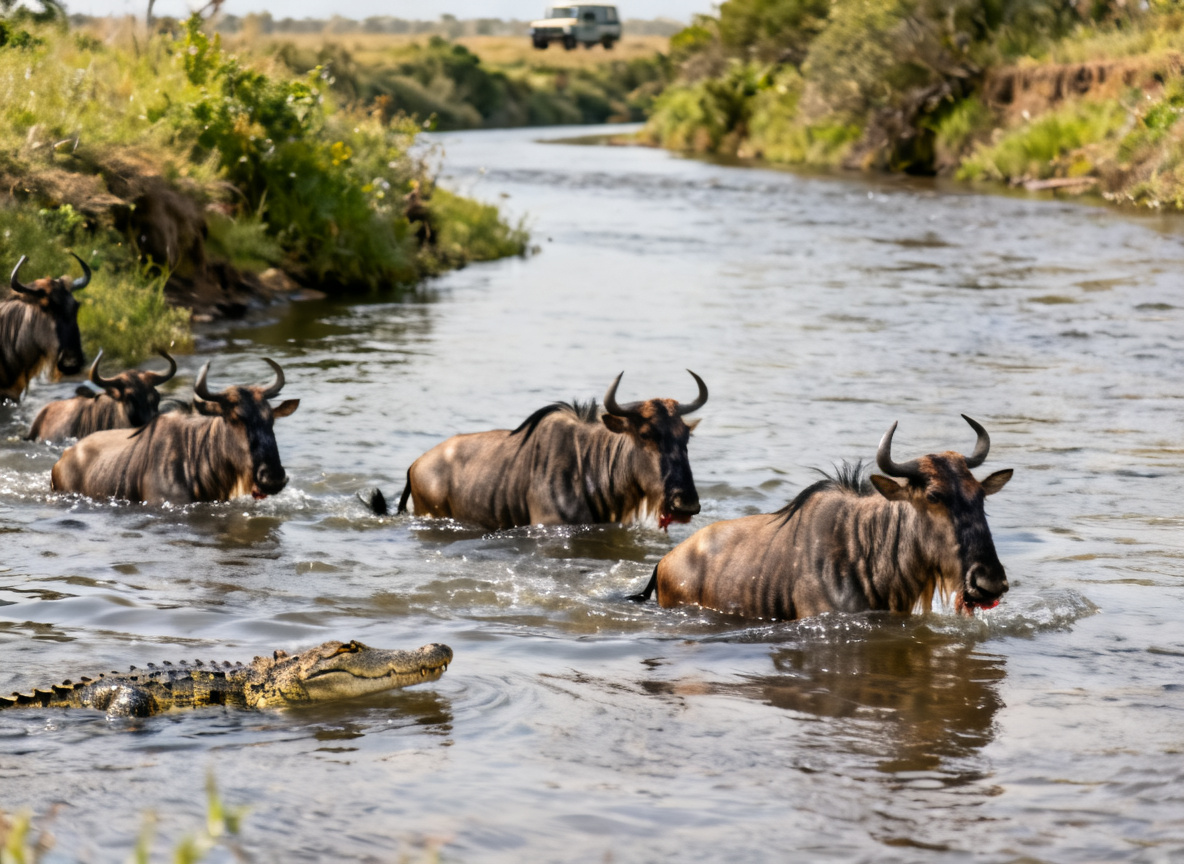
The serengeti vs masai mara migration decision comes down to one primary question: do you want to see river crossings?
If the answer is yes — and for most people, river crossings are the reason they booked a migration safari — then Kenya from July to October is the answer.
The Mara River runs directly across the migration path. The herds have no alternative route. They must cross, and they cross repeatedly, at multiple points, over a four-month window. This is the chapter that defines the great migration in every documentary you have seen — the wildebeest hurtling off steep banks, the Nile crocodiles waiting in the brown water, the chaos of animals scrambling up the far bank.
What makes the Mara chapter the headline act:
- Multiple crossing points within a compact area — you can attend several crossings in a single day if conditions align
- July to October is Kenya’s dry season — clear skies, excellent photography light, reliable game drive conditions
- The Masai Mara has the highest lion density in Africa — even without a crossing, the game viewing is exceptional
- Community conservancies give exclusive access with strict vehicle limits — the national reserve experience, but without 80 vehicles at a single crossing point
Kenya vs Tanzania: The Honest Comparison
| Tanzania (Serengeti) | Kenya (Masai Mara) | |
| **Best window** | January–March (calving), May–June (Grumeti) | July–October (Mara crossings) |
| **Primary drama** | Calving and predator action | Mara River crossings and crocodiles |
| **River crossings** | Grumeti (smaller, more intimate) | Mara River (larger, more spectacular) |
| **Crowds** | Lower overall | Higher in August; lower in conservancies |
| **Logistics** | Longer drives, some wet-season access issues | 45-min flight from Nairobi; compact ecosystem |
| **Cost** | Comparable; varies by camp and season | Peak season (Aug) is highest; Sept is better value |
| **Best for** | Wildlife photographers, calving enthusiasts, returning safari guests | First-time migration visitors, river crossing seekers |
Can You Do Both?
Yes — and for guests with 8–10 days, combining both chapters of the serengeti migration route and the Masai Mara is the ultimate migration experience. A typical combined itinerary visits the Mara for the crossings (July–October), then extends into Tanzania for a Serengeti day or overnight, or vice versa.
Trunktrails Safaris builds tailor-made Kenya safari tours and safaris that can incorporate cross-border itineraries. We work with trusted Tanzania partners and can handle the full circuit for guests who want both chapters.
Which Should You Choose?
Choose the Serengeti if:
- You want to see calving season (January–March)
- You have already done the Mara and want the other chapter
- You are a wildlife photographer who wants the Grumeti River on your list
- You prefer lower visitor numbers and are flexible with wet-season logistics
Choose the Masai Mara if:
- You specifically want to witness a Mara River crossing
- This is your first migration safari
- You are travelling between July and October
- You want the shortest logistics from Nairobi and the widest range of camp options
Choose both if:
- You have 10+ days and want the definitive migration experience
- You are a returning guest who has done one side and wants to complete the circuit
The Trunktrails Advantage
Trunktrails Safaris is Kenya-based, Kenya-owned, and Kenya-expert. Our primary territory is the Masai Mara and the community conservancies that surround it — the beating heart of the July–October migration chapter. We know the crossing points, the conservancy sections where the herds concentrate, and the guides who have been watching this ecosystem for years.
For guests who want to extend into Tanzania, we build combined Kenya-Tanzania migration safari tours and safaris with trusted cross-border partners. You deal with one operator, one point of contact, and one team that understands the full circuit.
5% of every Trunktrails Safaris booking goes to Mara wildlife and community conservation — because the migration only exists if the conservancies do. 🌍
📞 WhatsApp: +254 113 208888
📧 Email: info@trunktrailssafaris.com
🌍 Website: https://trunktrailssafaris.com
✅ KATO Member | TRA Licensed