Off-Road vs On-Road Game Drive in the Masai Mara: What the Rules Mean for Your Safari
Off-road and on-road game drive masai mara can deliver two completely different safaris in the same destination. Light changes, grass height shifts, crowds move, and wildlife behavior follows the season. Pick the wrong window for your goal and the trip feels mismatched. That is the off-road vs on-road game drive masai mara decision.
This is where Trunktrails Safaris adds real value. We are Nairobi-based and Kenyan-owned. We plan around migration windows, rain patterns, school-holiday pressure, and the practical feel of each month, not generic best-time lists. That gives clients dates that suit the experience they actually want.
Here is the honest comparison, the way we explain it to clients.
What Are the Game Drive Track Rules in the Masai Mara?
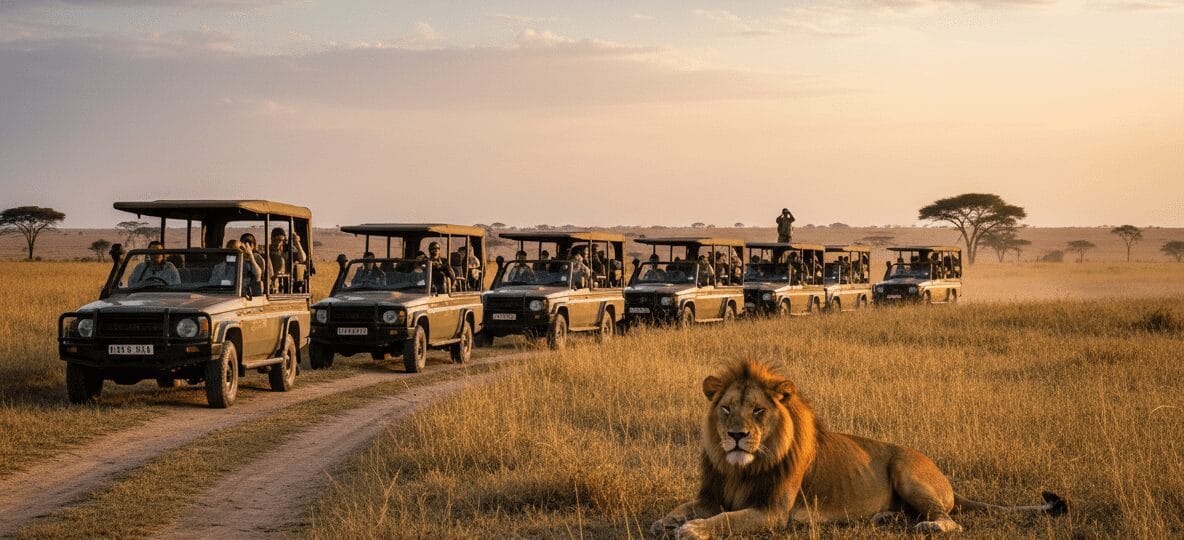
Masai Mara National Reserve: Off road driving masai mara national reserve is not permitted. All vehicles must remain on defined game drive tracks at all times. Guides cannot leave the track to approach a sighting from a better angle, position the vehicle for optimal light, or follow an animal into open grass. This rule is enforced by reserve rangers and violations result in fines.
Private Conservancies (Olare Motorogi, Naboisho, Mara North, etc.): Off road game drive masai mara is fully permitted within the private conservancies. Guides can drive anywhere within the conservancy – across open plains, through light bush, alongside river drainages – to position the vehicle exactly where the wildlife is and exactly where the light and angle are best. There are no track restrictions. For more detail, read our Kicheche Bush Camp Olare Motorogi Conservancy Maasai Mara.
This single difference in rules produces fundamentally different sighting quality at identical wildlife encounters.
Why Off-Road Is Not Allowed in the Masai Mara Reserve
The masai mara national reserve off road rules exist for clear ecological reasons:
Habitat protection: Unrestricted vehicle movement across grassland degrades vegetation, compacts soil, and creates erosion. With hundreds of vehicles entering the reserve daily at peak season, off-road driving would systematically damage the grassland ecosystem that supports all the wildlife it hosts.
Wildlife disturbance management: Tracks provide a degree of buffer between vehicles and sensitive wildlife – nesting birds, denning predators, and animals with young. Off-road driving removes this buffer.
Equity: If off-road is permitted, every guide at a sighting will pursue the best position simultaneously, creating a chaotic mass of vehicles converging from all directions on a single animal.
The masai mara vehicle track restrictions are the right policy for a high-volume national reserve. The conservancy model achieves exclusivity through guest bed limits, which makes off-road viable without the same ecological and management risks.
On-Road Game Drive Masai Mara – What It Means in Practice
On a standard on road game drive masai mara national reserve experience, when a guide spots a lion 50 metres into open grass to the left of the track, they can:
- Stop the vehicle on the track
- View the lion from that fixed position
- Wait until the lion moves toward the track
- Communicate the sighting to other vehicles who then converge on the same track position
What they cannot do: drive into the grass to get closer, reposition to the better-lit side of the animal, or drive parallel to a hunting cheetah across open plains.
The on-road restriction means that many sightings depend on animal proximity to the track, and the best photographic angles are often blocked by other vehicles on the same track.
Off-Road Game Drive Masai Mara Conservancy – What It Changes
In a masai mara conservancy no track rules context, when the same lion is 50 metres into open grass, the guide can:
- Drive directly toward the sighting
- Circle to approach from downwind if relevant to the animal’s behavior
- Position the vehicle with the sun behind the guests for optimal photography
- Stay alongside a hunting cheetah as it moves across the plains
- Follow a leopard into riverine bush
The masai mara off road safari experience changes the quality of individual sightings from observational (watching from a fixed point) to participatory (moving with the animal, adapting position to the action).
For wildlife photographers specifically, the masai mara bush driving freedom of a conservancy drive is a major advantage. The ability to choose the camera angle, manage the light direction, and maintain proximity to a moving subject is the difference between a good photograph and an extraordinary one.
Off-Road vs On-Road – Side-by-Side Comparison
| Factor | National Reserve (On-Road) | Conservancy (Off-Road) |
|---|---|---|
| Vehicle must stay on track | Yes | No |
| Approach angle to sighting | Fixed by track position | Fully flexible |
| Photography positioning | Limited | Fully controlled |
| Follow moving animals | Only if they move toward track | Yes, across open terrain |
| Wildlife at sighting | Equal | Equal |
| Vehicle density at sighting | Multiple vehicles on same track | Often just your vehicle |
| Vegetation access | Track corridor only | Open plains and light bush |
| Ecological justification | Protects reserve at high volume | Viable due to low guest caps |
Which Delivers Better Game Drive Quality?
For individual sighting quality – off-road wins unambiguously. The masai mara conservancy off road driving permission, combined with low guest bed caps, produces wildlife encounters that are impossible to replicate on a track-restricted national reserve drive.
But “better” is not the only consideration. The national reserve’s scale and road network give on-road drives access to a wider territory in a single drive. The Mara River, the central plains, the Talek River corridor – the reserve covers more ground than any single conservancy. Some of the most dramatic migration crossing viewing happens at fixed river bank positions that do not require off-road access.
The ideal Masai Mara safari combines both: conservancy off-road drives for intimate sighting quality, and reserve drives (on-road) for migration crossing access and wide-area game viewing during peak season.
Plan Your Masai Mara Game Drive with Trunktrails Safaris
Whether you want the freedom of off road game drive masai mara conservancy access or the scale of a national reserve circuit, Trunktrails Safaris tours and safaris match your game drive structure to your camp, your season, and your priorities.
Contact Trunktrails Safaris:
- 📞 WhatsApp: +254 113 208888
- 📧 Email: info@trunktrailssafaris.com
Website: https://trunktrailssafaris.com
Further reading
More safari planning resources
- Interactive Maasai Mara map from Valley Safaris
- Maasai Mara National Reserve guide on Touring Insights
- Masai Mara destination guide on FindMySafari
- Nairobi to Maasai Mara route guide from Valley Safaris
Ready to Plan Your Kenya Safari? Talk to Trunktrails Safaris
Trunktrails Safaris designs tailor-made tours and safaris for every traveller and every budget. From green-season adventures to private luxury camps, our tours and safaris are built by a Nairobi-based team that speaks to you directly, not through a call centre. Most WhatsApp enquiries about our Kenya tours and safaris get a reply from Trunktrails Safaris within the hour.
WhatsApp: +254 113 208888 Email: info@trunktrailssafaris.com 🌍 Website: https://trunktrailssafaris.com
✅ | Native Kenyan Owned | Conservation First | 24/7 Support