Car Hire in Nairobi for Safari: Is Self-Drive Worth It? A Honest Comparison
Picture this. You land in Nairobi, full of excitement, and someone suggests skipping the tour operator and just hiring a 4×4 yourself. Drive at your own pace. Stop when you want. No group itinerary. It sounds brilliant.
Then the Narok road opens up in front of you – a 140-kilometre stretch of potholes, blind bends, and overloaded lorries – and your rented Land Cruiser drops its front right tyre into a ditch the size of a bathtub, 60 kilometres from the nearest town. Your phone has no signal. The nearest recovery truck is three hours away.
This is not a scare tactic. It is a true account that plays out dozens of times a year on Kenya’s safari roads.
Car hire in Nairobi for safari is genuinely available, and for some very specific travellers it works. But for most people planning a Kenya safari, the honest comparison between self-drive car hire and booking guided tours and safaris with a specialist operator like Trunktrails Safaris reveals a clear winner. This guide gives you the full picture – costs, road conditions, vehicle quality, wildlife safety, and the experiences that self-drive simply cannot give you.
What Is Self-Drive Safari in Kenya?
The Appeal of Renting Your Own 4×4
Self-drive safari means hiring a vehicle from a Nairobi car rental company and driving yourself to one or more national parks. You book your own accommodation, navigate the parks using an app or map, and make all your own decisions about where to go and when.
The appeal is real. Self-drive gives you flexibility. You are not tied to a group itinerary or a fixed schedule. If you want to spend four hours watching a lion family near Sekenani Gate, you can. If you want to leave the park early, nobody stops you.
It also feels cheaper – at first. A basic 4×4 from a Nairobi car hire company starts at around KES 7,000 to KES 12,000 per day (roughly USD 54-93). That sounds manageable for a one-week trip.
What You Actually Need Before You Drive
Here is what most car hire comparison websites do not tell you. Before you can legally and safely self-drive in Kenya’s national parks, you need:
- A valid international driving permit (your home licence alone is not sufficient in all parks)
- Comprehensive insurance that explicitly covers off-road and park driving (many standard rental policies exclude this)
- A detailed offline map or GPS loaded with park tracks (mobile signal is unreliable or absent in most parks)
- A working understanding of KWS regulations – including minimum approach distances for wildlife, rules around leaving your vehicle, and what to do in an emergency
- A recovery plan for breakdowns – because the rental company’s assistance line will not reach you inside Tsavo East at 07:00
None of these requirements make self-drive impossible. But they add time, cost, and preparation that most travellers do not budget for.
The Real Cost of Car Hire in Nairobi for Safari
Rental Rates and Hidden Costs
A 4×4 safari vehicle hire in Nairobi – a genuine safari-spec vehicle with a pop-up roof, not a standard SUV – costs between KES 12,000 and KES 22,000 per day (approximately USD 93-170) from reputable operators. Cheaper options exist, but they typically come with standard saloon tyres, no pop-up roof, and inadequate ground clearance for park tracks.
Add the following to your budget:
- Fuel: Nairobi to Masai Mara and back is roughly 280 km each way. A Land Cruiser or similar diesel averages 10-12 litres per 100 km on corrugated roads. Budget for KES 8,000-12,000 in fuel per park round trip, more for distant parks like Samburu.
- Park entry fees: Adult non-residents pay USD 80-100 per person per day in Masai Mara, USD 60-80 per day in Amboseli and Tsavo. These fees are the same whether you are self-driving or on a guided tour.
- Vehicle entry fee: An additional vehicle fee applies at most parks – typically USD 25-40 per vehicle per day.
- Accommodation: You must book and pay for this separately.
- Excess insurance top-up: Many rental contracts carry an excess of KES 150,000-300,000 (USD 1,150-2,300). If you roll the vehicle or damage it on a park track, that liability is yours.
- Roaming charges and data: Offline maps cost money to load. International roaming in remote parks can be expensive.
A realistic self-drive budget for a 5-day Kenya safari (2 parks, solo traveller) lands at USD 1,400-2,200 before accommodation. That figure surprises most first-time self-drivers.
What Guided Safari Tours and Safaris Actually Cost
A guided 5-day Kenya safari tours and safaris package from Trunktrails Safaris – covering Masai Mara and Amboseli or Tsavo, with accommodation, all meals, park fees, and a professional guide – is priced competitively with what the self-drive total actually comes to. The difference is everything that is included: an expert guide, a purpose-built safari vehicle with a 360-degree pop-up roof, daily game drive strategy based on real-time ranger intelligence, and experiences that self-drive visitors cannot access.
To plan a guided tour and get accurate pricing for your travel dates, contact Trunktrails Safaris directly: WhatsApp or email ****.
Kenya Safari Road Conditions: What No One Warns You About
The Nairobi to Masai Mara Road
The B3 highway from Nairobi through Narok to the Masai Mara is one of the most important routes in Kenya’s safari economy. It is also one of the most demanding drives for an inexperienced driver.
The first 90 kilometres from Nairobi to Narok are tarmac and manageable. After Narok, the road quality changes sharply. The final 70-80 kilometres to the park gate are largely unpaved – corrugated murram in the dry season, deep mud in the rains. In April-May and November, this section can become impassable without genuine 4×4 capability and an experienced driver. Even in the dry season, this stretch regularly claims tyres and suspension components from underprepared rental vehicles.
Drivers unfamiliar with corrugated murram tracks often speed up instinctively to smooth out the vibration. The correct technique is counter-intuitive: drive slower. Experienced safari drivers know this. Most first-time self-drivers discover it the hard way.
Tsavo, Amboseli and the Unpaved Reality
Amboseli National Park sits in a dust bowl at the foot of Mount Kilimanjaro. In the dry season, visibility on park tracks can drop to near zero in dust storms. In the wet season, the park’s black cotton soil becomes adhesive – vehicles sink quickly, and a solo self-drive vehicle that bogs down has no immediate rescue option.
Tsavo East‘s tracks span 13,747 square kilometres. Roads inside the park are unpaved and can be deeply rutted. Navigation without an experienced local guide is genuinely difficult – many tracks look identical on a map and diverge without signage.
Safety on a Self-Drive Safari in Kenya
Wildlife Safety – Rules You Must Know
Kenya Wildlife Service (KWS) publishes clear regulations for self-drive visitors. Visit kws.go.ke for the full rulebook before you consider self-drive. The key rules include:
- Stay in your vehicle at all times in game drive areas unless in a designated walking zone
- Switch off your engine within 20-30 metres of predators to avoid distress behaviour
- No off-road driving outside designated areas (a rule frequently broken and frequently fined)
- No night driving in parks without an authorised guide
Self-drive visitors have no training in reading wildlife body language. When a lion yawns, most visitors think it is tired. A professional guide knows it is a stress signal. When an elephant ear-fans and mock-charges, a guide knows whether to hold position or reverse slowly. This knowledge takes years to develop and cannot be downloaded from an app.
Road Safety and Breakdown Risk
Kenya’s B-roads carry a mix of commercial trucks, matatus, motorbikes, and livestock. Driving at night – which you will need to do if your day runs long – significantly elevates risk. The 2023 Kenya National Transport and Safety Authority report recorded over 3,400 road fatalities nationally. Many involved foreign drivers unfamiliar with Kenyan road conditions and driving culture.
A guided tours and safaris vehicle is driven by a professional with thousands of hours on these specific roads. The vehicle is maintained on a professional schedule, not a rental fleet rotation.
The Best Vehicles for Safari in Kenya
What Self-Drive Hire Companies Offer
Nairobi’s car hire market offers a range of vehicles for safari. The most capable options are:
- Toyota Land Cruiser 76 or 79 Series – the gold standard, but rarely available in standard rental fleets
- Toyota Land Cruiser Prado – capable on most park tracks; better availability in Nairobi hire
- Land Rover Defender – available but parts availability in remote areas is limited compared to Toyota
- Suzuki Jimny / Vitara – frequently rented but genuinely undersized for multi-day park driving with luggage
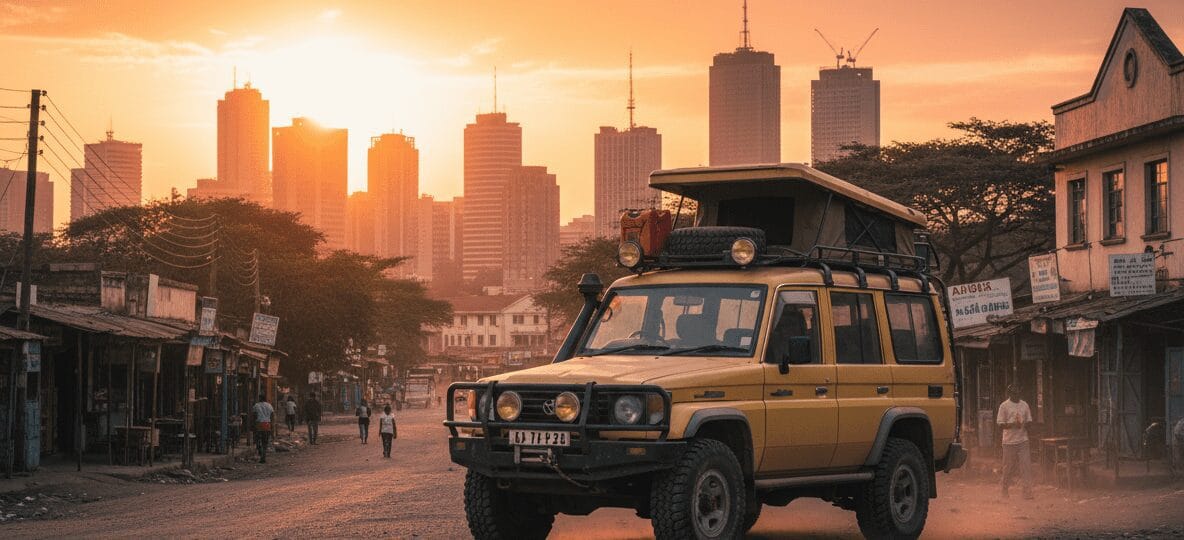
The pop-up roof – essential for standing game viewing and photography – is present on very few rental vehicles. Most rental 4x4s have a standard fixed roof, which means game viewing through an open window or sunroof. For the Big Five safari experience you have seen in photographs, a purpose-built safari vehicle with a 270- or 360-degree pop-up roof is the minimum requirement. Read more about what to expect when viewing African safari animals across Kenya’s parks.
What Trunktrails Safaris Uses (and Why)
Trunktrails Safaris operates purpose-built safari 4×4 vehicles maintained specifically for park conditions. Every vehicle has a full pop-up roof for standing game viewing, a fully equipped first-aid kit, a VHF radio for ranger network communication, and a recovery kit – shovel, tow strap, hi-lift jack, recovery boards. Our drivers are trained not just in mechanics but in wildlife behaviour and bush navigation.
Guided Safari Tours vs Self-Drive – The Honest Comparison
What You Gain with a Guide
A professional safari guide from Trunktrails Safaris brings a level of knowledge that transforms what you see. The difference between a guided and self-drive game drive is often the difference between driving past a bush and stopping because your guide spotted a leopard lying motionless in the branches 40 metres off the track.
Experienced guides also have access to ranger radio networks. When a cheetah hunt is happening in the northern Mara, your guide knows within minutes. A self-drive visitor following the same road map sees nothing but empty grassland.
Beyond sightings, a guide contextualises every experience. The migration mechanics – how wildebeest detect nitrogen levels in new grass growth and move accordingly – becomes a living, breathing story rather than a Wikipedia paragraph. The ecological relationships between species, the conservation pressures, the community stories – all of this is delivered in real time, in the field, at the moment it matters.
For a full breakdown of what guided Kenya safari tours and Masai Mara packages include, visit the Trunktrails tour guide page.
Walking safaris are another experience entirely closed to self-drive visitors. You cannot self-drive a walking safari. You cannot walk unguided in KWS parks. If a walking safari – moving through the bush on foot, tracking animal prints, listening to the guide read the landscape – is on your Kenya bucket list, a guided operator is not optional. It is the only way.
What You Give Up Going Alone
Self-drive visitors give up:
- Expert wildlife interpretation and tracking knowledge
- Real-time sighting intelligence from ranger radio networks
- Walking safari access
- A safety net in the event of breakdown, medical emergency, or wildlife incident
- The insider knowledge of which specific waterholes are active, which routes are open after rain, and where the pride has been sleeping for the past three days
Why Trunktrails Safaris Guided Tours and Safaris Deliver Better Value
Trunktrails Safaris is a Nairobi-based specialist operator offering guided tours and safaris to Kenya’s top wildlife destinations – Masai Mara, Amboseli, Tsavo East and West, Samburu, Laikipia, and Lake Nakuru. Every itinerary is tailored to your travel dates and interests. Every vehicle is purpose-built and maintained to professional safari standards.
Our guides are certified by the Kenya Professional Safari Guides Association (KPSGA) and carry years of field experience in the specific parks you will visit. Our community conservancy partnerships provide access to private conservancy land where self-drive visitors are not permitted – and where the wildlife density and tranquillity are unmatched.
For first-time Kenya visitors and returning safari travellers alike, the question is not really whether self-drive is possible. The question is whether it represents genuine value – in terms of total cost, total experience, and total peace of mind. For most travellers, the answer to all three is the same.
Guided wins.
To plan your Kenya safari with Trunktrails Safaris, get in touch today. Our team will build a custom itinerary around your travel dates, group size, and bucket-list experiences – no generic packages, no hidden costs.
- WhatsApp: – Email:
- Website: https://trunktrailssafaris.com
For more on the wildlife you will encounter, read our complete guide to African safari animals and Kenya’s Big Five. For the definitive destination guide, see our Masai Mara National Reserve guide.
Frequently Asked Questions – Car Hire Nairobi Safari
Can I self-drive in the Masai Mara? Yes, self-drive is permitted in Masai Mara National Reserve. However, most community conservancies surrounding the main reserve – where wildlife density is highest and vehicle numbers are lowest – restrict access to guests staying at conservancy-affiliated camps or on guided tours and safaris. Self-drive visitors are limited to the main reserve roads. Contact Trunktrails Safaris on WhatsApp to discuss conservancy access on a guided itinerary.
What is the best vehicle for self-drive safari in Kenya? A Toyota Land Cruiser (76 or 79 Series) or a Toyota Land Cruiser Prado with high clearance and genuine 4×4 capability. For serious game viewing, you need a pop-up roof – standard in all Trunktrails Safaris vehicles, rare in rental fleets.
Is self-drive safari in Kenya safe? It depends on your experience level, your vehicle, your preparation, and your park choice. Road safety on the Nairobi to Masai Mara route and wildlife safety inside the parks are both genuine considerations. KWS publishes self-drive regulations at kws.go.ke. For travellers without prior off-road or safari driving experience, a guided safari with Trunktrails Safaris is the safer and more rewarding option.
How much does car hire in Nairobi cost for a safari? A safari-spec 4×4 with a pop-up roof runs KES 12,000-22,000 per day (approximately USD 93-170). A standard SUV or Prado without a pop-up roof is cheaper but significantly limits your game-viewing experience. Always read the insurance policy before signing – most rental contracts carry a high damage excess.
What is the cheapest way to do a Kenya safari? A group guided safari tours and safaris package from Trunktrails Safaris often works out cheaper per person than a solo or two-person self-drive once all park fees, vehicle hire, fuel, and insurance costs are totalled. Group tours split fixed costs across several travellers. Contact us at for a no-obligation quote.
Trunktrails Safaris | Nairobi, Kenya | WhatsApp: Email: Web: https://trunktrailssafaris.com