Ethical Wildlife Encounters vs Standard Safari: What’s the Difference in Kenya
Ethical wildlife encounters and standard safari may happen in the same landscape, but they reward very different kinds of traveller. One favors patience, detail, or specialist interest. The other suits a broader safari rhythm. That is the ethical wildlife encounters vs standard safari choice.
This is where Trunktrails Safaris helps clients avoid the wrong fit. We are Nairobi-based and Kenyan-owned. Our guides know when a specialist activity genuinely adds depth and when it is just a glossy add-on. That matters if you want the safari to feel right, not merely busy.
Here is the honest ethical wildlife encounters vs standard safari comparison, with the strengths, limits, and best-fit traveller for each side.
Quick Comparison: Ethical vs Standard Safari Encounter
| Factor | Ethical Wildlife Encounter | Potentially Unethical Practices |
| Vehicle Distance | Follows minimum approach distance guidelines | Pushes closer for better photo; ignores animal distress |
| Animal Movement | Does not block or redirect animal path | Positions vehicle to cut off movement; encircles animals |
| Sighting Duration | Leaves when animal shows stress signals | Stays regardless of animal behavior |
| Vehicle Numbers | Respects unofficial maximum vehicle count | Participates in unlimited vehicle clustering |
| Baiting | Never uses food to attract predators | May use bait to position predators for photography |
| Engine Management | Turns off engine near resting animals | Keeps engine running; moves repeatedly |
| Guide Behavior | Explains ethics to guests; enforces standards | Prioritizes guest satisfaction over animal welfare |
| Off-Road Behavior | Off-road only in conservancies; no vegetation damage | Tracks through sensitive habitat unnecessarily |
| Night Drive Conduct | Red-light torch only; no direct spotlight on eyes | White spotlight directly in nocturnal animals’ eyes |
What Ethical Wildlife Tourism Means in Practice
Minimum Approach Distance
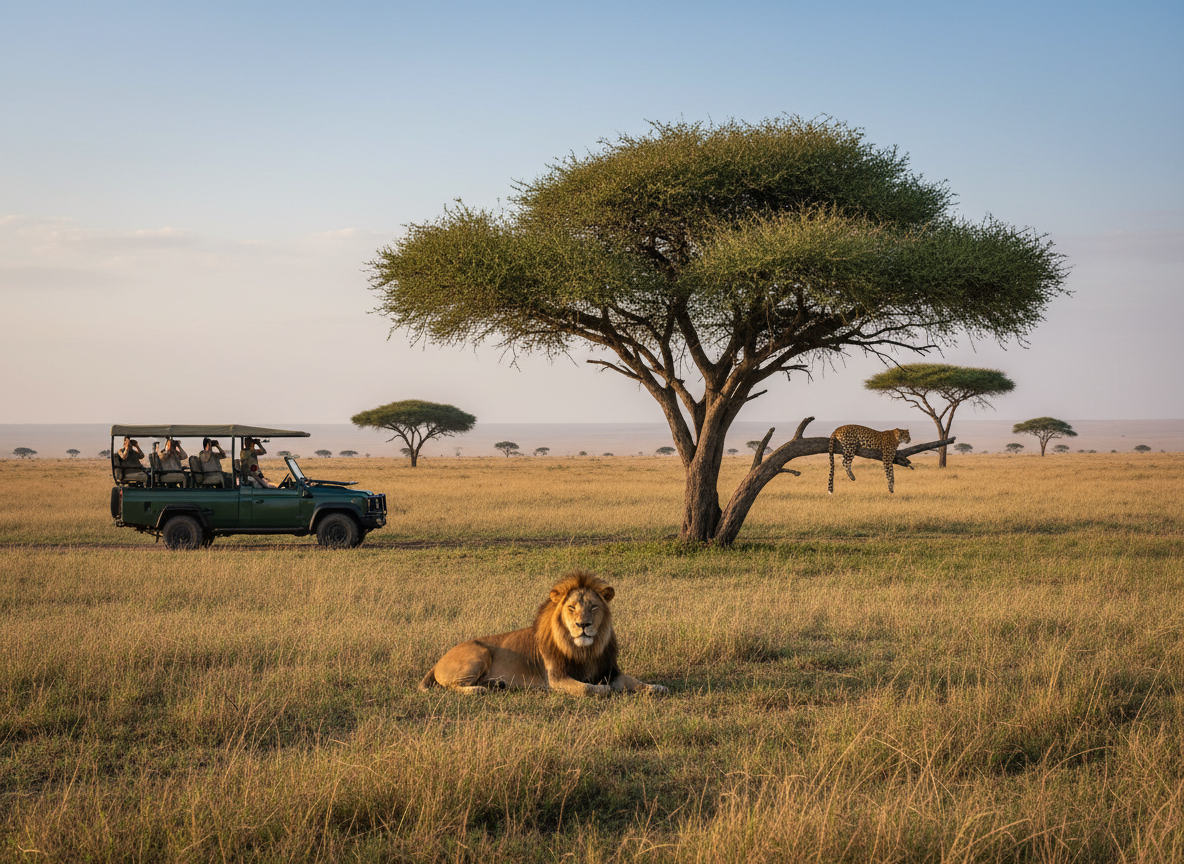
Kenya Wildlife Service guidelines and international safari best practice recommend minimum approach distances for different species: typically 20 to 50 meters for most large mammals, with specific adjustments for breeding pairs, mothers with young, and species with documented flight-distance sensitivity (particularly cheetahs and wild dogs, which abandon hunts when vehicle pressure is too high).
An ethical guide knows these distances and maintains them even when guests ask to move closer. A responsible operator brief guides that guest satisfaction does not justify animal distress.
Not Blocking Animal Movement
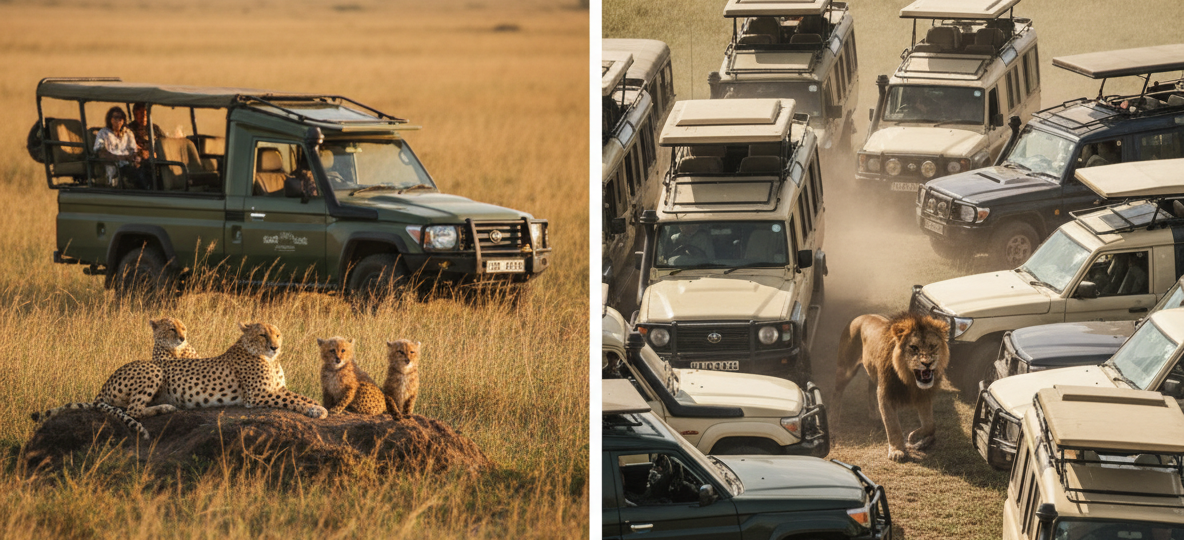
One of the most common ethical violations on the Masai Mara is vehicle clustering around a sighting in a way that effectively encircles the animal and blocks its natural movement. A cheetah mother who wants to move her cubs from an open area to a shaded depression cannot do so because 12 vehicles have surrounded her.
An ethical guide positions the vehicle to observe without blocking exit routes, turns off the engine to reduce stress signals, and moves away if the animal shows stress: ears flat, heavy panting, repeated staring at vehicles, or attempted movement blocked by vehicle positions.
No Baiting
Baiting: using food to attract predators into camera range: is illegal in Kenyan parks and conservancies and is widely recognized as harmful to both animal behavior and ecosystem dynamics. Predators that are repeatedly baited develop unnatural expectations of food from vehicles, which can lead to vehicle approach behavior that ultimately results in animal removal.
Any operator or guide who suggests or uses bait should be reported to Kenya Wildlife Service and the camp management.
Vehicle Number Management
The most visually obvious ethical issue in the Masai Mara during peak season is the clustering of large numbers of vehicles around a single sighting: particularly at cheetah or lion encounters. While 5 vehicles may represent reasonable observation, 25 to 30 vehicles form an ecological disturbance.
Ethical guides and operators have internal standards for when they leave a crowded sighting rather than contributing to the disturbance. Conservancy camps with controlled vehicle numbers per area are structurally better positioned to manage this than the main reserve.
How to Identify an Ethical Safari Operator
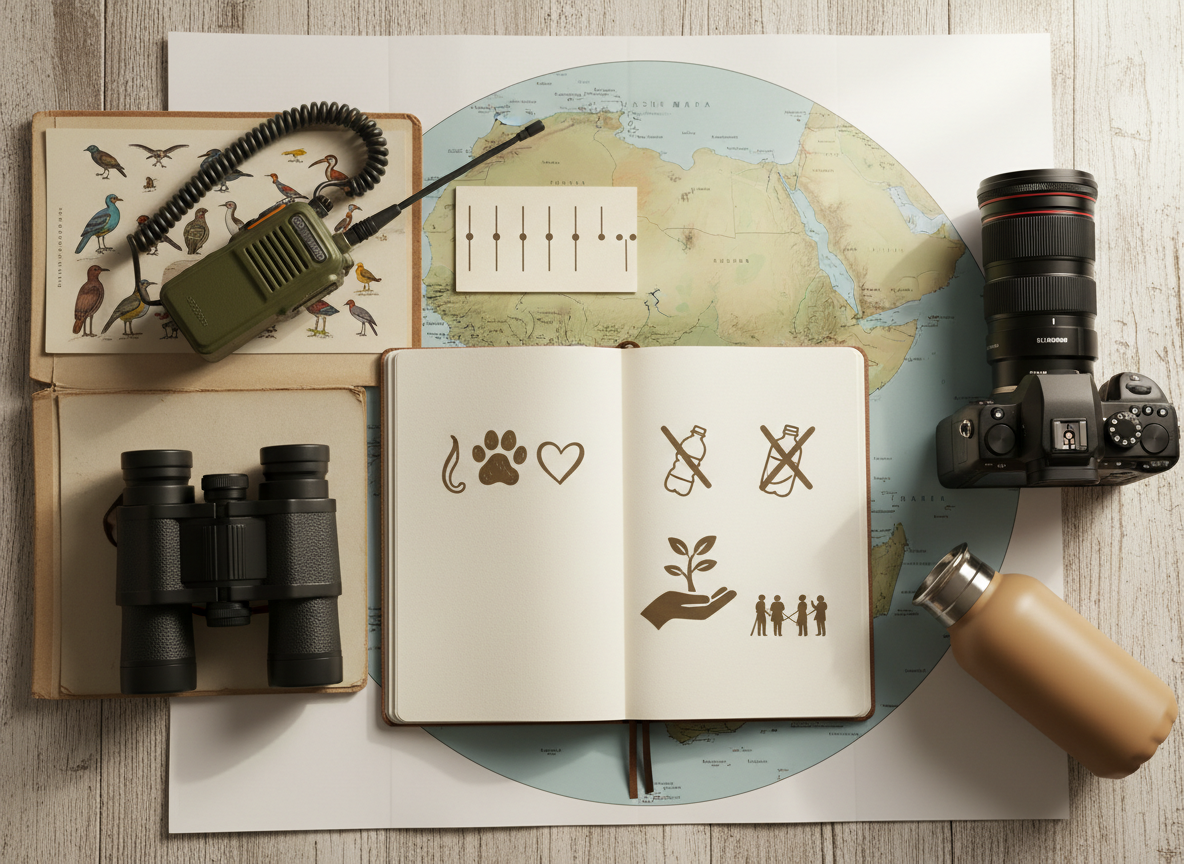
Before booking, ask your operator directly:
- What is your vehicle approach distance policy for cheetahs, wild dogs, and breeding females
- How do you handle situations where vehicles are crowding a sighting
- What is your policy on night drive spotlighting (red light only vs white light)
- Are your guides trained in animal stress signal recognition
- Does your operator have a formal wildlife ethics code
- Are you a member of any responsible tourism certification body
Operators who cannot or will not answer these questions clearly are not prioritizing animal welfare.
The Guest’s Role in Ethical Encounters
Safari guests have more power over encounter ethics than they realize. A guest who loudly asks to “get closer” creates social pressure on the guide to comply. A guest who says “please respect the animal’s space” creates the opposite pressure.
Practical guidance for guests:
- If you feel the vehicle is too close, say so: most guides will respond positively
- If the guide says “we need to give this animal space,” support that decision actively
- If you witness unethical behavior by another vehicle, report it at the camp in the evening: park rangers investigate complaints
- Choose not to share photographs taken at unethically close range: this normalizes the behavior for others who see the image
What Ethical Tourism Delivers That Unethical Does Not
Beyond the animal welfare dimension, ethical safari encounters often produce better wildlife photographs and better observation. An animal that is not stressed by vehicle pressure behaves naturally: it hunts, nurtures cubs, interacts socially, and moves through the landscape. An animal cornered by vehicles is stressed, static, and demonstrating defensive behavior. The natural behavior photographs are always better than the crowded stress photographs.
The cheetah that successfully hunts because the vehicle stayed far enough away is more memorable than the cheetah that abandons the hunt because a vehicle cut off her line of approach.
Which Should You Choose
There is no version of “standard safari” that intentionally harms wildlife for a reasonable traveler. The key is choosing an operator whose standards are high enough that good ethics are the default: not an exception made on request.
All Trunktrails Safaris game drives operate under a clear ethical code: minimum approach distances, no baiting, red-light-only night drives, engine-off protocols near resting animals, and guide authority to exit a sighting that is distressing the subject.
We believe that ethical wildlife encounters are not a premium offering: they are the baseline of responsible tours and safaris.
Ready to Plan Your Kenya Safari? Talk to Trunktrails Safaris
Trunktrails Safaris designs tailor-made tours and safaris for every traveller and every budget. From green-season adventures to private luxury camps, our tours and safaris are built by a Nairobi-based team that speaks to you directly, not through a call centre. Most WhatsApp enquiries about our Kenya tours and safaris get a reply from Trunktrails Safaris within the hour.
WhatsApp: +254 113 208888
Email: info@trunktrailssafaris.com
Website: https://trunktrailssafaris.com
KATO Member | TRA Licensed | Native Kenyan Owned | Conservation First | 24/7 Support